
This book documents the early gravestones and their inscriptions within the Old Dutch Burying Ground of Sleepy Hollow in North Tarrytown, New York. Commissioned in preparation for the 250th anniversary of the Old Dutch Church's founding, the project preserved and recorded the deteriorating brownstone and marble markers, many of which dated back to the 18th century. Led by William Graves Perry, the work involved detailed preservation techniques to arrest the disintegration of the stones, a graphic plot survey of the entire churchyard, and the compilation of a catalog of all remaining pre-1860 inscriptions here published in full. At the time of the enumeration of the gravestones the earliest detected stone rendered the death date of 1757, almost a hundred years from the founding of the church itself. Those earlier stones are lost, but the records of baptisms and marriages as found within the early church records in the Dutch language can assist genealogist researchers with determining family bonds.
The Old Dutch Burying Ground of Sleepy Hollow in North Tarrytown, New York
See also the First Record Book and the Second Record Book of the old Dutch Church of Sleepy Hollow.
Explanation
The Map entitled “Coordinate Layout of Existing Graves” below, marks the location of all gravestones within the area of the early Churchyard and assigns a number to each stone. Those which are listed in the “Record of Inscriptions,” within the manuscript, are identified by a black dot or cross hatching. The recorded inscriptions are arranged in order, beginning with the stones in the lower right-hand corner of the map, in coordinate square S2, thence proceeding, one square at a time, through the balance of the squares in vertical column S and next through the column marked R, continuing in this manner toward the left-hand side of the map.
The Reference Number, given for each inscription, refers to the map location of the corresponding stone. Thus stone N4-189 stands in coordinate square N4.
Where a Secondary Reference Number appears in parentheses below the map reference number it refers to the number given to that particular stone in “The Old Dutch Burying Ground of Sleepy Hollow,” published in 1926 by the History Research Society of the Tappan Zee, wherein additional biographical information may be found.
An asterisk following the reference number indicates that the stone is a brownstone. Where no asterisk occurs the stone is marble unless otherwise noted.
Brackets are used to enclose descriptive or explanatory notes which are for the convenience of the reader and do not represent information appearing on the gravestones themselves.
Parentheses enclose parts of an inscription which have become illegible, or are now entirely effaced. Wherever possible the missing data, which once appeared on the stone, have been filled in from other sources, such as earlier printed recordings or rubbings made years ago.
The arrangement of lettering on each stone has been followed as faithfully as possible, and some attempt has been made to suggest the general style of each inscription by the use of type approximating the style of letter on the stone itself. Boldface type is limited to the names of those to whom the stone was erected. Italics have been used for the verses since these almost invariably appear in small script on the stones. The Alphabetical Index at the end of the book should be used to locate inscriptions under family names. The Index also indicates those stones which have been repaired or rebuilt during the present survey.
Surnames Mentioned
Acker, Ackerman, Aims, Allen, Appleby, Applebee, Archer, Arden, Arser, Ascough, Auser, Austin, Avery, Badeau, Baker, Banker, Barnerd, Barnes, Bassett, Bayles, Beach, Beaumont, Becker, Bevan, Bigelow, Bishop, Blauvelt, Bly, Bogert, Bont, Bookhout, Boyce, Boyd, Brewer, Brower, Brown, Brundage, Brush, Buckhout, Burger, Burnham, Buys, Calhoon, Calhoun, Campbell, Chesebro, Chester, Child, Childs, Christian, Churchel, Clark, Clearwater, Close, Collard, Comb, Combs, Conckling, Conklin, Conover, Conway, Cooper, Copeland, Couenhoven, Cox, Cunningham, Cypher, daly, Davids, Davis, Dean, Dearman, Decker, DeLanoy, Denison, DeRevere, DeRonde, Devaue, Devoe, Dickerman, Dilkes, Dodge, Donnelly, Doty, Drak, Drake, Dubois, Duitcher, Dutcher, Dutfield, Dyckman, Eckler, Ecker, Edmond, Ellis, Embrey, Enters, Fairchild, Ferris, Finnegan, Fisher, Fochee, Folsom, Forrest, Foshay, Fowler, Fox, Gardiner, Gibbs, Gilbert, Graham, Gray, Griffiths, Guion, Hadley, Haerlager, Haff, Hall, Hammon, Hammond, Hanks, Harper, Harriott, Hart, Heartt, Hek, Hepworth, Higgs, Hilliker, Hobby, Honeywell, Horton, Hosie, Howes, Hudson, Hueson, Huestis, Hughs, Humphries, Humphreys, Hunt, Inman, Jerow, Jewel, Jones, Keen, Keese, Kennard, Ketcham, King, Knapp, Knowlden, Knowles, Kurrle, L'Amoureux, Landrine, Lawrence, Layland, Leggett, Lent, Leonard, Lockwood, Lord, Losee, Lyon, Magness, Mandeville, Mann, Manser, Marling, Martin, Martlenghs, Martling, Martlings, Mather, McBride, McChain, McCreery, McCullough, McCutchan, McGown, Mead, Mekeel, Merlling, Mertling, Millrose, Milrose, Minard, Minnerly, Minerly, Monnel, Monson, Montross, Moore, Munson, Mursick, Newman, Norgan, Odell, Olmsted, Onerdunk, Orser, Orsor, Parker, Partridge, Patterson, Paulding, Peers, Perry, Philbrick, Phillips, Pinckney, Pinkney, Place, Powel, Powell, Post, Pugsley, Purdy, Quereau, Ramsen, Rayson, Reed, Remsen, Requa, Revere, Riker, Riley, Rockefeller, Rockwell, Rodgers, Roe, Romer, Roods, Rosell, Ruton, Rycroft, sawdon, Scofield, Seaman, Sebring, See, Sharpney, Shearwood, Sherwood, Sirine, Skidmore, Slifer, Smith, Somerdyck, Stanley, Stephens, Stevens, Stewart, Stiver, Storm, Storms, Stymes, Sutton, Swartwout, Sypher, Talman, Taxter, Taylor, Terboss, Thorn, Tillotson, Tompkins, Tooker, Torboss, Underdunk, Underhill, Vail, Van Tassel, Van Tassell, Van Tessel, Van Wart, Van Wert, Van Wort, Vermilye, Walker, Watson, Watt, Watts, Webb, Weight, Wescott, West, Westervelt, White, Whitney, Wildey, Wiley, Willcey, Williams, Wood, Wright, Wylds, Yerks, Young, and Yurks.
List of Illustrations
| Date | Name | Facing Page No. |
|---|---|---|
| 1769 | Sara Fochee Enters (Frontispiece) | 1 |
| 1765 | Christina and Evert Arser | 32 |
| 1770 | Mino Duitcher | 33 |
| 1793 | Catriena Ecker Van Tessel | 48 |
| 1794 | Cornelius, Jacob and Winey Couenhoven | 49 |
| 1799 | Jane Van Winkel | 80 |
| 1801 | Elizabeth Applebee | 81 |
| 1807 | Rosetta Van Wart | 96 |
| 1811 | Isaac Odell | 97 |
| 1825 | Jeremiah Hadley | 128 |
| 1827 | George Combs | 129 |
| 1829 | Sarah See | 144 |
| 1830 | Ezekiel and Jane Leggett | 145 |
Introduction
In 1926, when a record of the gravestone inscriptions of a substantial part of the early Burying Ground, together with the locations of the stones, was compiled by the History Research Society of the Tappan Zee, it was noted that the gravestones erected to the original church members had been lost and that many of the stones then surviving were crumbling. The earliest date of death on the remaining legible stones was then recorded as 1757. The materials from which the original memorials were made is not known but, for the purpose of the present analysis, it may be assumed that they were unduly perishable, succumbing, if in wood, to normal decay or, if in stone, to elements that led the later church members (those now represented by the oldest stones today) to use materials that promised greater permanence. They chose brownstone and marble. Brownstone may well have been used during the earliest period, but this is a presumption for which there is no physical proof.
In 1948, when the present survey was begun, the large majority of the stones, whether of brownstone or marble, which had been listed in 1926 were still legible, although several of them were seriously in need of restoration. Notably, some of the oldest and finest of the brownstones were in perfectly sound condition. Notably, also, others less ancient and seemingly identical in stone structure had either lost their inscriptions entirely or were in precarious condition. The marble stones of early date had survived in greater proportion than the contemporary brownstones but, for causes that will be described, their inscriptions were in many cases less legible than those of the disintegrating brownstones.
In 1948, the perceptive visitor, quietly viewing the old Church and its surrounding Burying Ground, sensed the significance of this record of the early Dutch settlers and their descendants. He noted the gently undulating topography, the winding and rising path and the ancient gravestones in varying colors lying in a beautiful pattern, tree shaded and in repose. In studying the inscriptions he was impressed by the great beauty and variety of this scene and by the fine proportions of many of the stones. Some he found in excellent physical condition, some perhaps too sturdily repaired, others in rapidly crumbling or eroding state but numerous enough in themselves, if allowed to disintegrate, to jeopardize not only the significance of the churchyard but its intrinsic beauty. Interest in the Burying Ground springs from sources that are more numerous than usual. There is the high quality of the execution of the inscriptions, the designs of the stones themselves and the singularly satisfying repose of the setting. There is brought to mind the sense of origins, the gradual rejection of a foreign tongue, the modification of certain names, and the wide range in the simultaneous spelling of others.
Little is remembered of the earlier families other than the broad fact of their “industry and piety”;1 their stalwart faith and their common interest in husbandry. Their response to the call of the Revolution was consistent and proof of their loyalty to their adopted home. The cumulative record is more encompassing and impressive than that of any personage who may lie buried here. There is to be read here a vital record, appealing in its simplicity, revealing the identity of the members of this settlement, predominantly Dutch. Here also can be felt the sense of homogeneity; of a self-sufficient community of slow growth and, by inference therefore, of isolation. As it stands today, the record is a part of our social history; essential as a portion of the whole. The beautiful stones may be, to be sure, less ancient than others in more permanent materials and as well preserved in burying grounds of other old settlements. They reveal no evidence of a standard of culture less elevated than that in the cities; in many instances indeed they combine the characteristics of stones of an earlier period with a singularly high degree of artistic merit of design and execution. Thus most of the older ones, although erected subsequent to 1727, are designed in the manner of a period nearly a half century previous, possibly reflecting thereby a culture of high appreciation but of slow development. It may be reasonably assumed that the designs of these monuments represent a continuance in style and design, but not necessarily in skill of execution, of those which have since disappeared and which were erected to the earliest settlers.
The serenity of “Sleepy Hollow” still clings to this ancient Church and its Burying Ground. Here lie the “good people” who, at their firesides, had repeated the tales that grew with the telling, and also some of those around whose lives many of the tales were woven. To Washington Irving the “whole neighborhood” made an appeal that tempted him to go there and live. It was an appeal, he tells us, that was compounded of the fascination he felt in the legendary tales and his liking and respect for the quiet, pious, industrious country folk who lived under their spell. Today, the echo from a legendary past may still be heard by the imaginative ear, however rudely disturbed may be the “listless repose” of the village and its surroundings. It is to be felt most strongly in the old Burying Ground. Here is evident a tenacious preservation of the early characteristic of “repose” that is so essential both to the recreation of the picture of what was once an undisturbed countryside and also to a comprehension of a state of mind, fruitful and credulous of legendary lore, which was, as we know, potent enough to inspire some of the best writing in our American literature. When one is reminded that Irving, of the first small company to interest itself in the history of New York, was surprised to find how few of his fellow townsmen were aware that New York had once been called New Amsterdam, had never heard the names of the early Dutch governors, nor “cared a straw” for their own Dutch forebears,2 one is no longer surprised at the rapidity with which recent history in those days assumed the aspect of a “legendary past.” Few American scenes or places possessed the familiar associations that lived like spells about old world cities.3 In the Hudson Valley, Irving gathered fuel to rekindle a latent fire in the new world. That his Rip Van Winkle should have slumbered through the years of the Revolution and was, therefore, a character taking part, by presumption, in a period only thirty-five years past in the year 1815, when the story was already well established, is testimony to the “visionary propensity” of the inhabitants. When he records that Ichabod Crane lived “in a remote period of American history, that is to say some thirty years since,” he reflects a quizzical interest in this propensity, however founded this story may be on fact. The earliest date now legible on a stone in the Burying Ground is 1755 and it may best be considered in this light — “ancient” in the minds of all.
The selection of the type of stone for colonial gravestones varied from place to place in the eastern United States and also from earlier to later dates. Many records are available to establish the existence of a custom to import the carved stones from England. In some instances both foreign and domestic stones are signed by the stoneworker. At least one such marble stone stands in the Burying Ground. Identification of the actual type of stone, whether foreign or domestic, and if domestic, the location of the quarry, represents an effort that is more alluring than promising. It is known that brownstone lies within the states of Connecticut, New York and New Jersey, and that finished stones crossed the colony or state borders. Deterioration in stones had its influence on stone selection during the 18th and 19th centuries, but the deterioration was slow and the trend toward the more hardy materials was gradual. It was noted that brownstone and slate would “shell” and that marble would decompose. It was not until during and after the great granite era of 1850-1870 that granite became commonly used. It is, therefore, somewhat inconsistent that brownstone became the fashionable building stone in the cities in the last half of the 19th century. Today (1957) we are in possession of more information on its varying quality of durability.
It is always possible to identify the basic trend of the usages of decorative design from the 17th through the first half of the 19th centuries in the gravestones of any American colonial burying ground, and because this is true, the stylistic contribution runs parallel with architecture and the arts of the same periods. When architecture was bold and heavier in its construction, memorials were wide, abrupt and forceful. As the 19th century approached, the broad treatments of the associated arts were refined to delicacy. When the artistic revolution of the Greek revival occurred the gravestones quickly responded in new weight, greater simplicity and a novel adaptation of the classic alphabet.
At Sleepy Hollow these trends are all at hand to be seen, traceable in some instances within the confined lots of individual families. The workmanship is of a very high order, at times superlative. It is possible to one’s own satisfaction, but without proof, to identify the workmanship of the same hand on similar stones. If the decorative manner of the 17th century lagged here into the 18th century stones and was found to persist in 1755 and later, it may well be taken as evidence of the comparative isolation of the settlement, and of a slowly adjusting manner of life. If the later stones conform stylistically with contemporary stones elsewhere, as they do, it may point to an acceleration in cultural development. The Burying Ground at Sleepy Hollow is compact; it tells a very appealing story. Its eleven surviving inscriptions in Dutch are eloquent even to those who are unable to read them.
The Work of Preservation and Record
Family and parish interest has retarded disintegration of many stones over the years, both by repair and protection. Some of this work has been both strong and effective, some too much so, perhaps; some of it, in 1948, was again in need of attention. Funds for the timely work, made available most fortunately by one who is interested both in historical research and in helping to preserve historical data, have made it possible to restudy and amplify the record of the inscriptions; to prepare a graphic survey which, laid out in squares, numbers each stone that lies within the earlier area; to photograph important stones; to remove, rebuild, replace and treat some 84 brownstones; to treat 22 marble stones; and finally to prepare this booklet as a record. Grateful acknowledgment is made for the assistance given by the Officers of the First Reformed Church of Tarrytown; to the Reverend Howard C. Schade who has contributed also a foreword; to the officers and members of the New England Historic Genealogical Society in Boston, in whose library is to be found a most helpful typescript of inscriptions as of 1909; and to the officers and members of the Westchester County Historical Society in White Plains, possessors of some 160 full sized rubbings of inscriptions made in 1933. Appreciation is expressed also to the committee of the History Research Society of The Tappan Zee for their valuable work in 1926; and to the authors of the translation of the “First Record Book,” published by the Yonkers Historical and Library Association in 1901 and to the Tarrytown Historical Society which published the “First English Record Book” prepared by Edgar Mayhew Bacon in 1931. Efforts have been directed first, to the preservation of the stones more fully described below, and second, to the compilation of the record that is included in this booklet.
In order that the record should be accurate as well as complete, it has been necessary carefully to recheck all previous recordings and in comparing these with the actual inscriptions, to decide, in the absence of vital statistics elsewhere and when inscriptions have eroded, which spellings or dates should be accepted. Familiarity with the changing styles in alphabets has been of value in deciphering obscure letters and numerals. The valuable typescript and rubbings also have helped, but in the last analysis it has been necessary in a few instances to assert one’s own identification of the actual letter or numeral, when the previous records are obviously in error or are not in agreement one with another.
The present readings from the stones, as taken from 1948-1950, are necessarily less complete than those taken in 1909, 1926 and 1931. On the other hand, many of the readings of 1926 do not include the whole inscription and in many instances editors have interpolated data from the vital records which do not actually appear on the stones. Fortunately, the typescript of 1909 was prepared principally for vital records. In the forty years since it was made, effacement of inscriptions has occurred which renders highly valuable its record of supplementary data on 62 stones. Moreover, it is possible with this record in hand to locate positively and to identify 31 stones which are today broken off or illegible, and in addition, the probable locations of 31 others. It has assisted greatly also in the deciphering of the traces of letters and numerals.
The full size rubbings of 1933 include 160 inscriptions. From these, it has been possible to fill out 14 important inscriptions and to make letter and numeral identifications on a great many more. Moreover, the existing fragments of three stones, not otherwise to be identified, correspond exactly with three of these rubbings, giving us thereby the complete wording and locations of these inscriptions. Not least interesting is the rubbing of one lost brownstone, the only one of the name Van Winkel; no clue to its exact location exists.
The appended compilation attempts to present, as clearly as is possible, all that is knowno f each inscription, and to indicate by simple means the part that is legible today and the additional parts that were legible at the time of previous recordings. The new record has attempted to include all stones that antedate the year 1860. This date marks, as nearly as is practicable, an abrupt abandonment of “Colonial” styles in design. A few stones of later date, however, have been included when they represent a continuance of earlier styles or are a part of a closely related family group.
The record includes:
Brownstone
Marble stones
Bluestones
Fieldstones
269 (of which 11 are in Dutch)
668
3
2
942
Different types of brownstone and marble appear. Of the two, the brownstones have presented the more complex problem in restoration.
Brownstones
In the past, experimental repairs or seriously directed efforts at stone restoration within the Burying Ground have been in general unsatisfactory. The reason for this becomes apparent when the nature of the stone is understood. It is a sandstone, generally laminated, dating from the Triassic period. When hard and compact it is very durable indeed. When it is not homogeneous in its structure, as is too often the case, it has not the right to be classified as durable. Difficulties arise from the disconcerting similarity when first quarried, of a durable and nondurable stone. “Good” and “bad” stones may be found microscopically to be held together by exactly the same cement. While the broken down stone may reveal that this cement has been distributed in a manner other than in the sound stone, there could be no outward indication of this when the stone was first quarried.
Professor Frederick L. Morris of the Massachusetts Institute of Technology attributes the initial disintegration in the less than perfect stone to internal stresses inherently existing within the structure. Such stresses are common to all stones and vary in their degree. They result from heat and pressures at depth. In the case of brownstone the pressures have not been very great. None the less, internal stresses do exist, and when they do, they are responsible for most of the damage with which we are familiar. The propensity of the stone, once quarried, to harden on its surfaces has led to a feeling of unjustified confidence in its durability. The carbonate of lime content, at that time dissolved in water, works to the surface when exposed to air. The “water of crystallization” evaporates and deposits its content, thereby further cementing and hardening the surfaces. But if internal stresses are sufficient, the stone “lets go” and fragments break away in the direction of release. As these minute fractures find their way toward the exposed faces, incipient cracks appear. These may be along the laminations or across them. Frost, which is of slight importance in the problem if the stone is impervious, becomes an element of destruction as it acts upon the released particles of calcareous material and soluble clay and expands within a fissure in the stone.
At Sleepy Hollow dramatic evidence of this damage was to be seen in 1948. In addition, there were stones that had fallen apart primarily because of the injury they had suffered from the innocently wielded hammer of the stone worker. The shocks from the blows had been transmitted to the interior of the stones at depths of % to #4 inch from the surface. When the impact had been upon particles already under some stress which were all too ready to separate, the destructive process was set in motion. To the action of internal pressure and frost which are forces of a physical nature must be added the equally destructive chemical action of oxidation within the stone, caused by the infiltration of water and the consequent expansion of new crystals, as powerful as the action of the frost itself. A brownstone, therefore, may disintegrate before one’s eyes and yet continue to conceal its defects until nearly the last disastrous moment when the face falls away. Moreover, the face in some instances will remain clean and perfect and in some cases intact, while the process is going on. This hardened surface of the stone is essentially impervious to water and because of its iron oxide binder, which cannot be classified as cementitious in the true sense, and its small content of calcareous material, it remains relatively inert. For these reasons brownstone no longer suggests itself as a generally suitable stone for memorial work exposed to the severe climates of northern latitudes. At this date, however, existing stones make their appeal to those who find themselves in possession of valuable pieces of good workmanship in brownstone and especially to the officers in charge of burying grounds who, faced with a problem similar to that encountered at Sleepy Hollow, may find the results of the present work worthy of study.
Marble Stones
The internal structure of marble is seldom affected by the action of the elements. In contrast with brownstone, it is susceptible to surface erosion. Its principal enemy is the carbon dioxide gas present in the air which, when it strikes the damp surface of marble or when it unites with rain, becomes carbonic acid. Ordinarily a weak acid, its effect on marble is progressively damaging. The marble stones at Sleepy Hollow are continuously subjected to the gases which accumulate from sources such as chimneys but particularly from the exhausts of motor vehicles ascending and descending the adjacent hill. The erosion has proceeded more slowly than would have been the case if the same stones had been located in an industrial area, but certainly more quickly than if the Burying Ground had remained isolated and free from such attack. The effect is not yet such that many of the inscriptions have become so blurred as to lose their legibility; but progressive granulation is apparent to the close observer. Again, as in the case of brownstone, the remedy lies in the exclusion of water, but in this case it must be excluded from the minute pockets of the surface. Unlike brownstone which suffers more severely during the winter, marble has more to fear from summer conditions. One type of marble, found elsewhere in early burying grounds in New York State, which shells in a manner similar to brownstone, was used to some degree at Sleepy Hollow.
Repair and Reconstruction
In the hope that the experience gained in this work may be of benefit to others who are faced with a similar problem and must take precautionary steps or face the progressive loss of an important record and artistic heritage, a short description of the methods and means employed is offered.
Brownstones
In every case, the affected stone must be removed for treatment. The shop, in turn, must be equipped to carry out the successive steps of repair or reconstruction. ‘The essential equipment consists of tanks, heated by steam coils, of sufficient dimension thoroughly to immerse the stone as it passes from one treatment to the next. The method is a development from previous similar procedures, and is believed to have improved upon them sufficiently to assure a new prolonged life for the stones.
At the shop the stone is laid flat, usually face down, but not until, by appropriate devices, it has been thoroughly dried. From this point, the treatment varies with each stone. In general, if the interior of the stone has disintegrated, the back and with it, in successive stages, all impurities are removed. The remaining face may be no thicker in some places than the depth of the inscription itself, in others there may be a full inch of thickness with which to work. If the stone has only partially disintegrated and it seems possible to make the necessary repairs without removal of the back, the workman may, with the exercise of considerable dexterity and good judgment, excavate with a long chisel into the sides of the stone or into weakened areas elsewhere until he has removed all loose and impure material. In both instances, the stone is then prepared for rebuilding. In rebuilding, the intent is not only to recreate a compact durable stone but to strengthen it by the use of metal reinforcement. By chemical immersion the repaired stone is rendered inert, and then by heating and thorough impregnation of wax it is made impervious. Temperatures are maintained at proven levels; the chemical immersion removes impurities, and tends to strengthen the stone by adding fluosilicates; the impregnation immersion follows with chemically inert wax of high melting point. The process for each stone from the start to the end of the last seasoning period extends over a period of four to five months.
The natural color of the stones varies widely from pinkish to reddish to violet brown, some being tinged deeply with lilac. Few of them can be indentified as having come from the same quarry. In rebuilding and repair, both texture and color have been, it is hoped, faithfully reproduced, but the matching of color cannot be tested until the stone has been thoroughly dried out after its impregnation, nor proven until it has been reexposed to the weather for an appreciable time.
The eighty-four stones that have been treated were divided into lots of twenty. With each set an improvement in result was noted; it is hoped that they will mellow and endure.
Marble Stones
The treatment consists of simple impregnation, a process that is best handled in the shop where heat may be more conveniently applied, and where the chemical treatment can be given. It may, however, be carried on at the site. Once the stone is rendered impervious it may be expected to repel the attack of the carbonic acid.
Precautions
The salvage of the brown and marble stones above described was justified by their intrinsic beauty and also because the inscriptions were in whole or in part legible and recoverable. It is emphasized that the effect of disintegration on the legibility of the inscriptions has been more serious on the marble than on the brownstones, except in cases where the brownstones were not treated in time and had already lost part or all of the face.
Attention is called to two other destructive factors: the basically irreparable damage to brownstone inscriptions caused by grass fires which had been allowed to smoulder long and destructively at the base of the stone, and lack of adequate drainage in the central portion of the Burying Ground. Conceivably, many of the stones that have disappeared were located in this area, now largely denuded of its stones. They were destroyed in all probability by the presence of water and the more destructive action of frost at this low level.
As years go by, the condition of the treated stones will, it is hoped, be periodically noted. It is to be expected that minor fissures may reappear in some of the weaker brownstones at some later date. Because the stones have been impregnated throughout with wax, any repairs with such masonry materials as aqueous cement will be out of the question. Viscous materials are available which can be simply applied, and these will last for long periods before requiring renewal. A record has been kept of the peculiarities of each stone and procedures have been outlined for application to any condition that may develop.
Carving
It has been a temptation to recarve the lost portions of the inscriptions, particularly when an accurate record such as a rubbing exists. The recarving, however, has not been attempted.
William Graves Perry
Boston, Massachusetts
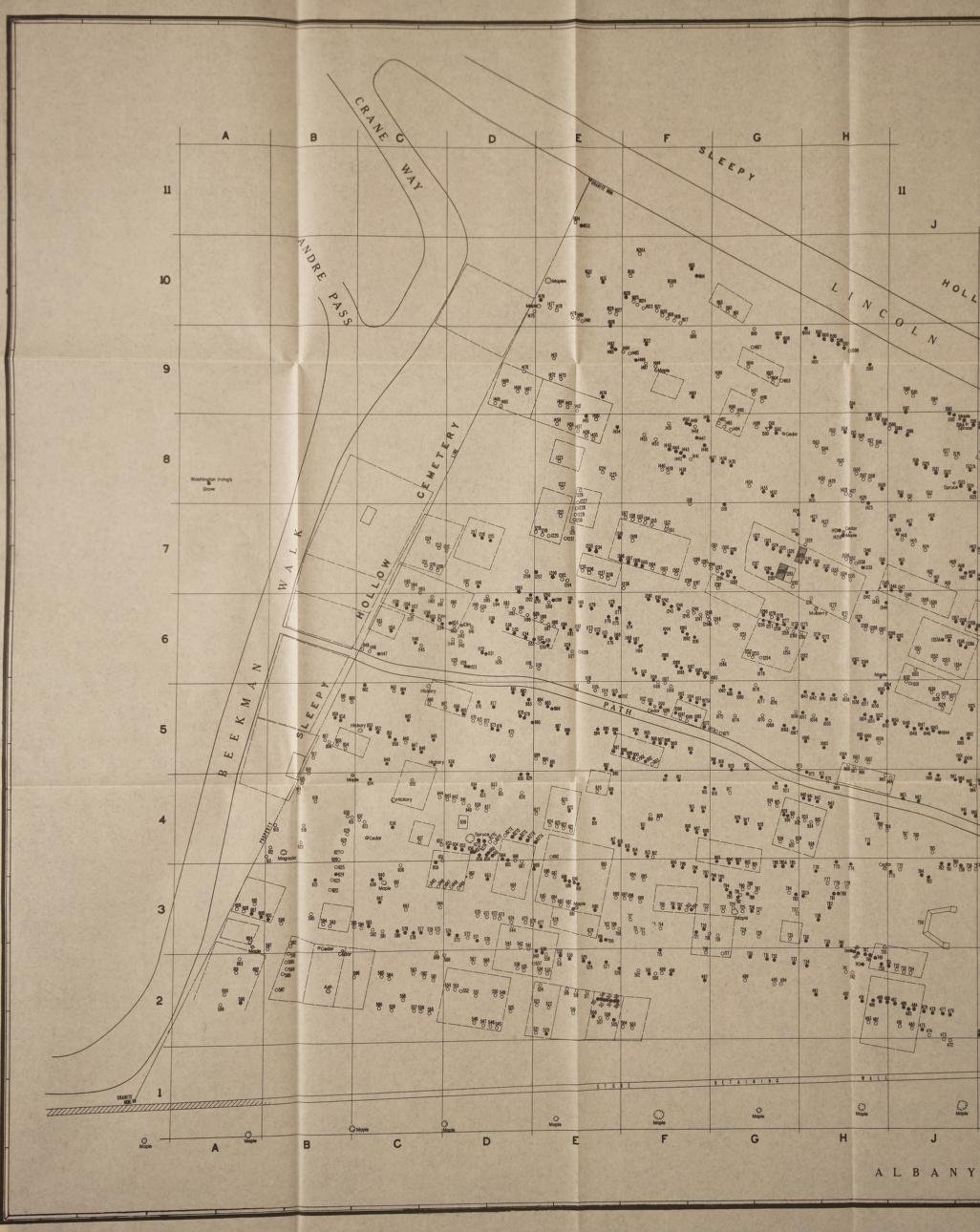
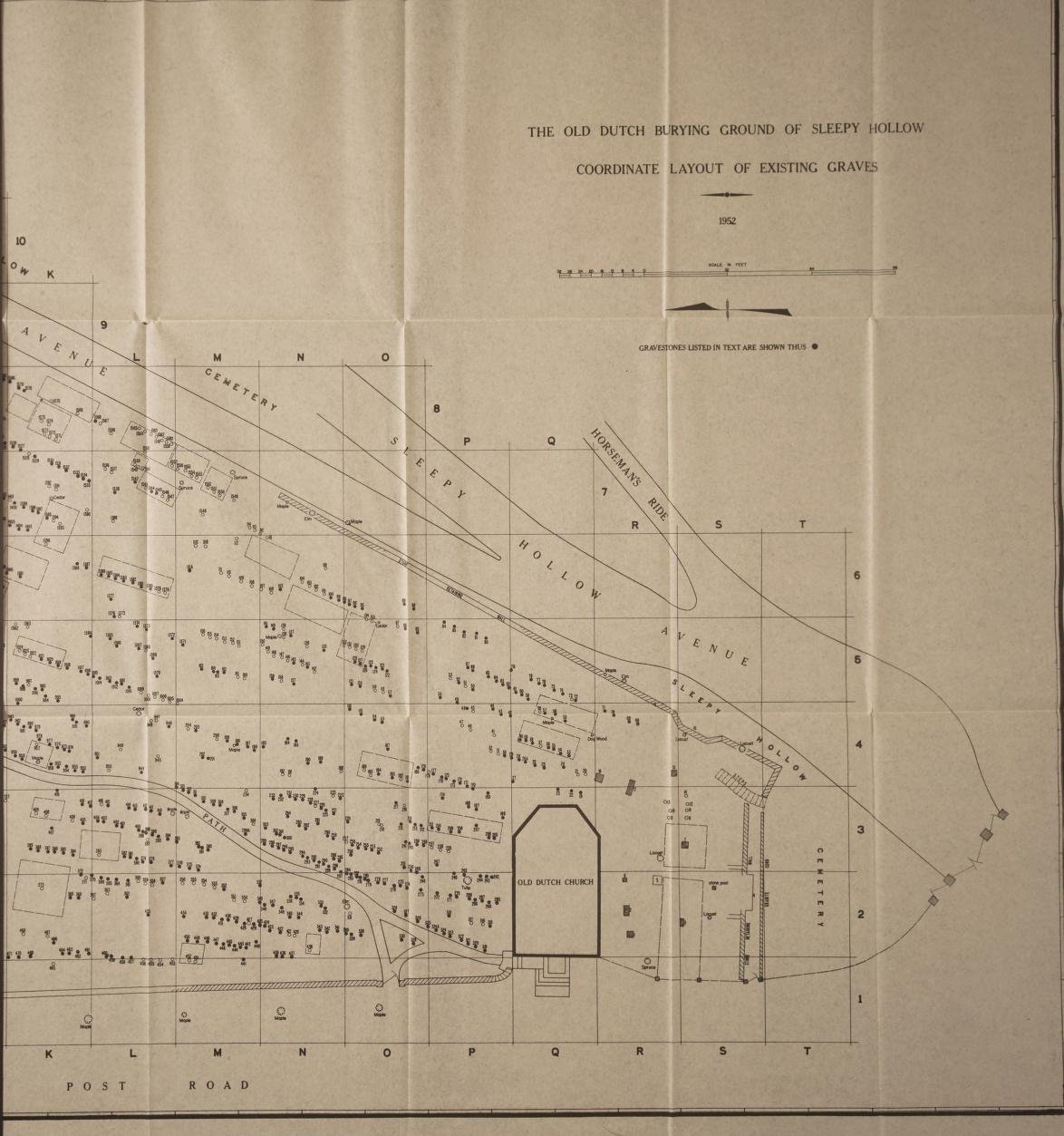
Coordinate Layout of Existing Graves
This map marks the location of all gravestones within the area of the early Churchyard and assigns a number to each stone. Those which are listed in the “Record of Inscriptions” are identified by a black dot or cross hatching.
Source
Perry, William Graves, The Old Dutch Burying Ground of Sleepy Hollow in North Tarrytown, New York; a record of the early gravestones and their inscriptions, Boston : The Rand Press, 1953.
Citations:
Thank you for this and ALL of the wonderful things you find and share which help the research of many, many people!
You are very much welcome and thank you for the kind comment!
Last name Young of grandparents.