History of Derby Connecticut, 1642-1880

Edmund Leavenworth of Derby, Connecticut

The book titled “History of the Old Town of Derby, Connecticut, 1642-1880” presents a comprehensive account of Derby’s development, including the town’s Indian history, early settlers, and significant events like the Revolutionary War. It emphasizes education, commerce, and church influences, while offering an extensive collection of biographies and genealogies.
The Old Dutch Burying Ground in North Tarrytown New York

Old Dutch Church Graveyard

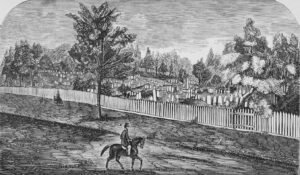
This book documents the early gravestones and inscriptions of the Old Dutch Burying Ground in North Tarrytown, New York, focusing on preservation efforts led by William Graves Perry. Commissioned for the church’s 250th anniversary, it records the deteriorating brownstone and marble markers, some dating back to the 18th century. The text highlights the artistry of gravestones and the community’s historical significance. Despite losses, surviving inscriptions are important for understanding the genealogy of early settlers in the area.

History of Hutchinson Kansas

Hutchinson a Prairie City in Kansas

Published in 1946 by McCormick-Armstrong Co., Wichita, Kansas, “Hutchinson, a Prairie City in Kansas” is an important historical resource that captures the quintessence of a small city transitioning through time. The author, Willard Welsh, has painstakingly collected stories, facts, and photographs to compose a narrative that preserves the memory of Hutchinson’s development from its early days to an expanding city center.

Wintergreen Cemetery, Port Gibson, Mississippi

Wintergreen Cemetery, Port Gibson, Mississippi

This survey of Wintergreen Cemetery, Port Gibson, Mississippi, was completed in 1956 by Mr. Gordon M. Wells and published by Joyce Bridges the same year. It contains the cemetery readings Mr. Wells was able to obtain at that date. It is highly likely that not all of the gravestones had survived up to that point, and it is even more likely that a large portion of interred individuals never had a gravestone.

The Amidon Family of Rehoboth, MA

The Amidon Family

The Amidon Family genealogy book details the lineage of Roger Amadowne, a French Huguenot who fled to England and later to America after the revocation of the Edict of Nantes. Documented in Salem, Massachusetts in 1637, variations of his surname include Amadon, Amidown, and Ammidon. The work, organized with biographical sketches and two helpful indexes, presents the family’s history and is richly illustrated. Originally published in 1904, it serves as a valuable resource for descendants and historians alike.

Walter Merryman of Harpswell, Maine, and his descendants

Walter Merryman of Harpswell, Maine, and his descendants - FM

Walter Merryman was kidnapped in an Irish port in 1700 and brought to Boston, Massachusetts, where he was indentured to a shipbuilder in Portland, Maine. He married Elizabeth Potter and settled in Harpswell, Maine. Descendants and relatives lived in Maine, New Hampshire, Connecticut, New York, Pennsylvania, Idaho and elsewhere. Includes Alexander, Curtiss, Hamilton, McManus, Stover, Webber and related families.

Richard Dexter Genealogy, 1642-1904

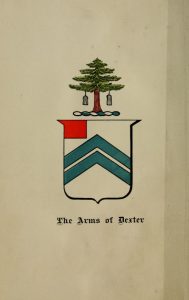
Arms of Dexter

Being a history of the descendants of Richard Dexter of Malden, Massachusetts, from the notes of John Haven Dexter and original researches. Richard Dexter, who was admitted an inhabitant of Boston (New England), Feb. 28, 1642, came from within ten miles of the town of Slane, Co. Meath, Ireland, and belonged to a branch of that family of Dexter who were descendants of Richard de Excester, the Lord Justice of Ireland. He, with his wife Bridget, and three or more children, fled to England from the great Irish Massacre of the Protestants which commenced Oct. 27, 1641. When Richard Dexter and family left England and by what vessel, we are unable to state, but he could not have remained there long, as we know he was living at Boston prior to Feb. 28, 1642.

1923 Historical and Pictorial Directory of Angola Indiana

1923 Angola Indiana Directory Book Cover

Luedders’ historical and pictorial city directory of Angola, Indiana for the year 1923, containing an historical compilation of items of local interest, a complete canvass of names in the city, which includes every member of the family, college students, families on rural lines, directory of officers of county, city, lodges, churches, societies, a directory of streets, and a classified business directory.

Treaty of January 17, 1837

Treaty of January 17, 1837 page 7

The Treaty of January 17, 1837, between the Choctaw and Chickasaw tribes allowed the Chickasaws to form a district within Choctaw territory while maintaining a degree of autonomy. The agreement, made under pressure from U.S. expansion policies, ensured the Chickasaws received equal representation in the Choctaw council and outlined financial arrangements, including a payment of $530,000 to the Choctaws. This treaty illustrates the complexities of Native American negotiations during a time of displacement and serves as a precursor to later agreements that sought to solidify tribal governance.

Biographical Sketch of Margaret Humphreys

Margaret Woodall Humphreys, born on July 18, 1866, married James Humphreys on November 24, 1909, in Tahlequah. James, born in Monroe County, Tennessee in 1867, is affiliated with the Masonic and Odd Fellow organizations. Together, they had four children: Roxis (1910), Harrison (1912), Eula (1914), and Virgil (1916). Their family history reflects the intertwining of personal and community ties in early 20th-century America.

Treaty of September 18, 1823

The Treaty of September 18, 1823, facilitated the cession of Florida territory by native chiefs in exchange for U.S. protection and support. The agreement established boundaries for tribal habitation, promising agricultural aid, monetary support for 20 years, food provisions, and educational resources. Special reservations were designated for particular chiefs, ensuring their peaceful possession while stipulating their cooperation in maintaining order. Additionally, measures were included to compensate for relocation and improvements abandoned by tribes. This treaty exemplifies the complexities of U.S. relations with Native American tribes during this period.

J. G. Humphreys

Private 1st Class J. G. Humphreys, from Halifax County, was the son of James and Osceola Humphreys and the husband of Ethel May Humphreys. He entered military service on March 28, 1918, at Weldon, North Carolina, and was assigned to the Medical Company, B Hospital. After serving, he was mustered out at Camp Jackson, South Carolina, on September 13, 1919.

Humphreys, Sarah Lulu Odell – Obituary

Sarah L. Humphreys, aged 80, passed away on November 5, 1962, in Vancouver, Washington, where she had resided since 1948. Born on November 5, 1882, in Dayton, Oregon, she was part of a pioneering family in the Willamette Valley. She is survived by her son Norman, daughter Lois, two grandchildren, and three great-grandchildren. Her brother, Albert L. Odell, lives in Portland, Oregon. Funeral services will be held on November 8 at the Vancouver Funeral Chapel, followed by interment at Brush Prairie Cemetery.

Sea Captains – Hooper to Humphreys

Baroque Washington

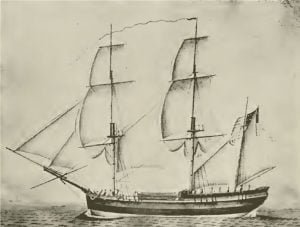
Asa Hooper (1767-1833) was a notable sea captain from Marblehead, serving various ships, including the privateer brigantine Thorn, which he captained during the War of 1812. He was also involved in local governance as a representative to the General Court. Other Hoopers, like Henry, John G., and Robert, similarly contributed to maritime activities in the 18th and 19th centuries, commanding numerous vessels and engaging in trade and privateering. Their legacies, including official commissions and maritime records, remain significant in Marblehead’s maritime history.

Biography of Judge C. W. Humphreys

Judge C. W. Humphreys was born in Mason County, Kentucky, and descends from Irish immigrants who settled in Virginia after the Revolutionary War. His family history, rich in tales of resilience, includes notable figures such as his grandfather, who fought in the Battle of Point Pleasant. In 1874, Humphreys moved to Santa Ana, where he served as justice of the peace and built a successful career in real estate and conveyancing. He married Cordelia Franklin and had six children, with three surviving today.