History of Rindge New Hampshire

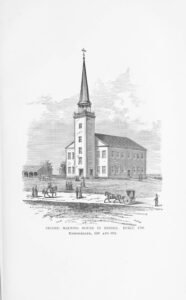
Second Meeting House in Rindge New Hampshire

The History of the Town of Rindge, New Hampshire by Ezra S. Stearns, was published in 1875, and covers the period from the original Rowley Canada grant or Massachusetts charter through the year 1874. Stearns traces the legal, territorial, and institutional development of Rindge, beginning with colonial land grants and boundary disputes and proceeding through settlement, incorporation into a town and development into a small manufacturing hub. More than half the volume is devoted to genealogical material. The genealogical register of Rindge families includes thousands of names compiled from a wide range of sources and assisted by contributions from residents and researchers beyond the town.
History of the Town of Cornwall Connecticut

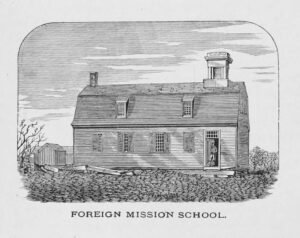
Foreign Mission School, Cornwall, Connecticut

The History of the Town of Cornwall Connecticut is a comprehensive account of the town’s evolution from colonial organization in 1731 to its involvement in national events like the Civil War. They include detailed geographical descriptions, ecclesiastical histories of local churches, and biographical sketches of families such as the Sedgwicks and Golds. The records also reflect social life, farming, early fashion, and the noteworthy Foreign Mission School.

The Old Dutch Burying Ground in North Tarrytown New York

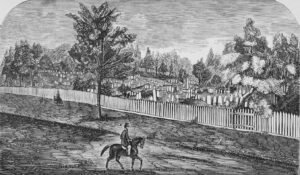
Old Dutch Church Graveyard

This book documents the early gravestones and inscriptions of the Old Dutch Burying Ground in North Tarrytown, New York, focusing on preservation efforts led by William Graves Perry. Commissioned for the church’s 250th anniversary, it records the deteriorating brownstone and marble markers, some dating back to the 18th century. The text highlights the artistry of gravestones and the community’s historical significance. Despite losses, surviving inscriptions are important for understanding the genealogy of early settlers in the area.

Wintergreen Cemetery, Port Gibson, Mississippi

Wintergreen Cemetery, Port Gibson, Mississippi

This survey of Wintergreen Cemetery, Port Gibson, Mississippi, was completed in 1956 by Mr. Gordon M. Wells and published by Joyce Bridges the same year. It contains the cemetery readings Mr. Wells was able to obtain at that date. It is highly likely that not all of the gravestones had survived up to that point, and it is even more likely that a large portion of interred individuals never had a gravestone.

Brown Genealogy

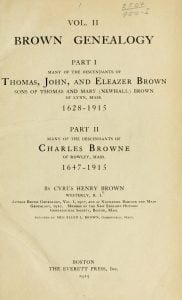
Brown Genealogy

In 1895, Cyrus Henry Brown began collecting family records of the Brown family, initially with the intention of only going back to his great-grandfathers. As others became interested in the project, they decided to trace the family lineage back to Thomas Brown and his wife Mary Newhall, both born in the early 1600s in Lynn, Massachusetts. Thomas, John, and Eleazer, three of their sons, later moved to Stonington, Connecticut around 1688. When North Stonington was established in 1807, the three brothers were living in the southern part of the town. Wheeler’s “History of Stonington” contains 400 records of early descendants of the Brown family, taken from the town records of Stonington. However, many others remain unidentified, as they are not recorded in the Stonington town records. For around a century, the descendants of the three brothers lived in Stonington before eventually migrating to other towns in Connecticut and New York State, which was then mostly undeveloped. He would eventually write this second volume of his Brown Genealogy adding to and correcting the previous edition. This book is free to search, read, and/or download.

History of Littleton New Hampshire

1895 Map of Littleton New Hampshire

The History of Littleton New Hampshire is comprised of three volumes, two volumes of history, and a final volume of genealogies. Considered one of the best examples of local history written in the early 20th century, is your ancestors resided in Littleton then you need these books. Read and download for free!

History of Bentleysville, Pennsylvania

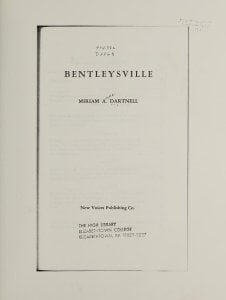
Bentleysville title page

This book is a collection of stories, letters, and historical records detailing the brief history of Bentleysville, a rural community in southwestern Pennsylvania. Established around a mill operated by Sheshbazzar Bentley Sr. and Jr. on Pigeon Creek in 1816, the town grew to a population of 300 by 1868. The author traces the origins of Bentleysville back to the 1770s to document the earliest settlers, while also providing context through significant national events like the Whiskey Rebellion and the Civil War. Although Bentleysville’s history as a village ended before 1900, this work preserves its legacy for future generations.

Weymouth ways and Weymouth people

Weymouth ways and Weymouth people

Edward Hunt’s “Weymouth ways and Weymouth people: Reminiscences” takes the reader back in Weymouth Massachusetts past to the 1830s through the 1880s as he provides glimpses into the people of the community. These reminiscences were mostly printed in the Weymouth Gazette and provide a fair example of early New England village life as it occurred in the mid 1800s. Of specific interest to the genealogist will be the Hunt material scattered throughout, but most specifically 286-295, and of course, those lucky enough to have had somebody “remembered” by Edward.

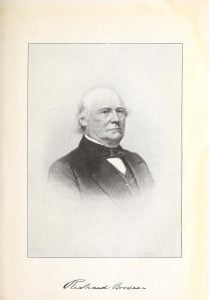
Descendants of Joseph Borden of Fall River MA

Richard Borden

The Borden family, descended from Joseph Borden of Fall River, MA, boasts a rich lineage extending back to Richard Borden, an English soldier settled in Portsmouth, R.I., in the 17th century. The Bordens became prominent landowners and industrialists, particularly during the rise of Fall River as a textile manufacturing hub. Nathaniel Briggs Borden, a notable descendant, served in various public offices, advocating for abolitionist causes and contributing significantly to local development. His legacy continues through his descendants, who maintained the family’s influence in Fall River’s civic and business arenas.

Establishment of Fort Smith in 1817

Quapaw Cession Map

In 1817, a military post was established at Belle Point, now Fort Smith, Arkansas, to protect white settlers and the Cherokee from Osage hostilities. Major William Bradford led the detachment tasked with this, supported by Major Stephen H. Long, who surveyed the area. The post was strategically located at the junction of the Poteau and Arkansas rivers, facilitating navigation and trade. Subsequent treaties with the Osage and other tribes led to significant land cessions, shaping early relations and territorial boundaries in the region.

Biographies of Western Nebraska

History of Western Nebraska and its People

A historical overview of western Nebraska and its pioneer settlers, this volume highlights the men who helped build counties across the Nebraska Panhandle, including Cheyenne, Box Butte, Deuel, Garden, Sioux, Kimball, Morrill, Sheridan, Scotts Bluff, Banner, and Dawes. It also points readers to biographies, history volumes, and a gallery of 143 photographs.

Baldwin County Georgia Marriages 1806-1850

This index compiles 1,352 Baldwin County, Georgia marriage records from court documents covering 1806 to 1850. It lists groom, bride, and marriage date entries in chronological order, offering a valuable genealogical resource for tracing family history, local relationships, and early county residents across more than four decades.

Hodgen Cemetery, Hodgen, LeFlore County, Oklahoma

Hodgen Cemetery, LeFlore County, Oklahoma

Hodgen Cemetery, located just south of Hodgen, Oklahoma, is the town’s active burial ground and the subject of this extensive online cemetery record. Compiled from headstone inscriptions, the listing preserves names, dates, family relationships, and military service details for generations of local residents, with thanks to Paula Doyle-Bicket for the submission.

Biographical Sketch of Newton S. Calhoun

Newton S. Calhoun was born on February 12, 1855, in Connecticut. He graduated from Brown University in 1879 and later moved to Cleveland. His career began in education before transitioning to law, ultimately becoming treasurer and then president of the Johnson Jennings Co. in 1905. He was also involved with the Royal Tourist Car Co. Calhoun was active in the community as a member of the Chamber of Commerce and Pilgrim Congregational Church. He married Caroline Jennings in 1884 and had two children.

M. D. Calhoun

M. D. Calhoun, a bugler in the 317th Field Artillery, Battery E, was born in Edgecomb County to B. W. Calhoun and his wife. He entered military service on May 28, 1918, in Rocky Mount, North Carolina, and trained at Camp Jackson before moving to Camp Mills. Calhoun sailed for France on August 10, 1918, and returned to the United States on June 7, 1919, where he was mustered out at Camp Lee on June 20, 1919.

Biography of George B. Calhoun, M.D.

Dr. George B. Calhoun, born on October 19, 1837, in New Brunswick, is a prominent figure in the Puget Sound medical community. After a childhood in Maryland and education in Nova Scotia and Glasgow, he served as an assistant surgeon in the U.S. Army during the Civil War. Calhoun established the marine hospital in Port Townsend before moving to Seattle, where he practiced medicine and engaged in local governance. He later relocated to La Conner, where he continues to enjoy a successful life with his wife, Ellen Mein, and their nine children.