History of Rindge New Hampshire

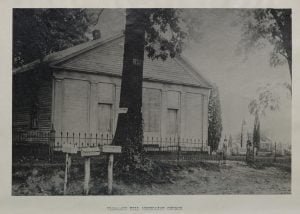
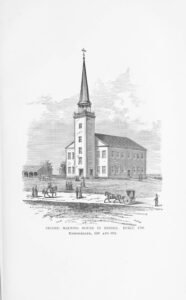
Second Meeting House in Rindge New Hampshire

The History of the Town of Rindge, New Hampshire by Ezra S. Stearns, was published in 1875, and covers the period from the original Rowley Canada grant or Massachusetts charter through the year 1874. Stearns traces the legal, territorial, and institutional development of Rindge, beginning with colonial land grants and boundary disputes and proceeding through settlement, incorporation into a town and development into a small manufacturing hub. More than half the volume is devoted to genealogical material. The genealogical register of Rindge families includes thousands of names compiled from a wide range of sources and assisted by contributions from residents and researchers beyond the town.

New Hampshire Men

1892 Map of New Hampshire

New Hampshire Men presents 407 biographical sketches, with portraits, of men who were active in commercial, professional, and political life in New Hampshire in 1893.

History of Bedford, New Hampshire

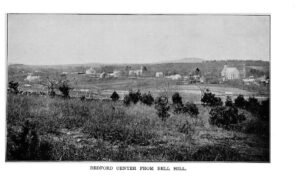
Bedford Center from Bell Hill

This volume, titled History of Bedford, New Hampshire, from 1737, was compiled by Peter P. Woodbury, Thomas Savage, and William Patten. It was published in Concord, N.H., by The Rumford Printing Co. in 1903. The primary objective of this edition was to incorporate all facts from the predecessor’s work, along with additional details and events that occurred since its publication, documenting the town’s history up to the occasion of the one hundred and fiftieth anniversary of its incorporation on May 15, 1900. A significant portion of the work is dedicated to Genealogies of 157 families, furnished largely by family representatives and compiled by Miss Mary E. Manning. The book also includes Biographies of notable figures associated with Bedford and a chapter on Vital Statistics (births, deaths, and marriages) compiled from town records, with recognized limitations due to the incompleteness of earlier record-keeping.

History of Francestown New Hampshire

Map of Francestown New Hampshire

History of Francestown, New Hampshire is a historic and genealogical record of the town from its first settlement in 1758 through the beginning of 1891. It records Francestown’s settlement, civic growth, religious and educational institutions, military participation, industries, and social customs, followed by an extensive genealogical register of families associated with the town.

History of Amherst New Hampshire

Residence of Isaac Brooks in Amherst New Hampshire

The history of Amherst, New Hampshire, unfolds from its 1675 land grant to veterans of the Narraganset War, marking the impetus for settlement along the Souhegan River. From its early governance and incorporation in 1760 to territorial adjustments that birthed Mont Vernon and Milford, this narrative encompasses local geography, economy, and Indigenous presence. Key military engagements, civic institutions, and genealogical records are explored up to 1882, offering a comprehensive view of the town’s evolution and its prominent figures.

History of Hampton New Hampshire vol 2

1892 Map of Hampton NH

The original version of this monumental work was published in 2 volumes. Volume 1 contains the history of the town of Hampton, New Hampshire from its settlement in 1638 to the autumn of 1892 and can be found here. Volume 2 featured the genealogical and biographical details of the early families of Hampton, NH up to the autumn of 1892 and this is the volume shown below. This manuscript was meticulously researched by Joseph Dow up until his death in 1889. Unfortunately his death preceded the final compilation of the genealogies and his daughter, Lucy Ellen Dow, took on the task after his decease. For genealogists this is an important fact. Lucy admits in her preface that she had difficulty bringing the genealogies down to date (1892) for lack of full understanding of Josiah Page’s notes and for the lack of accurate town records. As she laments about the town records “but whole decades are passed over with scarcely an entry of birth or marriage.” Indeed they are.

Historical Sketch of Lisbon Connecticut, 1786-1900

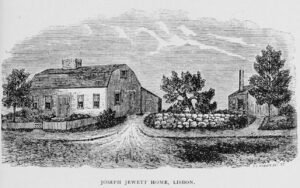
Joseph Jewett Home in Lisbon Connecticut

Though the work, Historical sketch of Lisbon, Conn., from 1786-1900, forms a modest octavo volume of only eighty-four pages, this book condenses within that limit the ecclesiastical and narrative history of the town, together with brief biographies and genealogies of its sons and daughters. The ecclesiastical history covers the sixty-eight years from 1718 to 1786 when Lisbon was a part of Norwich, and brings the record down to the 1900, embracing the Hanover parish, which celebrated its 125th anniversary in 1891. The narrative and descriptive history commences with Lisbon’s independent existence as a town, and comes down to the present day; and the brief biographical and genealogical sketches which follow occupy the last half of the book, and include lists of town officers, members of the General Assembly, and soldiers and sailors who served in the various wars of our country.

The Old Dutch Burying Ground in North Tarrytown New York

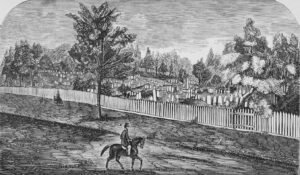
Old Dutch Church Graveyard

This book documents the early gravestones and inscriptions of the Old Dutch Burying Ground in North Tarrytown, New York, focusing on preservation efforts led by William Graves Perry. Commissioned for the church’s 250th anniversary, it records the deteriorating brownstone and marble markers, some dating back to the 18th century. The text highlights the artistry of gravestones and the community’s historical significance. Despite losses, surviving inscriptions are important for understanding the genealogy of early settlers in the area.

Essex County Massachusetts Probate Records 1665-1674

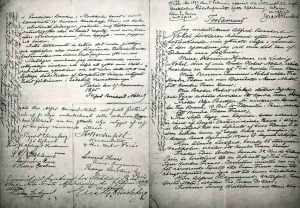
Sample Last Will and Testament

The “Governor and Company of Massachusetts Bay” established a judicial system in 1628, with a General Court in Boston and quarterly courts in major towns like Salem and Ipswich by 1635. These courts managed probate matters, and after Essex County’s formation in 1643, individual probate courts were later established in 1692. These are the probate records from 1665 to 1674, sourced from various original documents, including detailed wills and estate settlements.

Records of Pleasant Hill Methodist Church, 1829-1894

Pleasant Hill Methodist Church, 1953

This is a copy of a record book of the Pleasant Hill Methodist Church in Washington Township, Guernsey County, Ohio. The front portion of this manuscript contains the history of Pleasant Hill Methodist Church, which we provide here, and biographies of their pastors up to 1953. Starting on page 18 you will find the Membership Record for the church beginning in 1829 and through January of 1894.

Southborough Massachusetts vital records

Vital records of Southborough, Massachusetts, to the end of the year 1849 title page

The list of vital records of Southborough, Massachusetts, comprised in this volume includes all which were entered in the Town Books during the period from the earliest date there found to the end of the year 1849. Some additions and corrections of names and dates have been made from the records of the First Church, these being indicated in each instance by proper reference. There are a total of 6,267 births, marriages, and deaths recorded. This book is free to read or download.

The Amidon Family of Rehoboth, MA

The Amidon Family

The Amidon Family genealogy book details the lineage of Roger Amadowne, a French Huguenot who fled to England and later to America after the revocation of the Edict of Nantes. Documented in Salem, Massachusetts in 1637, variations of his surname include Amadon, Amidown, and Ammidon. The work, organized with biographical sketches and two helpful indexes, presents the family’s history and is richly illustrated. Originally published in 1904, it serves as a valuable resource for descendants and historians alike.

A history of Parsonsfield Maine

A history of Parsonsfield Maine

A history of the first century of the town of Parsonsfield, Maine. Incorporated Aug 29, 1785, and celebrated with impressive ceremonies at North Parsonfield August 29, 1885.

Families of Ancient New Haven

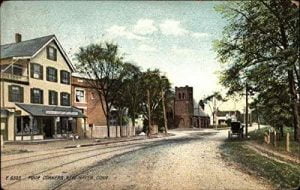
Four Corners New Haven Connecticut

The Families of Ancient New Haven compilation includes the families of the ancient town of New Haven, covering the present towns of New Haven, East Haven, North Haven, Hamden, Bethany, Woodbridge and West Haven. These families are brought down to the heads of families in the First Census (1790), and include the generation born about 1790 to 1800. Descendants in the male line who removed from this region are also given, if obtainable, to about 1800, unless they have been adequately set forth in published genealogies.

Abbe-Abbey Genealogy

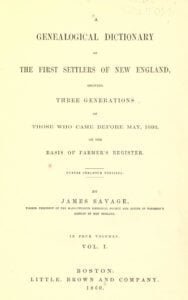
A genealogical dictionary of the first settlers of New England vol 1

The “Abbe-Abbey Genealogy” serves as a comprehensive and meticulously compiled homage to the heritage of the Abbe and Abbey families, tracing its roots back to John Abbe and his descendants. Initiated by the life-long passion of Professor Cleveland Abbe, this genealogical exploration began in his youth and expanded throughout his illustrious career, despite numerous challenges. It encapsulates the collaborative efforts of numerous family members and researchers, including significant contributions from individuals such as Charles E. Abbe, Norah D. Abbe, and many others, each bringing invaluable insights and data to enrich the family’s narrative.

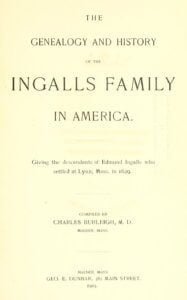
The genealogy and history of the Ingalls family in America

The genealogy and history of the Ingalls family in America

Edmund Ingalls, son of Robert, was born about 1598 in Skirbeck, Lincolnshire, England. He immigrated in 1628 to Salem, Massachusetts and with his brother, Francis, founded Lynn, Massachusetts in 1629. He married Ann, fathered nine children, and died in 1648.

Genealogy of Elizabeth Caroline Seymour Brown

Genealogy of Elizabeth Caroline Seymour Brown

Over a period of many years Mrs. Elizabeth Caroline Seymour Brown, early member of Linares Chapter, D.A.R., collected genealogy of her forebears. It was her wish that her work be sent to the library of the National Society, Daughters of the American Revolution. This collection was painstakingly copied, with some additions and corrections, maintaining the same general form as used in the original notes. Elizabeth’s family originated in England moving to New England in the 1600’s. Her family lines involve many of the early lines in Connecticut, Massachusets, and New Hampshire. The families are arranged mostly in alphabetical order, and contain information from a simple direct line descendancy, to more elaborate genealogy.

Major families researched include: Alverson, Arms, Arnold, Ballou, Barden, Barker, Barnard, Bassett, Belden, Benedict, Betts, Blakeslee, Blanchard, Bradstreet, Brigham, Bronson, Buckmaster, Bull, Butterfield, Carpenter, Clark, Clerke, Cooke, Coombs, Cornwall, Corbin, Curitss, Dickerman, Dickson, Doolittle, Downey, Dudley, Eastman, Easton, Errington, Evarts, Fairbank, Foote, Gilbert, Goodrich, Graves, Gregory, Groves, Hale, Hand, Hall, Hawkes, Hawkins, Hills, Holmes, Hopkins, Hoyt, Huitt, Hurd, Keayne, Keene, Lockwood, Lupton, Lord, Manning, Marvin, Mayo, Merriman, Miller, Morris, Morton, Mosse, Moulton, Munger, Needham, Parker, Parkhurst, Potter, Peck, Pettiplace, Purefoy, Priest, Rusco, St John, Scofield, Seymour, Sherman, Smith, Strong, Swinnerton, Symonds, Threlkell, Thorne, Ventriss, Wade, Watson, Weed, White, and Yorke.

Richard Dexter Genealogy, 1642-1904

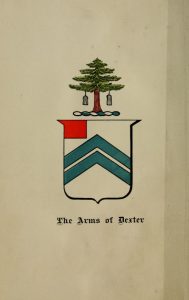
Arms of Dexter

Being a history of the descendants of Richard Dexter of Malden, Massachusetts, from the notes of John Haven Dexter and original researches. Richard Dexter, who was admitted an inhabitant of Boston (New England), Feb. 28, 1642, came from within ten miles of the town of Slane, Co. Meath, Ireland, and belonged to a branch of that family of Dexter who were descendants of Richard de Excester, the Lord Justice of Ireland. He, with his wife Bridget, and three or more children, fled to England from the great Irish Massacre of the Protestants which commenced Oct. 27, 1641. When Richard Dexter and family left England and by what vessel, we are unable to state, but he could not have remained there long, as we know he was living at Boston prior to Feb. 28, 1642.

Stover Genealogy of Blue Hill, Maine

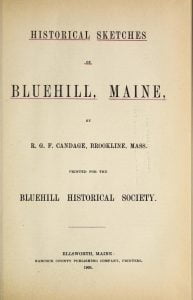
Historical Sketches of Bluehill Maine

Jeremiah Stover, born in Penobscot in 1770, built a two-story house in Blue Hill before 1800. He married Abigail Devereux in 1793, and they had nine children. The family, involved in farming and tanning, continued in these trades after Jeremiah’s death in 1824. His son, Jeremiah Jr., later replaced the original house around 1840. The family’s legacy persists, with descendants continuing to own their ancestral property. Meanwhile, Isaac Stover, another family member, settled in Blue Hill and also left a sizeable lineage.

Descendants of Alexander Bisset Munro of Bristol, Maine

Munro Family

Alexander Bisset Munro was born 25 Dec. 1793 at Inverness, Scotland to Donald and Janet (Bisset) Munro. Alexander left Scotland at the age of 14, and lived in Dimecrana in the West Indies for 18 years. He owned a plantation, raising cotton, coffee and other produce. He brought produce to Boston Massachusetts on the ship of Solomon Dockendorff. To be sure he got his money, Solomon asked his to come home with him, where he met Solomon’s sister, Jane Dockendorff. Alexander went back to the West Indies, sold out, and moved to Round Pond, Maine, and married Jane. They had 14 children: Janet, Alexander, Margaret, Nancy, Jane, Mary, Solomon, Donald, John, William, Bettie, Edmund, Joseph and Lydia.