Genealogies of the Town of Goffstown New Hampshire
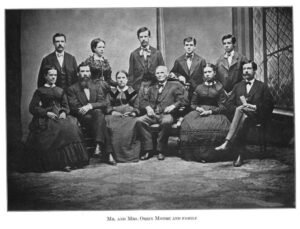
Orrin Moore and family of Goffstown, New Hampshire

The genealogical record of Goffstown, New Hampshire, was a substantial undertaking, hampered by the extinction of early families and the widespread scattering of descendants. Efforts to gather vital statistics necessitated considerable travel and correspondence, often revealing discrepancies in recorded dates across various sources. Despite challenges, contributions from former works and assistance from individuals proved invaluable in compiling this record. The comprehensive index reflects the depth of research involved in documenting the town’s heritage.

History of Amherst New Hampshire

Residence of Isaac Brooks in Amherst New Hampshire

The history of Amherst, New Hampshire, unfolds from its 1675 land grant to veterans of the Narraganset War, marking the impetus for settlement along the Souhegan River. From its early governance and incorporation in 1760 to territorial adjustments that birthed Mont Vernon and Milford, this narrative encompasses local geography, economy, and Indigenous presence. Key military engagements, civic institutions, and genealogical records are explored up to 1882, offering a comprehensive view of the town’s evolution and its prominent figures.

The Old Dutch Burying Ground in North Tarrytown New York

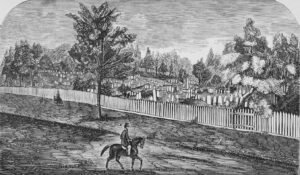
Old Dutch Church Graveyard

This book documents the early gravestones and inscriptions of the Old Dutch Burying Ground in North Tarrytown, New York, focusing on preservation efforts led by William Graves Perry. Commissioned for the church’s 250th anniversary, it records the deteriorating brownstone and marble markers, some dating back to the 18th century. The text highlights the artistry of gravestones and the community’s historical significance. Despite losses, surviving inscriptions are important for understanding the genealogy of early settlers in the area.

History of Chester, New Hampshire, including Auburn

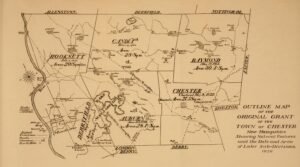
Outline map of the Original Grant of the town of Chester New Hampshire

The *History of Chester, New Hampshire, Including Auburn* by John Carroll Chase, published in 1926, serves as a supplement to the original 1869 *History of Old Chester*. This work was produced in response to a desire to document events that had occurred in the town since the previous publication, as well as to cover topics that were initially omitted. While Chester had seen a decline in population and industrial activity, the book highlights notable historical and social developments. It incorporates additions to military history, church records, and gravestone inscriptions, providing a comprehensive overview of Chester and Auburn’s past.

History of old Chester from 1719 to 1869

History of Old Chester title page

The *History of Old Chester from 1719 to 1869* by Benjamin Chase, published in 1869, offers a detailed account of the early settlement and development of Chester, New Hampshire. Compiled with the assistance of local historian Judge Samuel D. Bell, the book explores the town’s founding, genealogies, and significant events, using primary sources such as deeds, probate records, and personal diaries. Chase aimed to preserve the history and traditions of Chester’s early settlers while providing a comprehensive record for future generations. The work covers a broad range of topics, including religious, military, industrial, and genealogical history.

The Cox family in America

The Cox family in America

Two volumes of Cox family genealogy combined as one. The first volume contains information about the various early Cox families across America. The second volume deals specifically with the descendants of James and Sarah Cock of Killingworth upon Matinecock, in the township of Oysterbay, Long Island, New York.

The genealogy and history of the Ingalls family in America

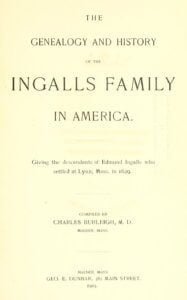
The genealogy and history of the Ingalls family in America

Edmund Ingalls, son of Robert, was born about 1598 in Skirbeck, Lincolnshire, England. He immigrated in 1628 to Salem, Massachusetts and with his brother, Francis, founded Lynn, Massachusetts in 1629. He married Ann, fathered nine children, and died in 1648.

Abstracts of Wills on File in the City of New York Surrogate’s Office 1660-1680

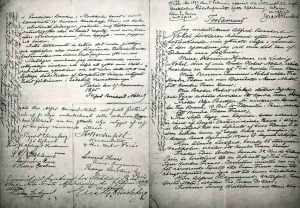
Sample Last Will and Testament

Abstracts of wills on file in the surrogate’s office city of New York 1660-1680. From May 1787 to the present, county surrogate’s courts have recorded probates. However, the court of probates and court of chancery handled estates of deceased persons who died in one county but who owned property in another. An 1823 law mandated that all probates come under the jurisdiction of the county surrogate’s courts. Each surrogate’s court has a comprehensive index to all probate records, including the unrecorded probate packets. Interestingly enough, there are wills existing and on record at the Surrogate’s Office in New York City for the time-span of 1660-1680. Genealogical extracts of these wills have been provided below.

Will of John Underhill, Capt. – 1675

Captain John Underhill of Killingworth, Long Island, left his entire estate to his wife Elizabeth in his will, stipulating it would remain hers during her widowhood. He appointed his eldest son, also named John, along with others, as trustees for his children. Following Elizabeth’s death, the younger John assumed the role of administrator on November 4, 1675.

Slave Narrative of Susan High

Susan High, a 70-year-old former slave from North Carolina, recounts her early life on a plantation where her parents endured harsh conditions and strict rules. She describes the daily labor from dawn to dusk, scant education, and limited clothing. High shares memories of her mother saving their master’s life during the Civil War and the family’s struggle after emancipation. Despite hardships, she expresses gratitude for kind white people and reflects on her life, including marriage and her views on influential leaders like Lincoln and Roosevelt.

Paul Underhill

Paul Underhill served as a 1st Class Foreman in the Navy during World War I. He was the son of J. A. and Annie Underhill and married to Victoria Underhill. He enlisted on October 25, 1917, in Norfolk, Virginia, and was assigned to the U.S.S. Kaguema, participating in a voyage on the U.S.S. Palmer and laying submarine cable from Maine to Key West. Underhill was released from active duty and mustered out at Hampton Roads, Virginia, on March 8, 1919.