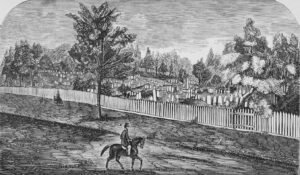
The Old Dutch Burying Ground in North Tarrytown New York

Old Dutch Church Graveyard

This book documents the early gravestones and inscriptions of the Old Dutch Burying Ground in North Tarrytown, New York, focusing on preservation efforts led by William Graves Perry. Commissioned for the church’s 250th anniversary, it records the deteriorating brownstone and marble markers, some dating back to the 18th century. The text highlights the artistry of gravestones and the community’s historical significance. Despite losses, surviving inscriptions are important for understanding the genealogy of early settlers in the area.

Stephenson County Illinois World War 1 Veterans

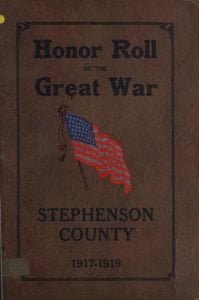
Honor roll of the Great War, Stephenson County, 1917-1919

This small booklet contains all the known men and women who participated in World War 1 and claimed their home of record as Stephenson County, Illinois. By participation, this record does not limit this to soldiers, but also contains the records of those men and women who served the Red Cross, Y.M.C.A., and other non-fighting positions. This book is free to read or download.

History of Adair County Iowa and its People – vol 2

History of Adair County, Iowa, and its people vol 2 title page

Back in 1915, Lucian Moody Kilburn, was engaged to write a history of Adair County Iowa by the Pioneer Publishing Company of Chicago Illinois, he then being at that time a resident of the county for 50 years. The manuscript was divided into two volumes. This volume, numbered 2, provides biographical sketches of 348 leading men and women of the County of Adair including many of its founding families. You can read or download the free eBook from this website.

Brown Genealogy

Brown Genealogy

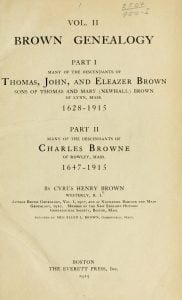
In 1895, Cyrus Henry Brown began collecting family records of the Brown family, initially with the intention of only going back to his great-grandfathers. As others became interested in the project, they decided to trace the family lineage back to Thomas Brown and his wife Mary Newhall, both born in the early 1600s in Lynn, Massachusetts. Thomas, John, and Eleazer, three of their sons, later moved to Stonington, Connecticut around 1688. When North Stonington was established in 1807, the three brothers were living in the southern part of the town. Wheeler’s “History of Stonington” contains 400 records of early descendants of the Brown family, taken from the town records of Stonington. However, many others remain unidentified, as they are not recorded in the Stonington town records. For around a century, the descendants of the three brothers lived in Stonington before eventually migrating to other towns in Connecticut and New York State, which was then mostly undeveloped. He would eventually write this second volume of his Brown Genealogy adding to and correcting the previous edition. This book is free to search, read, and/or download.

Abbe-Abbey Genealogy

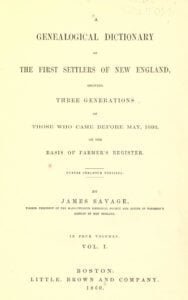
A genealogical dictionary of the first settlers of New England vol 1

The “Abbe-Abbey Genealogy” serves as a comprehensive and meticulously compiled homage to the heritage of the Abbe and Abbey families, tracing its roots back to John Abbe and his descendants. Initiated by the life-long passion of Professor Cleveland Abbe, this genealogical exploration began in his youth and expanded throughout his illustrious career, despite numerous challenges. It encapsulates the collaborative efforts of numerous family members and researchers, including significant contributions from individuals such as Charles E. Abbe, Norah D. Abbe, and many others, each bringing invaluable insights and data to enrich the family’s narrative.

The Cox family in America

The Cox family in America

Two volumes of Cox family genealogy combined as one. The first volume contains information about the various early Cox families across America. The second volume deals specifically with the descendants of James and Sarah Cock of Killingworth upon Matinecock, in the township of Oysterbay, Long Island, New York.

Tombstone records of eighteen cemeteries in Poundridge, New York

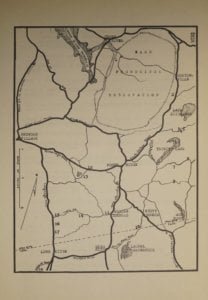
Map of cemeteries in Poundridge New York

In 1940 and 1941 Mrs. Sterling B. Jordan and Mrs. Frank W. Seth walked the 18 cemeteries in Poundridge, New York compiling the names and dates for all gravestones. Added to some of those gravestone listings were familial relationships if known. In addition, they referenced an even earlier listing of a few of the cemeteries by William Eardley taken in 1901.

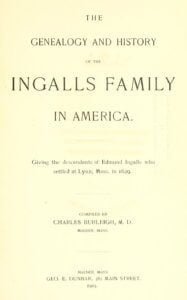
The genealogy and history of the Ingalls family in America

The genealogy and history of the Ingalls family in America

Edmund Ingalls, son of Robert, was born about 1598 in Skirbeck, Lincolnshire, England. He immigrated in 1628 to Salem, Massachusetts and with his brother, Francis, founded Lynn, Massachusetts in 1629. He married Ann, fathered nine children, and died in 1648.

Genealogy of Elizabeth Caroline Seymour Brown

Genealogy of Elizabeth Caroline Seymour Brown

Over a period of many years Mrs. Elizabeth Caroline Seymour Brown, early member of Linares Chapter, D.A.R., collected genealogy of her forebears. It was her wish that her work be sent to the library of the National Society, Daughters of the American Revolution. This collection was painstakingly copied, with some additions and corrections, maintaining the same general form as used in the original notes. Elizabeth’s family originated in England moving to New England in the 1600’s. Her family lines involve many of the early lines in Connecticut, Massachusets, and New Hampshire. The families are arranged mostly in alphabetical order, and contain information from a simple direct line descendancy, to more elaborate genealogy.

Major families researched include: Alverson, Arms, Arnold, Ballou, Barden, Barker, Barnard, Bassett, Belden, Benedict, Betts, Blakeslee, Blanchard, Bradstreet, Brigham, Bronson, Buckmaster, Bull, Butterfield, Carpenter, Clark, Clerke, Cooke, Coombs, Cornwall, Corbin, Curitss, Dickerman, Dickson, Doolittle, Downey, Dudley, Eastman, Easton, Errington, Evarts, Fairbank, Foote, Gilbert, Goodrich, Graves, Gregory, Groves, Hale, Hand, Hall, Hawkes, Hawkins, Hills, Holmes, Hopkins, Hoyt, Huitt, Hurd, Keayne, Keene, Lockwood, Lupton, Lord, Manning, Marvin, Mayo, Merriman, Miller, Morris, Morton, Mosse, Moulton, Munger, Needham, Parker, Parkhurst, Potter, Peck, Pettiplace, Purefoy, Priest, Rusco, St John, Scofield, Seymour, Sherman, Smith, Strong, Swinnerton, Symonds, Threlkell, Thorne, Ventriss, Wade, Watson, Weed, White, and Yorke.

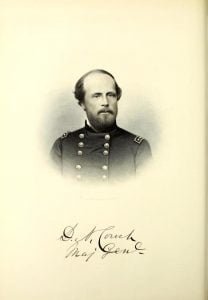
Descendants of Leonard Crocker Couch of Taunton MA

couch

The Couch family of Taunton, represented by Leonard Crocker Couch, traces its lineage back to Simon Couch, a freeman of Connecticut in 1664. Simon’s descendants engaged in various professions and politics, notably producing Maj. Gen. Darius Nash Couch, a distinguished Civil War figure. Leonard Crocker Couch has been a significant presence in Taunton, evolving from a machinist to a businessman. His familial ties extend to prominent families like the Crockers and Leonards, shaping a legacy of community involvement and service across generations.

1923 Historical and Pictorial Directory of Angola Indiana

1923 Angola Indiana Directory Book Cover

Luedders’ historical and pictorial city directory of Angola, Indiana for the year 1923, containing an historical compilation of items of local interest, a complete canvass of names in the city, which includes every member of the family, college students, families on rural lines, directory of officers of county, city, lodges, churches, societies, a directory of streets, and a classified business directory.

Narrative of the Captivity of Nehemiah How

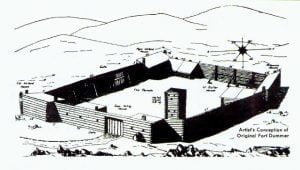
Fort Dummer

A Narrative of the captivity of Nehemiah How, who was taken by the Indians at the Great Meadow Fort above Fort Dummer, where he was an inhabitant, October 11th, 1745. Giving an account of what he met with in his traveling to Canada, and while he was in prison there. Together with an account of Mr. How’s death at Canada. Exceedingly valuable for the many items of exact intelligence therein recorded, relative to so many of the present inhabitants of New England, through those friends who endured the hardships of captivity in the mountain deserts and the damps of loathsome prisons. Had the author lived to have returned, and published his narrative himself, he doubtless would have made it far more valuable, but he was cut off while a prisoner, by the prison fever, in the fifty-fifth year of his age, after a captivity of one year, seven months, and fifteen days. He died May 25th, 1747, in the hospital at Quebec, after a sickness of about ten days. He was a husband and father, and greatly beloved by all who knew him.

Biographical Sketch of Lead Tucker Scofield

Lead Tucker Scofield, born on November 9, 1842, in Cleveland, was the son of architect William Scofield. He served as a lieutenant and later captain in the Civil War. Post-war, he became a prominent architect, contributing to significant structures such as the Cleveland Workhouse and the Cleveland Soldiers and Sailors Monument. Scofield married Elizabeth Clark Wright in 1867 and had sons who also pursued careers in architecture and military service. He was an active member of the community and enjoyed golf.