Abington Massachusetts Birth Records

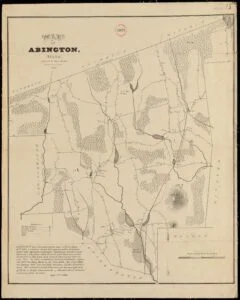
1830 Map of Abington, Massachusetts

Volume 1 of the Abington, Massachusetts vital records details births recorded in the town up to 1850, featuring comprehensive research from town records, cemeteries, and church documents. Established in 1712, Abington’s jurisdictional changes may affect genealogical searches. The records also include separate listings for Black families, primarily by given names. Additionally, various surnames are cataloged, emphasizing the need to consider alternate spellings. For marriages and deaths, researchers should consult Volume 2.

History of Francestown New Hampshire

Map of Francestown New Hampshire

History of Francestown, New Hampshire is a historic and genealogical record of the town from its first settlement in 1758 through the beginning of 1891. It records Francestown’s settlement, civic growth, religious and educational institutions, military participation, industries, and social customs, followed by an extensive genealogical register of families associated with the town.

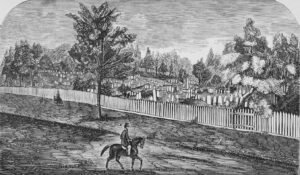
The Old Dutch Burying Ground in North Tarrytown New York

Old Dutch Church Graveyard

This book documents the early gravestones and inscriptions of the Old Dutch Burying Ground in North Tarrytown, New York, focusing on preservation efforts led by William Graves Perry. Commissioned for the church’s 250th anniversary, it records the deteriorating brownstone and marble markers, some dating back to the 18th century. The text highlights the artistry of gravestones and the community’s historical significance. Despite losses, surviving inscriptions are important for understanding the genealogy of early settlers in the area.

The Amidon Family of Rehoboth, MA

The Amidon Family

The Amidon Family genealogy book details the lineage of Roger Amadowne, a French Huguenot who fled to England and later to America after the revocation of the Edict of Nantes. Documented in Salem, Massachusetts in 1637, variations of his surname include Amadon, Amidown, and Ammidon. The work, organized with biographical sketches and two helpful indexes, presents the family’s history and is richly illustrated. Originally published in 1904, it serves as a valuable resource for descendants and historians alike.

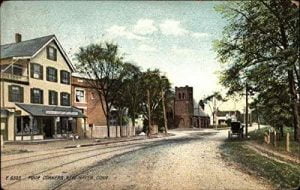
Families of Ancient New Haven

Four Corners New Haven Connecticut

The Families of Ancient New Haven compilation includes the families of the ancient town of New Haven, covering the present towns of New Haven, East Haven, North Haven, Hamden, Bethany, Woodbridge and West Haven. These families are brought down to the heads of families in the First Census (1790), and include the generation born about 1790 to 1800. Descendants in the male line who removed from this region are also given, if obtainable, to about 1800, unless they have been adequately set forth in published genealogies.

Weymouth ways and Weymouth people

Weymouth ways and Weymouth people

Edward Hunt’s “Weymouth ways and Weymouth people: Reminiscences” takes the reader back in Weymouth Massachusetts past to the 1830s through the 1880s as he provides glimpses into the people of the community. These reminiscences were mostly printed in the Weymouth Gazette and provide a fair example of early New England village life as it occurred in the mid 1800s. Of specific interest to the genealogist will be the Hunt material scattered throughout, but most specifically 286-295, and of course, those lucky enough to have had somebody “remembered” by Edward.

Genealogy of Elizabeth Caroline Seymour Brown

Genealogy of Elizabeth Caroline Seymour Brown

Over a period of many years Mrs. Elizabeth Caroline Seymour Brown, early member of Linares Chapter, D.A.R., collected genealogy of her forebears. It was her wish that her work be sent to the library of the National Society, Daughters of the American Revolution. This collection was painstakingly copied, with some additions and corrections, maintaining the same general form as used in the original notes. Elizabeth’s family originated in England moving to New England in the 1600’s. Her family lines involve many of the early lines in Connecticut, Massachusets, and New Hampshire. The families are arranged mostly in alphabetical order, and contain information from a simple direct line descendancy, to more elaborate genealogy.

Major families researched include: Alverson, Arms, Arnold, Ballou, Barden, Barker, Barnard, Bassett, Belden, Benedict, Betts, Blakeslee, Blanchard, Bradstreet, Brigham, Bronson, Buckmaster, Bull, Butterfield, Carpenter, Clark, Clerke, Cooke, Coombs, Cornwall, Corbin, Curitss, Dickerman, Dickson, Doolittle, Downey, Dudley, Eastman, Easton, Errington, Evarts, Fairbank, Foote, Gilbert, Goodrich, Graves, Gregory, Groves, Hale, Hand, Hall, Hawkes, Hawkins, Hills, Holmes, Hopkins, Hoyt, Huitt, Hurd, Keayne, Keene, Lockwood, Lupton, Lord, Manning, Marvin, Mayo, Merriman, Miller, Morris, Morton, Mosse, Moulton, Munger, Needham, Parker, Parkhurst, Potter, Peck, Pettiplace, Purefoy, Priest, Rusco, St John, Scofield, Seymour, Sherman, Smith, Strong, Swinnerton, Symonds, Threlkell, Thorne, Ventriss, Wade, Watson, Weed, White, and Yorke.

Leach Genealogy of Bridgewater, Massachusetts

James Cushing Leach

The Leach family has been integral to Bridgewater, Massachusetts, since its early settlement, with roots tracing back to Lawrence Leach, an immigrant from England in 1629. His descendants, including Giles Leach, a town founder, and James Cushing Leach, a prominent businessman and politician, have significantly influenced the community. The Leach lineage is marked by contributions to public service, education, and local governance, fostering a rich heritage in the region. The genealogy reflects a lineage of resilience and commitment to civic duty, underscoring the family’s enduring legacy.

Descendants of Nicholas Snow of Eastham, MA

snow

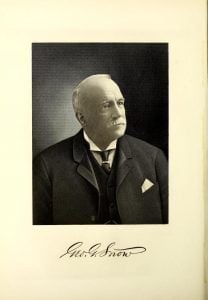
Nicholas Snow, an English settler, arrived in Plymouth in 1623 and later became a vital figure in Eastham, where he served as town clerk and held various civic roles. He married Constance, a Mayflower descendant, and fathered ten children. His lineage continued through his son Stephen and grandson Miijah, leading to notable descendants like Edmund Snow, a town founder in Orleans, and George G. Snow, a successful shoe manufacturer in Brockton. This legacy showcases the Snow family’s influence in early American history.

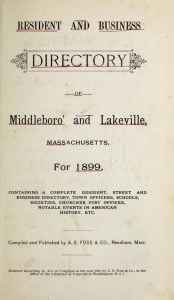
1899 Directory for Middleboro and Lakeville Massachusetts

1899 Middleboro and Lakeville Massachusetts Directory Cover

The 1899 Directory for Middleboro and Lakeville, Massachusetts, compiled by A. E. Foss & Co., provides a comprehensive list of residents and businesses, alongside town officers, schools, churches, and societies. It includes notable historical events and offers a detailed account of the local community, featuring numerous surnames from both towns. This directory serves as an essential resource for understanding the demographics and social structure of Middleboro and Lakeville during that period.

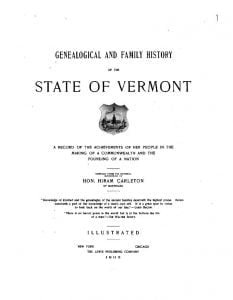
Genealogical and Family History of Vermont

Genealogical and Family History of the State of Vermont vol 1

Hiram Charlton took on the publication of the Genealogical and Family History of the State of Vermont for Lewis Publishing. In it, he enlisted the assistance of living residents of the state in providing biographical and genealogical details about their family, and then he published all 1104 family histories in two distinct volumes.

History of the Methodist Church at Norwich Vermont

Rev. Emanuel C. Charlton

Methodism in Vermont began to establish itself around 1796, with its first society formed in Vershire. The movement saw rapid growth, particularly in the early 19th century. In Norwich, Methodist meetings were initiated by circuit preachers by the early 1810s, leading to the construction of the first church around 1815. The current brick church at Union Village was built in 1836. Over the years, the community has faced population declines, yet the Methodist Episcopal Society of Norwich and Thetford continues to thrive, with about 150 families currently participating.

Biographical Sketch of George Oscar Dickerman

George Oscar Dickerman, born February 13, 1847, in Loudon, N.H., became a prominent wholesale grocer in Concord. He began his career as a bookkeeper and advanced to assistant cashier for the Northern Railroad Company, eventually working as a traveling salesman. In 1887, he established a successful wholesale grocery business. A dedicated Republican, Dickerman served as Alderman and Cemetery Commissioner. He married Mary A. Staniels in 1868 and had two daughters. Active in the Masonic order, he held several esteemed positions within the fraternity and led the Webster Club.