
A Tribal History of the Little Traverse Bay Bands of Odawa Indians

The Little Traverse Bay Bands of Odawa Indians, originally a nomadic group in Michigan, adapted to permanent life due to European settlement, starting businesses and halting migrations. Despite this adaptation, the U.S. Government breached treaty promises, leading to litigation for rightful claims. The Odawa formed influential groups like the Michigan Indian Defense Association and the Northern Michigan Ottawa Association to politically unify and press their rights. Initially lacking federal recognition, the Little Traverse Bay Bands reorganized and were federally recognized in 1994 after relentless advocacy. This achievement honored the 1836 and 1855 Treaties, affirming their sovereign rights and heritage.
Registers of the Parish of Michilimackinac

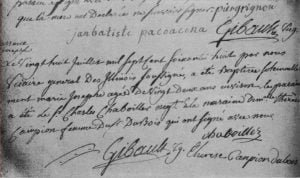
Entry in Mackinac Registry 28 July 1768

The Michilimackinac register, translated by Edward O. Brown in 1889, documents significant events from the parish, such as baptisms, marriages, and burials, though it reveals substantial gaps due to a lack of clergy and the shifting loyalties of residents. Notably, records from 1760-1790 are sparse, coinciding with notable historical events in the region. The register provides valuable insights into the community’s demographics and connections, including adoptions and illegitimate births, while also highlighting challenges in record-keeping during certain periods.

A Short History of Michilimakinak

Mackinac, known by various names such as Michilimakinak and Fort Michilimakinak, served as a crucial outpost for French fur traders in the Great Lakes region. Established in the 17th century and linked to Father Jacques Marquette, the mission of St. Ignace influenced local Native American tribes. The fort played a vital role in the fur trade, shifting between British and American control. Despite challenges, including the sale of alcohol to Native Americans, Mackinac remained an important commercial center until the mid-19th century.

Register of Interments in the Parish of Michilimackinac

The register of interments for Michilimackinac indicates a less meticulous record than that of marriages and baptisms. Entries span from 1743 to 1806, with early records by Father Le Franc beginning in 1754. Notably, various individuals, including children and slaves, are documented with their burial details, often highlighting the sacraments received prior to death. The register reflects a community’s religious practice and social fabric, with scattered entries compiled chronologically to provide a clearer historical account of interments at this mission.

Miscellaneous Notes In The Mackinac Registers

The Mackinac Register includes various entries related to church affairs, notably the elections of church wardens for Ste. Anne de Michilimakina. Noteworthy figures such as Charles Chaboillez and Daniel Bourassa were elected in 1787, committing to oversee the church’s interests. In 1821, new appointments were made, including William McGulpine and John Dousman, alongside instructions to manage church property and seek land for a new stone church. The records reflect the evolving religious governance within the community over the years.

Register of Baptisms In The Parish Of Michilimackinac

The document is a transcription of the Register of Baptisms from the Mission of St. Ignace de Michilimakinak, covering entries from 1695 to 1741. It includes names and dates of baptism, with additional notes about individuals’ statuses and later life events. The transcription reflects an effort to condense the original format for clarity, maintaining essential details while omitting repetitive information. The entries serve as a key historical record for understanding the early population and religious practices of the Michilimackinac area.

Mackinac Baptism Records 1810-1821

Between 1804 and 1821, no baptisms were recorded in Mackinac due to the absence of a priest, although evidence suggests a priest may have visited in 1818. Following the British retreat after the Treaty of Ghent in 1815, a military post was established on Drummond Island. Baptisms resumed in 1821, conducted by Gabriel Richard, parish priest of Ste Anne du Detroit. The records list numerous conditional baptisms, detailing the names, parentage, and godparents, reflecting the diverse community around Mackinac during this period.

Mackinac Baptism Records 1800-1809

Between January and July 1804, numerous individuals from the Saulteux nation and mixed heritage families were privately baptized under the oversight of missionary priests in Michilimackinac. Notable entries include the baptism of Marie Louise, Marie, and Joseph, among others, with varying ages and familial backgrounds. The ceremonies involved godfathers and godmothers, many of whom were local community members. Several entries also noted the parents’ presence and the capacity limitations in signing their names. This collection provides valuable insight into the early religious practices and familial structures of the region.

Mackinac Baptism Records 1790-1799

The Mackinac Baptism Records from 1790 to 1799 provide a detailed account of numerous baptisms officiated by various priests, mainly in Michilimackinac. Notable entries include the baptisms of Michel Bourassa, Therese Victoire Barthe, and several children of Native American and mixed heritage. The records reflect familial structures and cultural practices of the time, often noting the lawful marriages and conditions of the parents. Each entry uniquely identifies the child, their parents, and their godparents, marking the intersection of European and Native American ecclesiastical traditions.

Mackinac Baptism Records 1780-1789

The Mackinac Baptism Records from 1780 to 1789 chronicle the ceremonial baptisms conducted by priests in the region, documenting the births of children from various backgrounds, including French settlers and Indigenous families. Notable entries include the baptism of Domitille, daughter of Charles Gautier, and several natural children from unions across cultural lines. Each record details the child’s name, parents, godparents, and the officiating priest, providing a glimpse into the diverse community and religious practices of the time.

Mackinac Baptism Records 1770-1779

The records document various baptisms conducted primarily by missionary priests at Michilimakina between 1770 and 1778. Significant entries include the private baptism of Charles Sanguinet and Veronique Cardin’s daughter in 1770 and multiple baptisms of children from the marriages of Louis Demouchelle and Joseph Laurent Bertrand. Each entry details the child’s birth date, parents, godparents, and the officiating priest. Notably, many fathers were unable to sign their names, indicating their illiteracy. These records reflect both individual family histories and the broader religious practices of the time.

Mackinac Baptism Records 1760-1769

Between 1760 and 1769, a series of baptism records were documented by clergy of the Society of Jesus at Mackinac. Notable entries include the baptism of Charlotte, a 14-year-old girl, and several children from various backgrounds, including enslaved individuals and Native Americans. The records indicate the involvement of local traders and their family members as godparents. Noteworthy is the baptism of Ignace in June 1763, the first recorded after the Pontiac conspiracy, highlighting the socio-religious dynamics of the region during this period.

Mackinac Baptism Records 1755-1759

Between 1755 and 1759, numerous baptisms were performed by missionaries of the Society of Jesus at Michilimackinac. The records detail the baptism of both free individuals and slaves, including children and adults, with prominent figures often serving as godparents. Key entries include the baptisms of Charle Louis Bourassa, Joseph Ketchinape, and various catechumens from different tribes. The ceremonies reflect the cultural and social dynamics of the time, highlighting the blend of indigenous and French colonial influences in religious practices.

Mackinac Baptism Records 1750-1754

Between March 1750 and September 1754, numerous baptisms were recorded by P. du Jaunay and other Jesuit missionaries in Mackinac, reflecting the diverse population of the area, including both free individuals and slaves. Notable baptisms included those of Basile, a slave child, and Jean François Regis, a young slave, as well as several children born to local French families. Godparents often held significant positions, highlighting social structures. This period illustrates the intersection of faith, community, and the complex realities of colonial life in early North America.

Mackinac Baptism Records 1745-1749

Between February 1745 and November 1749, numerous baptisms took place at the mission in Mackinac, reflecting the community’s blend of French and Indigenous influences. Notable entries include baptisms of children born to local residents and engaging with families from the surrounding areas, as well as the inclusion of individuals of Indigenous descent. Godparents often included local officials, indicating the interconnectedness of the community. The records highlight both the spiritual significance and social structure of the time, encapsulating a diverse, evolving society.

Mackinac Baptism Records 1742-1744

Between 1741 and 1744, numerous baptisms were conducted by priests of the Society of Jesus at the mission of St. Ignace in Michilimakinak. The records detail the baptisms of infants, children, and adults, including both indigenous and enslaved individuals. Notable entries include the baptism of Louis Joseph Chaboyer and several others, with specified godparents. These records reflect the religious practices and community structure of the period, highlighting the roles of missionaries and local residents in the sacrament of baptism.

Mackinac Marriage Records 1821

On August 11, 1821, William McGulpin and Madeleine Bourassa had their marriage validated by Gabriel Richard, a parish priest, following a certificate from justice of the peace Samuel Abbott. They acknowledged three legitimate children. Additionally, on the same date, John and Rosalie Dousman, along with Francois Paget and Celeste Reed, also had their marriages validated in the presence of witnesses, each recognizing their respective children. These records reflect the community’s adherence to Roman Catholic marriage rites in Mackinac during this period.

Mackinac Marriage Records 1800-1804

Between January 1800 and July 1804, several marriage consents were recorded by Adhemar St. Martin and J. Dilhet, justices of the peace and missionary priests at Mackinac. The records include individuals of both French and Sauteux descent, with many couples unable to sign their names and instead marking their consent. Notable marriages include those of Louis Hamelin to Marie Louise and Jacques Chauvin to Angelique, among others. The ceremonies often involved witnesses and varied in the required publication of bans, reflecting the diverse community in the region.

Mackinac Marriage Records 1790-1799

Between 1792 and 1799, several marriage consents were recorded at Michilimakinac, highlighting the diverse community of that period. Notable figures included Jean Baptiste La Borde, Alexis Laframboise, and various local residents and officials like Adhemar St. Martin and Father Gabriel Richard. Marriages involved individuals of European and Indigenous descent, with witnesses often comprising local dignitaries and families. These records illustrate the social fabric of Mackinac during a transformative era, as both French and British influences shaped the region’s culture and community dynamics.

Mackinac Marriage Records 1780-1789

Between 1781 and 1787, several marriages were solemnized at Mackinac, reflecting its diverse community and the interplay between civil and religious practices. The first recorded marriage, between Thomas Stone and Margaret Paterson, was officiated by Patrick Sinclair, marking a significant moment in Mackinac’s early history. Subsequent marriages included both French and Indigenous couples, highlighting the region’s cultural interactions. These ceremonies were conducted under various jurisdictions, with the signatures of notaries and witnesses affirming the community’s commitment to these unions.