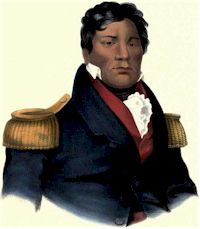
1817 Reservation Roll: Eastern Cherokee
A listing of 311 Cherokees claimants applying for a 640 acre tract in the East in lieu of removing to Arkansas. This was only good during their lifetime and then the property reverted back to the state.
In 1896-1897 the Kern-Clifton Roll was created to fill in the omissions of the Wallace Roll. Genealogists not finding their Cherokee ancestor in the Kern-Clifton Roll, should search the Wallace Roll to insure that this ancestor was not one of those originally identified by the John Wallace census. This census of the Freedmen and their descendants of the Cherokee Nation taken by the Commission appointed in the case of Moses Whitmire, Trustee of the Freedmen of the Cherokee Nation vs. The Cherokee Nation and the United States in the Court of Claims at Washington, D. C., the said Commission being composed of William Clifton, William Thompson and Robert H. Kern, the same being made from the testimony taken before said Commission in the Cherokee Nation between May 4th and August 10th, 1896.
The Dawes Act, also known as the General Allotment Act, implemented in 1887, aimed to allot tribal lands to individual Native Americans in order to promote agriculture and integrate them into American society. Each head of a family could receive a quarter section of land, while single individuals and orphaned children received smaller allotments. The act allowed for the federal government to manage the land in trust for 25 years, after which land ownership would be transferred to the individual. However, significant limitations were imposed on tribes, and it excluded certain groups, ultimately leading to the loss of millions of acres of tribal land.
The Drennen Rolls are the first census of Cherokee arrivals in 1839 after the Trail of Tears, documenting per-capita payments to Cherokees living in the West under the 1835 treaty. Prepared by John Drennen, the roll lists names, districts, and family groups, and may include enrollment application numbers in the notes.
The final roll of the Eastern Cherokee, prepared by United States Agent Fred A. Baker, pursuant to an act of the 68th Congress, (43 stat., 376), June 4, 1924. Before preparation of this roll, the Act required that all land, money, and other property of the Tribe be transferred to the United States for final disposition. Termination of the Tribe as a government and political entity was the ultimate goal. After termination efforts failed, the Tribe continued to use the 1924 Baker Roll as its base roll. Descendants of those persons of the original Baker Roll are enrolled on the Baker Revised Roll, providing they meet the membership requirements of the Tribe.

Search and understand the Armstrong Rolls as they relate to your Choctaw ancestor. Each Choctaw head of a family being desirous to remain and become a citizen of the States, shall be permitted to do so, by signifying his intention to the Agent within six months from the ratification of this Treaty, and he or she shall thereupon be entitled to a reservation of one section of six hundred and forty acres of land, to be bounded by sectional lines of survey; in like manner shall be entitled to one half that quantity for each unmarried child which is living with him over ten years of age; and a quarter section to such child as may be under 10 years of age, to adjoin the location of the parent. If they reside upon said lands intending to become citizens of the States for five years after the ratification of this Treaty, in that case a grant in fee simple shall issue; said reservation shall include the present improvement of the head of the family, or a portion of it. Persons who claim under this article shall not lose the privilege of a Choctaw citizen, but if they ever remove are not to be entitled to any portion of the Choctaw annuity.
A List of Choctaw Claims allowed in Nitachacha District in the treaty made at Dancing Rabbit creek on the 25th September 1830.
A September 7, 1831 true copy of Choctaw claims in Mingo Mushulatubbe’s District lists names, acreage, and outcomes such as relinquished, sold, kept, or provided for in treaty. Compiled by Special Agent F. W. Armstrong, the record documents land claims, captains’ allowances, cultivation rights, and transfers to individuals including Grant and Clement.