
Certificate to Franklin D. Love from Dr. E.S. Miller

In a certificate dated April 11, 1902, Dr. E.S. Miller attests that Col. Robert Love expressed his wish for his youngest child, Franklin D. Love, to inherit his watch before his death in 1876. The watch, a Swiss-made piece, holds significant familial value and was originally purchased by Robert Love and his brother-in-law. Franklin sought this certificate to clarify any misunderstandings regarding his father’s intentions, ensuring his rightful ownership of the watch, which he continues to wear.
Robert Love and Sarah Matilda Alexander – Descendants

Robert Love, born April 25, 1819, in East Tennessee, was the fourth son of Thomas Dillard Love and Anna Taylor. He married Sarah Matilda Alexander on May 25, 1848, and they had ten children before her death on October 13, 1871. Robert Love died on September 1, 1876. Their descendants include notable figures such as Anna Elizabeth Love, who raised her siblings, and Franklin Deaderick Love, who moved to Texas. Both Robert and Sarah are interred in Oak Hill Cemetery, Johnson City, Tennessee.

Alfred Wilson Taylor and Elizabeth Duffied – Descendants

The descendants of Alfred Wilson Taylor and Elizabeth Duffield include notable family members such as William Carter Taylor, who lived on the family homestead; Nathaniel Macon Taylor, a prominent lawyer with several children; and George Duffield Taylor, who served as a guardian for his siblings. Other descendants faced various fates, from early deaths to military service during the Civil War, aligning politically with the South while another branch leaned toward the North. The family’s history is intricately woven into the broader narrative of Tennessee’s past.

Ganum O. McBee and Salla Bell Love – Descendants

In a letter dated April 5, 1903, Robert Love McBee writes to F.D. Love regarding the genealogy of the Love family. He notes that his parents, Ganum O. McBee and Salla Bell Love, likely married in January 1821 and had nine children, detailing their births and marriages. Robert expresses concern about his declining health and comments on the absence of a likeness of his wife, reflecting on the inevitability of their reunion.

John Isaac Love – Notes on the Will

John Isaac Love, son of Thomas Dillard Love, passed away in Charleston, S.C. He left a will stipulating that his brother, R. Love, inherit his personal and landed estate, contingent upon the sale of the property. R. Love is obligated to pay his nephew, R.L. Dulaney, $500 at age 21, or the bequest becomes void. Additionally, he must contribute $500 to the American Bible Society when convenient. John I. Love was esteemed for his scholarly contributions and assisted historian Ramsey in compiling the Annals of Tennessee.

Dillard Love – Contents of Will (5 Oct 1869)

Dillard Love’s will, drafted on October 5, 1869, in Macon County, North Carolina, bequeathed most of his property to John Ingram, along with lands in Tennessee to William and Robert Ingram. He also allocated personal property to Mary Allman, Nancy L. Guinn, and Austin Guinn. Love requested tombstones for himself and his family, buried at the Methodist Episcopal Church South graveyard near Franklin. The will did not face opposition from the Love family, despite rumors of questionable associations with certain beneficiaries.

Asheville, North Carolina History

This excerpt from the Asheville Daily Citizen of 1898 details the early history of Asheville, focusing on the establishment of the town’s public square and key figures involved in its development, such as Thomas Love and Thomas Foster. The narrative notes the formation of the Buncombe County Court and highlights early settlements after the Revolutionary War, particularly around the Swannanoa River. It also mentions Thomas Foster’s contributions, including his role in local governance and the construction of infrastructure, offering insight into the community’s formative years.

Robert Love – Revolutionary War Pension Records

The Bureau of Pensions confirmed the military history of Robert Love, a Revolutionary War soldier, who served multiple terms from 1778 to 1782. Initially enlisted as a sergeant, he attained the rank of lieutenant over the years, participating in numerous skirmishes. Love resided in Montgomery County, Virginia, at enlistment and later applied for a pension in Waynesville, North Carolina, in 1833 at age 73. His claim was approved, and details about obtaining official records are provided for genealogy purposes.

Slave Narrative of Prince Johnson

Prince Johnson recounts his life as a slave in Mississippi, detailing his family’s journey from Alabama to Yazoo County under the ownership of the Love family, later becoming Johnsons after the young mistress’s marriage. He describes daily life, work, and relationships on the plantation, emphasizing the community’s resilience and the quality of their subsistence. Post-Civil War, he reflects on freedom, voting, and the social dynamics of the time, while expressing nostalgia for his former master and the order he provided. Johnson ultimately highlights his success as a farmer and community member.

Slave Narrative of Matilda Poe

Matilda Poe, at 80 years old, reflects on her life as a slave on Isaac Love’s plantation in Indian Territory, where conditions were relatively favorable. The Love family, particularly Isaac, treated the enslaved population well, ensuring they had ample food and limited heavy labor. Despite the cruelty of an overseer, Matilda’s memories include joyful times, religious gatherings, and community. After the war, she recalls gaining her freedom and moving to Texas with her family, expressing a fondness for notable historical figures.

Slave Narrative of Mary Lindsay

Mary Lindsay, born in 1845, recounts her experiences as a slave in Oklahoma. Raised in a family of slaves on a Chickasaw farm, she faced hardships from illness and labor. After the war, Mary was freed but remained with her former mistress for necessities. Eventually, she left to reunite with family, marrying Henry Lindsay and settling in the Creek Nation. Her narrative reflects the struggles and resilience of African Americans during and after slavery, alongside the complexities of life in a changing society.

Slave Narrative of Annie Hawkins

Annie Hawkins, a 90-year-old former slave from Colbert, Oklahoma, recounts her harrowing experiences of slavery, marked by cruelty and hardship under her master, Dave Giles. She describes the relentless labor, abuse, and the meanness of both her master and mistress, including severe punishment inflicted on her family. Despite harsh conditions, she recalls moments of relief, like attending church. After the war, she felt overwhelming joy upon gaining freedom. Hawkins shares the loss of her husbands and children, highlighting a life of resilience amidst suffering.

Biography of Charles Reynolds Love

Charles Reynolds Love, born August 23, 1848, in Pennsylvania, was a prominent Topeka businessman known for his generosity and strong character. He moved to Kansas in the late 19th century, initially living on a farm before transitioning to a successful career in wall paper and interior decorating in Topeka. A devoted family man and community member, Love was involved in various fraternal organizations and the Methodist Church. He passed away on April 15, 1910, leaving a legacy of kindness and business acumen, along with his daughter, Bertie, who also contributed significantly to society.

Love, Donald – Obituary

Donald Raymond Love, the 10-day-old son of Mr. and Mrs. Donald F. Love, passed away in St. Elizabeth Hospital. He is survived by his parents, grandparents, great-grandparents, and several aunts and uncles. Graveside services are scheduled for Wednesday at 3:30 p.m. in Mt. Hope Cemetery, led by Rev. W. W. DeBolt, with arrangements made by Beatty Chapel.

Surnames Kelly to Love

This document contains genealogical statements regarding various individuals and families of Creek, Choctaw, Chickasaw, and Mississippi Choctaw descent who sought recognition and enrollment in tribal rolls. The records, primarily from 1909 reports, detail claimants’ ancestry, enrollment issues, and tribal affiliations. Many individuals were denied enrollment due to factional disputes, legal technicalities, or failure to apply within deadlines. The document includes references to official reports and affidavits, offering insights into the complexities of Native American citizenship and land rights during the early 20th century.

Frank H. Love, Choctaw

The Frank H. Love case involved the enrollment of six children as Choctaws by blood, based on their mother, Lorena Frazier Love, a full-blood Choctaw. Despite evidence, including tribal recognition of Lorena’s family and her documented Choctaw ancestry, the Dawes Commission denied enrollment in 1904, citing lack of official records. Witnesses testified about Lorena’s upbringing, Choctaw lineage, and marriage to Willis Love, yet the Department of the Interior upheld the denial.

Rough Riders

Rough Riders

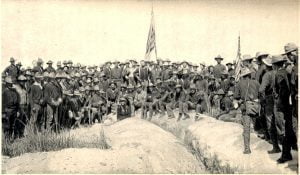
The compiled military service records of 1,235 Rough Riders, including Theodore Roosevelt, have been digitized. Each record features individual jackets detailing the soldier’s name, organization, rank, and medical records. The records also contain personal information and documentation descriptions. Discharges occurred for various reasons, such as age, ability, discipline issues, or hardship. This initiative provides significant insights into the personnel of the 1st U.S. Volunteer Cavalry during the Spanish-American War.