Guion Miller Application of Elijah Eaves
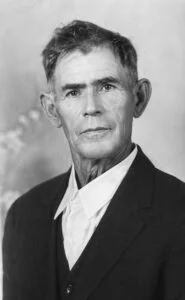
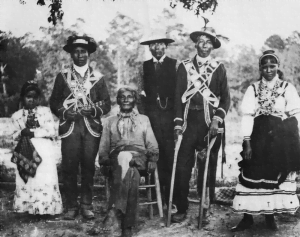
Photograph of Elijah Eaves

The application of Elijah Eaves, rejected under the Guion Miller Roll, involved claims from descendants of Alexander Brown, who was recorded on the 1835 Cherokee roll. Evidence presented indicated complications regarding the applicants’ heritage, including conflicting testimonies about Brown’s residency and tribal affiliation. No descendants were enrolled or received government benefits, raising doubts about their connection to the Cherokee. Despite claims of descent through Alexander Brown, all applications were ultimately rejected due to insufficient proof of lineage and tribal membership.
Indian Warfare Between Texas and Mexico

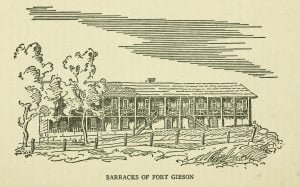
Barracks of Fort Gibson

In 1836, Major Chouteau explored the region between the Red River and the Colorado River, encountering numerous Comanche, Kiowa, and Kiowa Apache camps during their buffalo migration. Despite initial suspicion, he engaged in discussions with tribal leaders, ultimately facilitating a treaty in May 1837, aimed at peace among the tribes and protection for traders. However, amidst rising tensions due to Mexican influence and Indian warfare, further conflicts loomed, highlighting the precarious nature of relations between the tribes and the encroaching settlers in Texas.

Governor Stokes’s Uncompleted Plans

In March 1836, Governor Stokes became the sub-agent for the Cherokee, Seneca, and Shawnee tribes at Fort Gibson, receiving a modest salary of $750 annually. He faced numerous challenges, including a cramped office space and subordination to a disbursing officer, complicating his relations with the tribes. Stokes advocated for the rights of the Half-Breed reserves of the Osage Nation but struggled to secure assistance for them. Despite his dedication, his term ended without reappointment, and he passed away in November 1842, leaving a significant legacy.

Marriages of Charlotte County Virginia, 1784-1815

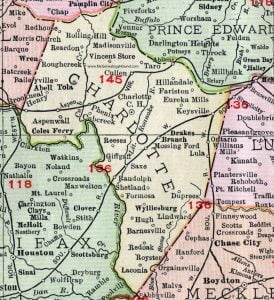
1911 Map of Charlotte County Virginia

This volume, “Marriages of Charlotte County, Virginia, 1784-1815,” compiles the marriage bonds and minister’s returns from Charlotte County during the specified period. The original work was painstakingly copied by Catherine Lindsay Knorr and published in 1951. The book spans 119 pages and includes a wealth of historical data on marriages that took place in this Virginia county. This publication presents several challenges for readers. Some pages are slightly tattered and torn, and the manuscript features irregular pagination. Additionally, there are tight or nonexistent margins, particularly at the bottom of the pages, and one page is typed on different paper than the rest.

Wistar Family: A Genealogy of the Descendants of Caspar Wistar, Emigrant in 1717

Wistar Family title page

The book “Wistar Family: A Genealogy of the Descendants of Caspar Wistar, Emigrant in 1717” delves into the fascinating history of the Wistar family, tracing its roots back to Caspar Wistar, who was born on February 3, 1696, to Hans Caspar and Anna Catharina Wüster in Hilspach, near Heidelberg in the Electorate of the Rhenish Palatinate. Caspar’s father served as a huntsman or forester for the Prince Palatine, a position that was hereditary in their family.

The Wilson Family, Somerset and Barter Hill Branch

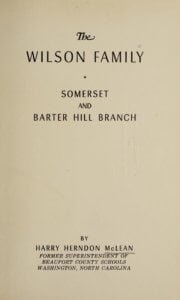
The Wilson family, Somerset and Barter Hill branch

In the preparation of “The Wilson family, Somerset and Barter Hill branch” I have discovered two lists of the names of the sons and daughters of Col. Ben and Ann Seay Wilson of “Somerset” in Cumberland County, Virginia, in addition to the list found in my father’s notes. None of these was arranged in the same chronological order. It was my good fortune in 1915 to find the Bible, claimed to be the Bible of Col. Ben and Ann Seay Wilson of “Somerset” in Cumberland County, Virginia. At that time this was in the hands of Miss Clementine Reid Wilson, Col. Ben’s great-granddaughter, and it was my privilege to copy, with the aid of a reading glass, for the ink was badly faded, the names of their children from that Bible in the same chronological order in which they were recorded. This chronological order, and military records found, support each other. I therefore believe that this sketch contains the most accurate chronological list of Col. Ben’s and Ann Seay Wilson’s children to be found outside of his Bible.

A Genealogy of the Lake Family

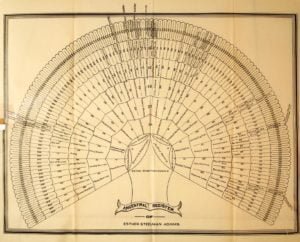
Ancestor Register of Esther Steelman Adams

A genealogy of the Lake family of Great Egg Harbour in Old Gloucester County in New Jersey : descended from John Lade of Gravesend, Long Island; with notes on the Gravesend and Staten Island branches of the family. This volume of nearly 400 pages includes a coat-of-arms in colors, two charts, and nearly fifty full page illustrations – portraits, old homes, samplers, etc. The coat-of-arms shown in the frontspiece is an unusually good example of the heraldic art!

Henry County Alabama Biographies

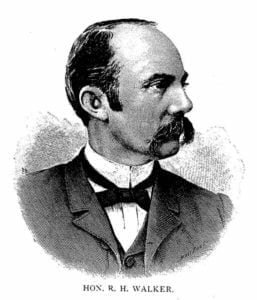
Hon Robert H. Walker

The list includes 59 notable individuals from Henry County, Alabama, whose biographies are accessible online or in print. Among them are figures such as William B. Aycock, Joseph Baker, and John F. Dawsey, each contributing to the county’s rich history. The biographical details highlight their diverse backgrounds and accomplishments, providing a glimpse into the lives that shaped the community. Click on their names for a deeper exploration of their legacies in Henry County.

The Stokes Treaty Commission

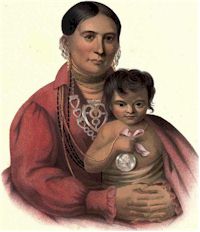
Mohongo

The Arkansas Osage, relocated from their old home to the Verdigris, faced significant challenges in their adjustment and governance. Initially lacking an agent until 1822, they experienced several leadership changes due to tragic events, such as Nathaniel Philbrook’s drowning. Frequent conflicts necessitated annual conferences, culminating in treaties with the Creeks and Cherokees in 1831. The 1833 commission, led by Governor Stokes, sought to establish peace and reassign boundaries between tribes, but faced persistent opposition from influential Osage leaders like Clermont, complicating negotiations amid severe hardship within the tribe.

Governor Houston at His Trading Post on the Verdigris

Surrender of Santa Anna

In February 1828, Colonel Brearley led the Creek immigrants to the Verdigris, following governmental commitments from the 1826 treaty. During this time, Samuel Houston, a former U.S. Army officer and politician, was redefining his life among the Cherokee. After abandoning his political career and personal troubles, he became deeply involved with the Cherokee, adopting their customs and language. Houston’s influence grew as he criticized corrupt Indian agents and sought to improve conditions for Native Americans, eventually being adopted into the Cherokee tribe in 1829.

Western Garrison Life

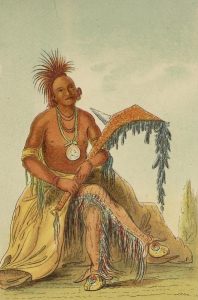
Clermont, Osage Chief

Holland Coffee, a trader at Fort Smith, led a trading expedition into western Indian territories alongside Robert M. French. They set up a trading post near the Red River, at the old Pawnee village, aiming to capitalize on friendly relations established by Colonel Dodge with western tribes. Despite challenges, including unrest among the tribes regarding treaty assurances, a significant conference was held at Fort Gibson in 1835, resulting in the first treaty with western prairie tribes, crucial for U.S. plans to relocate eastern Indians.

Fort Gibson Conference with the Indians, 1834

Catlin Painting a Chief at the Base of the Rocky Mountains

In September 1834, Colonel Dodge convened a significant council at Fort Gibson with chiefs from various tribes, including the Osage, Cherokee, and Kiowa, following earlier negotiations with the Comanche and others. More than 150 representatives attended amidst an atmosphere of curiosity and caution. The conference aimed to solidify peace and arrange future treaties, which were essential for the U.S. expansion into the Southwest. Despite the potential for violence, Dodge successfully navigated tensions, ensuring safe resolutions and presenting gifts to symbolize friendship.

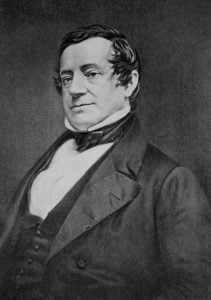
Washington Irving at Fort Gibson, 1832

Irving Washington

The McIntosh Creeks established productive farms along the Arkansas River, but their land was mistakenly included in the 1828 treaty with the Cherokee, leading to tensions and grievances. The Creeks petitioned the government for aid against attacks from other Indian bands. In response, Congress set up a commission to address these issues, appointing three commissioners, including Montford Stokes. Eventually, Washington Irving joined the commission’s journey from St. Louis to Fort Gibson, experiencing the rich tapestry of frontier life and the challenges faced by the tribes.

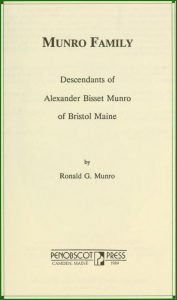
Descendants of Alexander Bisset Munro of Bristol, Maine

Munro Family

Alexander Bisset Munro was born 25 Dec. 1793 at Inverness, Scotland to Donald and Janet (Bisset) Munro. Alexander left Scotland at the age of 14, and lived in Dimecrana in the West Indies for 18 years. He owned a plantation, raising cotton, coffee and other produce. He brought produce to Boston Massachusetts on the ship of Solomon Dockendorff. To be sure he got his money, Solomon asked his to come home with him, where he met Solomon’s sister, Jane Dockendorff. Alexander went back to the West Indies, sold out, and moved to Round Pond, Maine, and married Jane. They had 14 children: Janet, Alexander, Margaret, Nancy, Jane, Mary, Solomon, Donald, John, William, Bettie, Edmund, Joseph and Lydia.

1923 Historical and Pictorial Directory of Angola Indiana

1923 Angola Indiana Directory Book Cover

Luedders’ historical and pictorial city directory of Angola, Indiana for the year 1923, containing an historical compilation of items of local interest, a complete canvass of names in the city, which includes every member of the family, college students, families on rural lines, directory of officers of county, city, lodges, churches, societies, a directory of streets, and a classified business directory.