History of Rindge New Hampshire

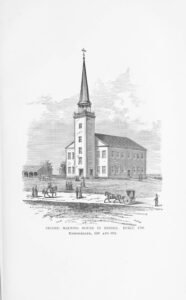
Second Meeting House in Rindge New Hampshire

The History of the Town of Rindge, New Hampshire by Ezra S. Stearns, was published in 1875, and covers the period from the original Rowley Canada grant or Massachusetts charter through the year 1874. Stearns traces the legal, territorial, and institutional development of Rindge, beginning with colonial land grants and boundary disputes and proceeding through settlement, incorporation into a town and development into a small manufacturing hub. More than half the volume is devoted to genealogical material. The genealogical register of Rindge families includes thousands of names compiled from a wide range of sources and assisted by contributions from residents and researchers beyond the town.

Vital Records of Sheffield Massachusetts, 1733-1792

Map of Sheffield, Harstville, Southfield and New Marlborough Massachusetts

The vital records of Sheffield, Massachusetts from 1733 to 1792 detail the town’s historical births, marriages, and deaths. While names and dates are transcribed accurately, some wording has been abbreviated for clarity. Marriage records often specify the union of couples, while birth records typically include parental names. Notably, some families lack marriage entries, starting instead with a child’s birth. The records also document a few out-of-wedlock births, emphasizing lineage through parental names, even in adult death records.

Medway Massachusetts vital records

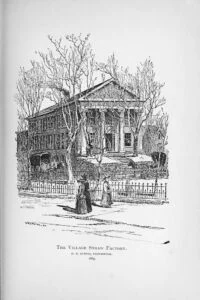
Medway Village Straw Factory

Alphabetical indexes to the vital records of Medway, Massachusetts, up to the year 1850, supplemented by information from church registers, cemetery inscriptions and other private sources to include Rev. Dr. Jacob Ide’s account of Marriages and Deaths, 1814-1849.

History of Amherst New Hampshire

Residence of Isaac Brooks in Amherst New Hampshire

The history of Amherst, New Hampshire, unfolds from its 1675 land grant to veterans of the Narraganset War, marking the impetus for settlement along the Souhegan River. From its early governance and incorporation in 1760 to territorial adjustments that birthed Mont Vernon and Milford, this narrative encompasses local geography, economy, and Indigenous presence. Key military engagements, civic institutions, and genealogical records are explored up to 1882, offering a comprehensive view of the town’s evolution and its prominent figures.

Families of Ancient New Haven

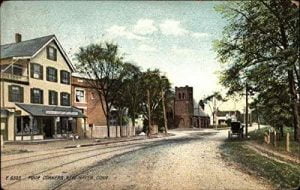
Four Corners New Haven Connecticut

The Families of Ancient New Haven compilation includes the families of the ancient town of New Haven, covering the present towns of New Haven, East Haven, North Haven, Hamden, Bethany, Woodbridge and West Haven. These families are brought down to the heads of families in the First Census (1790), and include the generation born about 1790 to 1800. Descendants in the male line who removed from this region are also given, if obtainable, to about 1800, unless they have been adequately set forth in published genealogies.

Descendants of Samuel Wright of Lenox, Massachusetts

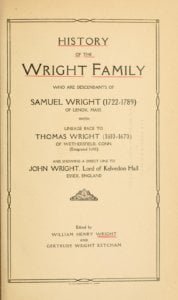
History of the Wright family, who are descendants of Samuel Wright (1722-1789) of Lenox, Mass., with lineage back to Thomas Wright (1610-1670) of Wethersfield, Conn., (emigrated 1640), showing a direct line to John Wright, Lord of Kelvedon Hall, Essex, England

The “History of the Wright Family” by William Henry Wright and Gertrude Wright Ketchum provides a detailed genealogical account of the descendants of Samuel Wright of Lenox, Massachusetts, tracing their lineage back to Thomas Wright of Wethersfield, Connecticut, and further to John Wright of Kelvedon Hall, Essex, England. This book is a meticulous endeavor to document the lives and movements of a family whose roots reach deep into both American and English soil, showcasing their significant transitions from the early 17th century to the late 19th century. Through painstaking research involving local records, pension applications, and family memorabilia, the authors piece together the lives of their ancestors, revealing a rich tapestry of historical and personal significance that bridges continents and centuries.

A Genealogy of the Lake Family

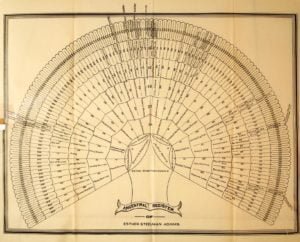
Ancestor Register of Esther Steelman Adams

A genealogy of the Lake family of Great Egg Harbour in Old Gloucester County in New Jersey : descended from John Lade of Gravesend, Long Island; with notes on the Gravesend and Staten Island branches of the family. This volume of nearly 400 pages includes a coat-of-arms in colors, two charts, and nearly fifty full page illustrations – portraits, old homes, samplers, etc. The coat-of-arms shown in the frontspiece is an unusually good example of the heraldic art!

Progressive Men of Western Colorado

Early Life in Colorado

This manuscript, in its essence, is a collection of 948 biographies of prominent men and women, all leading citizens of Western Colorado. In this context, Western Colorado encompasses the counties of Archuleta, Chaffee, Delta, Eagle, Garfield, Gunnison, Hinsdale, La Plata, Lake, Mesa, Mineral, Moffat, Montezuma, Montrose, Ouray, Pitkin, Rio Blanco, Routt, San Juan, and San Miguel.

Upper Otorara Presbyterian Church Records, Chester County PA

Upper Octorara Church, Erected in 1840

Provides records for the Upper Otorara Presbyterian Church in Chester County, Pennsylvania. Many early members are mentioned by names. Includes many drawings of the church, as well as the history of the church. Includes transcriptions of both cemeteries for the church.

1899 Directory for Middleboro and Lakeville Massachusetts

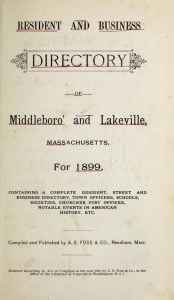
1899 Middleboro and Lakeville Massachusetts Directory Cover

The 1899 Directory for Middleboro and Lakeville, Massachusetts, compiled by A. E. Foss & Co., provides a comprehensive list of residents and businesses, alongside town officers, schools, churches, and societies. It includes notable historical events and offers a detailed account of the local community, featuring numerous surnames from both towns. This directory serves as an essential resource for understanding the demographics and social structure of Middleboro and Lakeville during that period.

Humboldt Mining Company

The Humboldt Mining Company, established in 1881 by Horose Sloan and others, oversees 320 acres near Canyon City known for its gold-rich old river channel. Previously worked since 1862, it averages nearly a million dollars in annual yield. The company has developed an 8½-mile ditch with a 1,000-inch water capacity and implemented advanced equipment, including giant hydraulic machinery and extensive piping. General manager Ira Sproul guides operations, which encompass significant adjacent creek bottom areas.

Biographical Sketch of James E. Sloan

James Ellis Sloan, born on January 7, 1894, to Edward E. and Naomi Sloan, was educated in local schools in Delaware. He married Gillie May Carroll on December 1, 1917, with whom he had three daughters: Percilla, Naomi, and Dorris. A veteran of World War I, Sloan enlisted on September 3, 1918, and served until January 7, 1919. Gillie May was the daughter of John M. and Mary C. Carroll, linking the families through generations.

Biographical Sketch of Samuel J. Sloan

Samuel John Sloan, born on March 1, 1889, to Edward Estel and Naomi Ann (Cole) Sloan, grew up in Vinita and later married Ruth McKissick on October 13, 1908. The couple had two sons, Samuel Floyd and Charles Herbert. Although trained as an electrician, Samuel John currently engages in farming near Big Cabin. His family lineage includes notable relatives, such as Deborah Starr and her son Edward Estel Sloan, who also plays a role in the family’s narrative.

Biographical Sketch of M.L. Sloan

M.L. Sloan, born in 1848 in Harrison County, Ohio, moved to Iowa in 1866 and settled in Sioux City in 1870, where he began his career as a clerk in the auditor’s office. He was elected county auditor of Woodbury County in 1877. Sloan married Ida M. Hill in 1875 and they had two daughters, Isabella P. and Alice M.

Biographical Sketch of Clark W. Sloan

Clark W. Sloan, an optometrist born in Ironton, Ohio, on October 18, 1875, was educated at Ironton Grammar and High School and graduated from Chicago Ophthalmic College in 1899. He married Frances E. Donohoe in 1893 and had four children. After six years with Bowler Burdick Co. and one with Webb C. Ball Co., he established his own practice in 1903. Sloan held various leadership roles in professional associations, championing legislation for optometry standards. He was also active in local civic organizations.

Biography of E. O. Sloan, M. D.

Dr. E. O. Sloan, born on February 25, 1855, in Polk County, Missouri, emerged as a prominent physician in Crawford County, practicing for over twenty-five years. Raised in a family with a rich heritage, he pursued medicine, graduating from the Missouri Medical College in 1881. Sloan initially practiced in Walnut Grove before relocating to Cherryvale and then to Pittsburg, where his ethical standards and dedication to public welfare distinguished his career. A member of various medical societies and the Masonic order, he also contributed to the community as city health officer. He married Lucy Mizener, with whom he had four children.