1860 Census West of Arkansas – Creek Nation
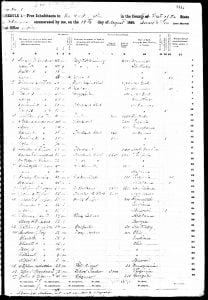
1860 Free Inhabitants Creek Nation Page 1

The 1860 census for the Creek Nation, located west of Arkansas, reveals a diverse array of free inhabitants, including Native Americans from Creek and Seminole tribes. This listing indicates that many individuals either renounced their tribal affiliations or were never granted citizenship. Several entries mark those who married Native individuals but were still denied citizenship, suggesting a complex social structure within the community. The presence of individuals identified by racial categories reflects the intricate interplay of identities during this period.
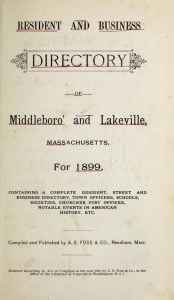
1899 Directory for Middleboro and Lakeville Massachusetts

1899 Middleboro and Lakeville Massachusetts Directory Cover

The 1899 Directory for Middleboro and Lakeville, Massachusetts, compiled by A. E. Foss & Co., provides a comprehensive list of residents and businesses, alongside town officers, schools, churches, and societies. It includes notable historical events and offers a detailed account of the local community, featuring numerous surnames from both towns. This directory serves as an essential resource for understanding the demographics and social structure of Middleboro and Lakeville during that period.

A History of Waterloo New York Newspapers

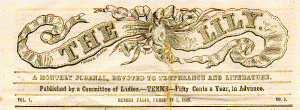
Masthead of the Lily in Seneca Falls

George Lewis, the first printer in Seneca County, initiated the Seneca Patriot in 1815, later renaming it The Ovid Gazette. After relocating the county seat to Waterloo in 1817, he produced The Waterloo Gazette, the village’s first newspaper. Throughout the years, various publications emerged, including The Waterloo Enunciator, The Seneca Farmer, and The Waterloo Observer, reflecting local political sentiments and events. Many of these papers are preserved in collections, offering vital insights for genealogists and historians researching the area’s history.

A History of Interlaken New York Newspapers

Winchester Star

The post details the history of eight newspapers from Interlaken, New York, spanning from 1822 to 1994, highlighting their significance for genealogists. It outlines key publications such as the Seneca County Sentinel and the Interlaken Review, emphasizing their role in documenting local history. The piece also mentions the Interlaken Historical Society’s 2006 index, which serves as a crucial resource for accessing these newspapers, available in various libraries and historical societies. Overall, the content provides a rich tapestry of local journalism’s evolution in Interlaken.

History of the Seneca County New York Press

Masthead of the Lily in Seneca Falls

The history of the press in Seneca County reflects the broader narrative of American journalism’s evolution, characterized by local newspapers that documented societal changes and opinions. The first publication, the Seneca Patriot, emerged in 1815, followed by various newspapers that reflected political trends from Federalism to Democratic ideals. Notable figures, such as Amelia Bloomer, contributed to the media landscape with publications advocating reform. Though many papers faced struggles with sustainability, they played pivotal roles in shaping public discourse and preserving local history, ultimately illustrating the press’s enduring influence in the county.

Murdock Family of Norwich Vermont

Hon. Thomas Murdock moved to Norwich from Connecticut in 1767, marrying Elizabeth Hatch and raising a family that included six children. Prominent in local affairs, he held various positions before his death in 1803. His sons, Asahel and Constant, were active voters, with Asahel eventually returning to Connecticut. Jasper, also a son, built an impressive residence at Norwich Plain. The estate changed hands over the years, influencing the town’s development, and remnants of it, including a fish pond, remain part of its history.

Postmasters and Postal Service in Norwich Vermont

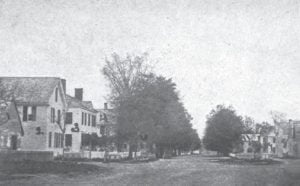
Norwich Vermont Street Scene

Norwich, Vermont, established its first post office on July 1, 1805, with Jacob Burton as postmaster. Operating from his harness shop, he managed limited mail, receiving only two weekly deliveries. By contrast, the volume of mail handled today far surpasses that of early 19th-century Vermont, and the postal system has evolved significantly since the state’s admission to the Union in 1791. Over the years, additional post offices were created throughout the area, reflecting the growth and changing needs of the community.

Norwich Vermont in the Civil War

During the Civil War, Norwich, Vermont, contributed 185 soldiers to the Union Army, representing over ten percent of its population of 1,759. Of these, 27 men died in service. The town provided substantial bounties totaling around $32,000 to support its troops. Although the community largely supported the war effort, some residents expressed disloyalty, yet over time, many reconciled their past by honoring the fallen soldiers on Memorial Days. Overall, Norwich’s commitment to the Union cause reflected a broader dedication seen throughout Vermont.

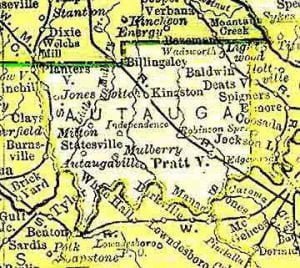
Autauga County Alabama Genealogy

Autauga County, Alabama

An extensive collection of material relating to Autauga County Alabama genealogy, includes vital records, cemeteries, census, history, and other records.

Baldwin County Georgia Marriages 1806-1850

This index compiles 1,352 Baldwin County, Georgia marriage records from court documents covering 1806 to 1850. It lists groom, bride, and marriage date entries in chronological order, offering a valuable genealogical resource for tracing family history, local relationships, and early county residents across more than four decades.

Genealogy of the Cherokee Riley Family

The genealogy of the Cherokee Riley family outlines significant familial connections, beginning with Samuel Riley, a White man who married sisters Gu-lu-sti-yu and Ni-go-di-ge-yu of the Long Hair clan. The records detail multiple generations, marriages, and notable individuals, such as David Carter, a prominent figure who held several judicial positions in the Cherokee Nation. The list includes various descendants and their spouses, reflecting the family’s extensive lineage and interconnected relationships within the Cherokee community.

Slave Narrative of Mamie Riley

In an interview with interviewer Phoebe Faucette, Mamie Riley, an ex-slave from Estill, South Carolina, recounts her memories of slavery and the arrival of Union soldiers. She describes her family’s life on the plantation of Mr. Henry Solomon and the chaos that ensued as the Yankees approached. Mamie recalls her father’s flight to the woods and her mother’s attempts to hide from the soldiers, who took possessions from their home. After emancipation, Mamie remained in the area until her marriage.

Biographical Sketch of Mrs. Stella Riley

Stella Riley, née Moore, was born in 1873 in Missouri to Milton and Jemima Scott Moore. She married John H. Riley in 1894, and together they had four children: Ruth Pearl, Mamie A., Mabel, and Prentice. A dedicated member of the Latter Day Saints Church, Mrs. Riley lived as a farmer near Vera, contributing to her community through both her faith and labor.

Biographical Sketch of J. Watson Riley

J. Watson Riley, a prominent agricultural implement dealer and farmer in Albion, has been in business for over four years, handling significant cash and commission goods. Initially a sole proprietor, he later formed partnerships before returning to solo operations in 1881. Born in Leeds, England, in 1830, he immigrated to America in 1847 and engaged in various trades before settling in Boone County in 1872. He has 160 acres under cultivation and has served as County Judge of Boone County and as a leader in the local Republican party.

Biography of James W. Riley

James W. Riley, born in 1847 in Franklin County, Missouri, is a prominent farmer in Spring Creek Township, Howell County. His parents, Lewis and Ann Riley, migrated through several counties in Missouri, and Lewis died in the Civil War. Following the war, James settled in Howell County with his mother, marrying Martha Corrico in 1867. A skilled farmer and stock dealer, he has improved his 230-acre farm significantly. Politically active, he supports the Populist party and has held roles as a justice of the peace and notary public.

Biography of William T. Riley

William T. Riley, a pivotal figure in the founding of Hailey, Idaho, was born on March 31, 1843, in Allegany County, New York. He served honorably in the Civil War, enduring injuries that marked his dedication. After the war, he contributed to the development of the West through various business ventures, including merchandising and real estate. Riley played a crucial role in laying out Hailey and was involved in essential community projects, such as establishing a water company. He was a devoted family man and an active member of his community and fraternal organizations.

Biographical Sketch of William F. Riley

William F. Riley, born on January 10, 1871, in Ohio, became a prominent banker in Topeka, Kansas, after establishing himself as a farmer in Wabaunsee County. The youngest of eight, he moved to Kansas in 1883 with his family, who were integral to the state’s development. He married Hattie Dailey in 1894 and has two children. President of the State Bank of Topeka since 1906, Riley also manages a 170-acre farm and owns 650 acres in total, reflecting his deep roots in agriculture and finance.