
Herbert G. Riley

Herbert G. Riley, a Blacksmith 1st Class in the Naval Air Service, hailed from Orange County and was the son of Mr. and Mrs. G. W. Riley. He entered military service on December 10, 1917, and was deployed to France on February 5, 1918, aboard the French ship La Touraine. His service included time in both France and Italy. Riley returned to the United States on December 16, 1918, and was mustered out on July 30, 1919, at Hampton Roads, Virginia.
Enoch Riley

Private Enoch Riley served in Company H of the 120th Infantry Regiment, part of the 30th Division, during World War I. Hailing from Alamance County, he was the son of G. H. and Laura Elizabeth Riley. He entered the service in September 1917, training at various camps before sailing for France on May 11, 1918. Riley participated in all engagements involving the 120th Infantry and returned to the United States on April 2, 1919, before being mustered out at Camp Jackson on April 8, 1919.

Biography of Rev. J. W. Riley

Rev. J. W. Riley was born on November 9, 1823, in Clermont County, Ohio, into a lineage of Baptist ministers. His father established the first Missionary Baptist Church in 1835, leading to the formation of the Bloomfield Baptist Association. Riley was ordained in 1845 and served as pastor in Mattoon from 1864, despite health issues that prompted him to seek recovery in the South. He authored a notable work, “U. S. A., the World’s Empire Passing from Prophecy to History.” He married twice and had seven children.

List 6, Choctaw Freedmen

List of Choctaw Freedmen whose names were omitted from final rolls because no application was made or by. reason of mistake or oversight. Shows the names of 281 persons, all minors except 4. The approved roll of minor Choctaw freedmen contains 473 names. The large percentage of omissions in this class is explained elsewhere. It is quite probable that there are others of this class whose claims have not yet been presented or disclosed.

List 2, Creeks

List of Creeks and Creek Freedmen, whose names were omitted from final rolls because no application was made or by reason of mistake or oversight. Shows the names of 62 persons of Creek blood and of 2 Creek freedmen all of whom except 10 are minors. Since the approved rolls of Creek citizens by blood contain 11,967 names, and the rolls of Creek freedmen contain 6,837 names, it is seen that the percentage of omissions is remarkably small.

Decision Rendered Mary Ann Riley

The Assistant Attorney-General’s opinion on the case of Mary Ann Riley and others reveals that the applicants, seeking enrollment as Cherokee freedmen, do not qualify based on their historical compliance with stipulated residency and enrollment criteria. The Commission concluded that neither Mary Ann Riley nor her descendants met the necessary requirements set by previous legal definitions and decrees regarding Cherokee citizenship. The applications are officially denied, reaffirming the distinction between administrative and judicial processes in tribal enrollment.

Biographical Sketch of N. B. Riley

N. B. Riley was born on September 14, 1841, in Logan County, Kentucky, to John and Mary Riley. After receiving education in local schools, he worked on the family farm until settling on his own land in Todd County in 1872. He became a partner in a general store in Allensville in 1883 and is involved in farming and stock-raising. A Confederate veteran, he rose to the rank of Captain during the Civil War. Riley married Isabella Page in 1867 and has five children. He has served as a Magistrate since 1882.

Biographical Sketch of John W. Riley

John W. Riley, born on June 18, 1855, in Logan County, Kentucky, is the son of James and Mary A. Riley. Raised on his family’s farm, he was educated at Browder Institute and became a successful farmer after moving to Todd County in 1878. He owns a 254-acre stock farm, recognized for its quality. Married in 1875 to Eddie A. Rutherford, they have two children. An active community member, Riley also serves as the tax collector for the Allensville-Elkton Turnpike Company and is a Democrat.

1894 Hinckley Minnesota Forest Fire Deaths

1894 Hinckley Minnesota Forest Fire

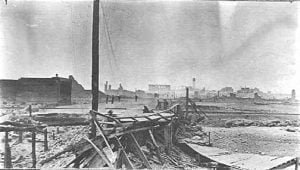
A detailed account of the 1894 Hinckley forest fire in Minnesota describes how drought, hurricane-force winds and smoldering fires turned the region into an inferno. It recounts the destruction of Hinckley, Brook Park, Pokegama and nearby settlements, desperate escapes by train and refuge in ponds and pits, and the confirmed death toll of 413.