Vital records of Stratham, New Hampshire, 1700-1867

Plan of the Town of Stratham

In 1934, Priscilla Hammond compiled vital records from Stratham, New Hampshire, covering the years 1700 to 1867, based on original town records. This compilation, transcribed with imperfect typing, was privately published and distributed to libraries and societies. The records are presented largely as found, with family members often grouped together. An index is included to assist in locating individual records. Users should be cautious with dates, especially those before 1752, as it is unclear if old dates were converted.

History of Glastonbury Connecticut, 1653-1853

Indian Map of Glastonbury

The history of Glastonbury, Connecticut, from 1653 to 1853 chronicles an account of its schools, commerce, mills, and ecclesiastical societies. The author, Alonzo Bowen Chapin, balances the general history with personal narratives, making the reading engaging for individuals tracing their ancestry. The work provides valuable insights into the town’s development, the contributions of its early ministers, and the influences of religion and learning that shaped the community. Unfortunately, the work is limited in the depths of the genealogy presented.

Essex County Massachusetts Probate Records 1635-1664

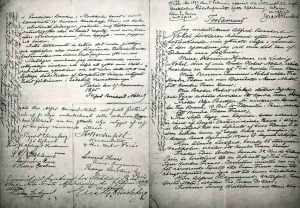
Sample Last Will and Testament

The “Governor and Company of Massachusetts Bay” established a judicial system in 1628, with a General Court in Boston and quarterly courts in major towns like Salem and Ipswich by 1635. These courts managed probate matters, and after Essex County’s formation in 1643, individual probate courts were later established in 1692. These are the probate records from 1635 to 1664, sourced from various original documents, including detailed wills and estate settlements.

Marriages of Charlotte County Virginia, 1784-1815

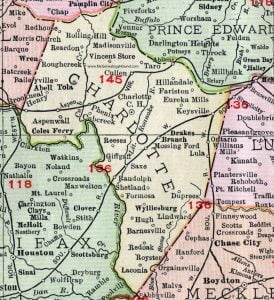
1911 Map of Charlotte County Virginia

This volume, “Marriages of Charlotte County, Virginia, 1784-1815,” compiles the marriage bonds and minister’s returns from Charlotte County during the specified period. The original work was painstakingly copied by Catherine Lindsay Knorr and published in 1951. The book spans 119 pages and includes a wealth of historical data on marriages that took place in this Virginia county. This publication presents several challenges for readers. Some pages are slightly tattered and torn, and the manuscript features irregular pagination. Additionally, there are tight or nonexistent margins, particularly at the bottom of the pages, and one page is typed on different paper than the rest.

History of Jefferson County Oklahoma

History of Jefferson County, Oklahoma

In “History of Jefferson County, Oklahoma,” Jim M. Dyer provides a comprehensive account of the development and heritage of Jefferson County within the broader context of Oklahoma’s growth since its inception as a state in the Union. This work is particularly significant as it commemorates Oklahoma’s Semi-Centennial, marking fifty years of statehood filled with rich productivity and development. Dyer’s exploration is driven by a multifaceted purpose: to celebrate the state’s achievements, to preserve the memory of Jefferson County’s “birth and growth” for future generations, and to honor the pioneers whose resilience and dedication laid the foundations for the county’s prosperity.

Marriages of Orange County, Virginia, 1747-1810

Marriages of Orange County, Virginia, 1747-1810

Catherine Lindsay Knorr’s Marriages of Orange County, Virginia, 1747-1810 stands as a pivotal work for genealogists and historians delving into the rich tapestry of Virginia’s past. Published in 1959, this meticulously compiled volume sheds light on the matrimonial alliances formed within Orange County, Virginia, during a period that was crucial to the shaping of both local and national histories. The absence of a contemporary marriage register presented a formidable challenge, yet through exhaustive examination of marriage bonds, ministers’ returns, and ancillary records, Knorr has reconstructed a reliable record of these marriages.

1st Mississippi Light Artillery

The 1st Mississippi Light Artillery, also known as Withers’ Light Artillery, comprised several companies raised across Mississippi, participating in key battles during the Civil War. Initially assembled in May 1862, the regiment played a crucial role in the defense of Vicksburg against Union forces, with notable contributions at Chickasaw Bayou and the Vicksburg campaign. Throughout its service, the artillery faced significant casualties and challenges, ultimately surrendering at Vicksburg in July 1863. Afterward, surviving members regrouped as infantry before continuing their service in various capacities.

History of Clinch County, Georgia

History of Clinch County, Georgia

History of Clinch County, Georgia, revised to date, giving the early history of the county down to the present time (1916): also complete lists of county officers, together with minor officers and also sketches of county officers’ lives; with chapters on the histories of old families of Clinch County; also other information as is historical in its nature, comp. and ed. by Folks Huxford

Progressive Men of Western Colorado

Early Life in Colorado

This manuscript, in its essence, is a collection of 948 biographies of prominent men and women, all leading citizens of Western Colorado. In this context, Western Colorado encompasses the counties of Archuleta, Chaffee, Delta, Eagle, Garfield, Gunnison, Hinsdale, La Plata, Lake, Mesa, Mineral, Moffat, Montezuma, Montrose, Ouray, Pitkin, Rio Blanco, Routt, San Juan, and San Miguel.

1860 Census West of Arkansas – Creek Nation

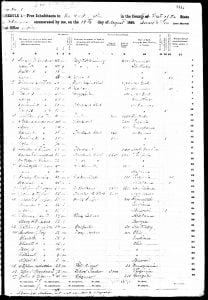
1860 Free Inhabitants Creek Nation Page 1

The 1860 census for the Creek Nation, located west of Arkansas, reveals a diverse array of free inhabitants, including Native Americans from Creek and Seminole tribes. This listing indicates that many individuals either renounced their tribal affiliations or were never granted citizenship. Several entries mark those who married Native individuals but were still denied citizenship, suggesting a complex social structure within the community. The presence of individuals identified by racial categories reflects the intricate interplay of identities during this period.

Biographies of Western Nebraska

History of Western Nebraska and its People

A historical overview of western Nebraska and its pioneer settlers, this volume highlights the men who helped build counties across the Nebraska Panhandle, including Cheyenne, Box Butte, Deuel, Garden, Sioux, Kimball, Morrill, Sheridan, Scotts Bluff, Banner, and Dawes. It also points readers to biographies, history volumes, and a gallery of 143 photographs.

Choctaw Traditions

The Papago tribe prophesied the return of their Messiah, Moctezuma, who would rescue them from suffering, a belief echoed in their open-door custom. The Choctaws shared unique traditions surrounding eclipses, believing them caused by a mischievous black squirrel. During eclipses, they would create loud disturbances to scare it away. Their historical mound, Nunih Waiyah, is venerated as a significant ancestral symbol, reflecting their migration story, while the Choctaws consistently asserted their origins as stemming from a distant land to the west.

The Discovery Of This Continent: It’s Results To The Natives

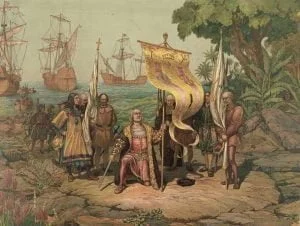
Columbus Landing on Hispaniola

In 1470, Christopher Columbus married Dona Felipa, daughter of a renowned navigator, and settled in Porto Santo, where they shared dreams of discovering lands to the West. Their ambitions fueled Columbus’s determination, leading to his 1492 voyage that resulted in the European discovery of the Americas. However, this event marked the beginning of devastation for native peoples, introducing warfare, disease, and colonization that would decimate their populations and cultures, ultimately transforming their rich, diverse societies into shadows of their former selves.

The Meeting in 1811 of Tecumseh and Apushamatahah

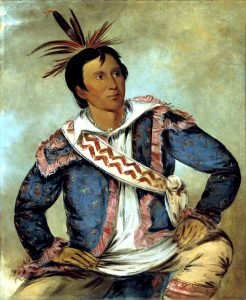
Peter Perkins Pitchlynn was the Choctaw Principal Chief from 1864-1866

In 1811, Tecumseh, the Shawnee leader, met with Apushamatahah, a prominent Choctaw chief, to rally southern tribes against American encroachment amidst looming war between the U.S. and England. Tecumseh passionately urged unity against their common foe, warning of the dire consequences of inaction. Apushamatahah countered with a call for prudence, advocating for peaceful measures. Ultimately, the council resulted in favoring American alliance, thwarting Tecumseh’s ambitions. This pivotal meeting highlighted the contrasting strategies of the two influential leaders, shaping tribal responses during a critical historical period.

Early Incidents in the Mississippi Territory

History of Alabama and incidentally of Georgia and Mississippi, from the earliest period

Napoleon Bonaparte’s ambitions for Louisiana prompted its cession from Spain to France, and ultimately to the United States for sixty million francs. Governor Claiborne formalized the U.S. occupation of New Orleans amid growing tensions with Spanish settlers. The establishment of a Superior Court and the appointment of Judge Harry Toulmin reflected administrative efforts in the Mississippi Territory, while border disputes with Spain over the Baton Rouge and Mobile districts fueled unrest. The region saw increased American migration as it opened for settlement, alongside notable legislative and educational advancements.

Autauga County Alabama Genealogy

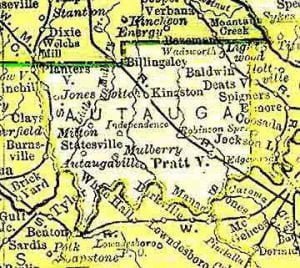
Autauga County, Alabama

An extensive collection of material relating to Autauga County Alabama genealogy, includes vital records, cemeteries, census, history, and other records.

Slave Narrative of Rachel Gaines

Rachel Gaines, an African American woman aged approximately 95-100, recalls her experiences as a slave in Nashville, Tennessee. She was sold only once to Dr. Bainbridge Dickerson and describes a relatively kind treatment, where she earned $35 a year and received necessities. Gaines reminisces about festive gatherings, dances, and vibrant community life, contrasting it with present hardships. She reflects on superstitions and the transition from slavery to her later life of domestic work until losing her sight, ultimately moving in with her daughter in Nashville.