Essex County Massachusetts Probate Records 1675-1681
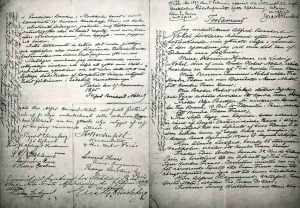
Sample Last Will and Testament

The “Governor and Company of Massachusetts Bay” established a judicial system in 1628, with a General Court in Boston and quarterly courts in major towns like Salem and Ipswich by 1635. These courts managed probate matters, and after Essex County’s formation in 1643, individual probate courts were later established in 1692. These are the probate records from 1675 to 1681, sourced from various original documents, including detailed wills and estate settlements.
Essex County Massachusetts Probate Records 1665-1674

Sample Last Will and Testament

The “Governor and Company of Massachusetts Bay” established a judicial system in 1628, with a General Court in Boston and quarterly courts in major towns like Salem and Ipswich by 1635. These courts managed probate matters, and after Essex County’s formation in 1643, individual probate courts were later established in 1692. These are the probate records from 1665 to 1674, sourced from various original documents, including detailed wills and estate settlements.

Essex County Massachusetts Probate Records 1635-1664

Sample Last Will and Testament

The “Governor and Company of Massachusetts Bay” established a judicial system in 1628, with a General Court in Boston and quarterly courts in major towns like Salem and Ipswich by 1635. These courts managed probate matters, and after Essex County’s formation in 1643, individual probate courts were later established in 1692. These are the probate records from 1635 to 1664, sourced from various original documents, including detailed wills and estate settlements.

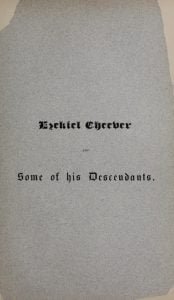
Ezekiel Cheever and some of his Descendants

Ezekiel Cheever and some of his descendants

The paper entitled Ezekiel Cheever and Some of his Descendants was prepared for, and published in, the New England Historical and Genealogical Register for April 1879. The same type has now been used to print a few copies in pamphlet form, for private distribution. There has been added to it, as an Appendix, the Cheever Manuscript in the Library of the Boston Athenaeum, now for the first time printed in full.

Abbot Family of New England

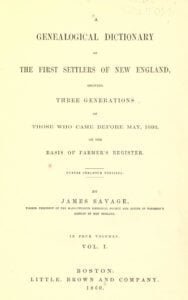
A genealogical dictionary of the first settlers of New England vol 1

The Abbot family of New England, traced in James Savage’s genealogical work, includes notable figures such as Arthur Abbot, who settled in Marblehead around 1634 and had a son, Philip. Several generations followed, with families established in towns such as Ipswich, Andover, and Cambridge. Many Abbots contributed to early colonial life, engaging in various trades and civic duties. The family’s legacy persists, with descendants continuing to thrive across New England into the 19th century.

The Cox family in America

The Cox family in America

Two volumes of Cox family genealogy combined as one. The first volume contains information about the various early Cox families across America. The second volume deals specifically with the descendants of James and Sarah Cock of Killingworth upon Matinecock, in the township of Oysterbay, Long Island, New York.

The Ancestry of Sarah Stone

Ancestry Chart for Sarah Stone

The ancestry of Sarah Stone, wife of James Patten of Arundel (Kennebunkport) Maine
Contains also the Dixey, Hart, Norman, Neale, Lawes, Curtis, Kilbourne, Bracy, Bisby, Pearce, Marston, Estow and Brown families.

Descendants of Chauncey Sears of Fall River, MA

The Sears family, of Fall River, MA, traces its origins back to Richard Sares, who arrived in America circa 1632. Initially settled in Marblehead, he later moved to Yarmouth, where he died in 1676. Over generations, the family produced prominent figures, including Chauncey Howe Sears, a successful mason contractor and builder. Chauncey started his career at eighteen and built a substantial business, contributing to many local mills and public buildings. A respected community member, he also held various affiliations in fraternal organizations and married Georgianna Newell in 1883, having two children.

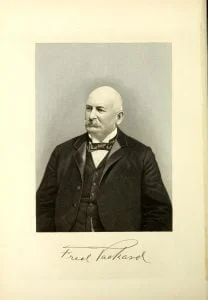
Descendants of Frederick Packard of Brockton, MA

Fred. Packard

Frederick Packard, born in 1836 in Brockton, MA, emerged as a prominent figure in the local shoe manufacturing industry. His success stemmed from hard work and business acumen. He began his career making boots and shoes, eventually founding firms such as Burt & Packard, which gained a reputation for quality. A respected community member, Packard was active in local organizations and politics but shunned public office. He married Mary Eliza Ramsdell, and after a long and prosperous life, he passed away in 1910, leaving a lasting legacy.

Free Massachusetts Vital Records

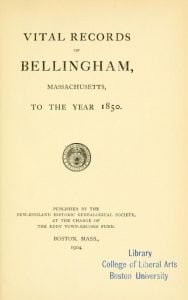
Vital Records of Bellingham Massachusetts to 1850

This is a collection of free vital records books for Massachusetts towns, most of them known as “Tan Books.” Generally, these records go up to 1850 at which, the genealogist can use the census records to assist in identifying the family connections further. They’re called “tan books” because they were bound by tan cloth. Included with this article is an account of why and how these manuscripts were published along with links to all 274 Massachusetts vital record books which can be freely read.

Early New England People

Early New England People

Sarah Titcomb over her years of study of various New England families had collected quite a bit of material of several early New England families. At the bequest of some of her friends, she prepared and published them in book form. When reading through the material I was impressed with the amount of material collected on each individual, and rather then a brief genealogical sketch, readers are provided an in-depth study of each early family: Ayer, Bartlett, Bradley, Chase, Dean, Dow, Dunster, Ellis, Fuller, Hope, Kilby, Martine, Les Dernier, Maverick, Mills, Montague, Pemberton, Pepperrell, Poore, Precott, Sewall, Longfellow, Spofford, Titcomb, Watmough, and Willard.

Narrative of the Captivity of Nehemiah How

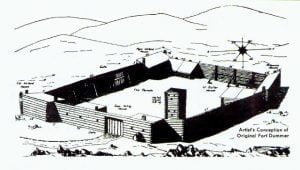
Fort Dummer

A Narrative of the captivity of Nehemiah How, who was taken by the Indians at the Great Meadow Fort above Fort Dummer, where he was an inhabitant, October 11th, 1745. Giving an account of what he met with in his traveling to Canada, and while he was in prison there. Together with an account of Mr. How’s death at Canada. Exceedingly valuable for the many items of exact intelligence therein recorded, relative to so many of the present inhabitants of New England, through those friends who endured the hardships of captivity in the mountain deserts and the damps of loathsome prisons. Had the author lived to have returned, and published his narrative himself, he doubtless would have made it far more valuable, but he was cut off while a prisoner, by the prison fever, in the fifty-fifth year of his age, after a captivity of one year, seven months, and fifteen days. He died May 25th, 1747, in the hospital at Quebec, after a sickness of about ten days. He was a husband and father, and greatly beloved by all who knew him.

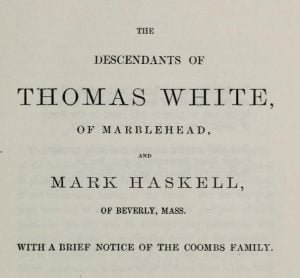
The Descendants of Thomas White of Marblehead

The Descendants of Thomas White

The book “The Descendants of Thomas White, of Marblehead, and Mark Haskell of Beverly, Mass: With a Brief Notice of the Coombs Family” by Perley Derby, published in 1872, provides a genealogical overview of these interconnected families. Despite possessing extensive materials, the compiler chose to present a concise pedigree of each family branch to fulfill the originator’s intent of preserving their lineage for future generations. The work highlights the frequent intermarriages among the White, Haskell, and Coombs families, emphasizing their longstanding connections. While acknowledging gaps in early records, especially for Thomas White, the book aims to inspire further research and a more comprehensive historical account of these families.

First and Second Churches in Marblehead Massachusetts

The first church in Marblehead, established in 1649, initially featured Mr. Walton as a preacher until his death in 1668. On August 13, 1684, the church was formally organized with Samuel Cleever as pastor. He served for nearly fifty years until his death in 1724. The second church was formed in 1714, with a series of pastors serving over the years. The new stone church was built in 1824, reflecting the community’s evolving religious needs.

Genealogy of the Adams Family

Jonas Adams, a mariner from Salem, married Sarah Jefferds in 1729. His will was proved in 1757, after which Sarah ran an inn until her death in 1786. They had several children, including Elizabeth, Sarah, Samuel, and William. Daniel Adams, also a mariner, married Hepzibah Batchelder and had numerous descendants. Other Adams family records from Marblehead and Ipswich detail multiple marriages and births, highlighting the family’s extensive lineage and connections within the region.

Biographical Sketch of Dr. Edward Horatio Foster

Dr. Edward Horatio Foster, born on October 13, 1839, in Canterbury, N.H., was a prominent medical practitioner in Concord. A descendant of early settlers, his lineage includes a grandfather who fought in both the French and Indian Wars and the Revolutionary War. After graduating from Bowdoin College in 1866, Foster practiced in various locations before settling in Concord in 1872. He was politically independent and held leadership roles in several companies. Dr. Foster was married twice and had three children, passing away on April 5, 1897.

Sea Captains Crowningshield, Edward to Cook, Samuel

The post details various sea captains and their vessels, highlighting their baptisms, notable ships, and maritime incidents. Edward Crowningshield, baptized in 1767, is noted for the schooner *Hannah* in 1824. John Cross had multiple vessels, including the ill-fated *Traveler*. Captains John Conway and William Cole are also featured, with their exploits and losses documented. Samuel Cook, baptized in 1750, is recorded as commanding the brigantine *Republican* in 1808. This compilation serves to preserve the maritime history of Marblehead.

Sea Captains Bailey, James to Bessom, Joseph

The document provides a historical account of various sea captains and their vessels from Marblehead, including notable figures like James and John Bailey, and George Barker. Capt. James Bailey commanded Fort Sewall during a transition period and was succeeded by his wife, an uncommon occurrence for that era. Other captains, such as Thomas Barker and Nicholas Bartlett, experienced piracy during their voyages, while William Bartoll became a prominent figure in local governance after a career at sea. Joseph Bessom commanded the Barque Abbie Bacon.

Ships and Sea Captains of Marblehead

The post details notable ships built in Marblehead from 1849 to 1857, including the “Compromise,” “Anna Kimball,” and “Brig Curlew.” It also lists sea captains documented in Dr. John Drury’s account book, such as William Andrews and Edward Bowen, along with additional names from Marblehead Vital Statistics, highlighting the local maritime heritage. Furthermore, it references by-laws of the Marblehead Marine Society, emphasizing membership for those who commanded vessels. This content underscores Marblehead’s integral role in maritime history.