History of the Town of Cornwall Connecticut

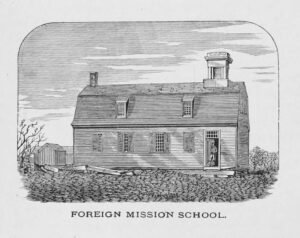
Foreign Mission School, Cornwall, Connecticut

The History of the Town of Cornwall Connecticut is a comprehensive account of the town’s evolution from colonial organization in 1731 to its involvement in national events like the Civil War. They include detailed geographical descriptions, ecclesiastical histories of local churches, and biographical sketches of families such as the Sedgwicks and Golds. The records also reflect social life, farming, early fashion, and the noteworthy Foreign Mission School.
Marriage records of Liberty County Georgia, 1785-1895

Marriage records of Liberty County, Georgia, 1785-1895

These marriage records were abstracted from unbound marriage bonds and licenses in the Liberty County Courthouse, Hinesville, Georgia. The names were copied as they were spelled on the bonds, often barely legible and often spelled differently on the same bond. Sometimes the marriages were performed before the licenses were issued. The first date given in the abstracts is the date of the license or bond; the second is the date of marriage. The following abbreviations are used in these abstracts with the meaning indicated:

Sevier County 1830 Tennessee Census

1830 Sevier County Census transcription

Published in Knoxville, Tennessee in 1956 and distributed by the Genealogical Publishing Company of Baltimore, Maryland, Sevier County, Tennessee: Population Schedule of the United States Census of 1830 (Fifth Census) provides a transcription of the often difficult to read, 1830 Sevier County Tennessee census. Authored by Blanche C. McMahon and Pollyanna Creekmore, this meticulous reproduction of the original census record sheds light on the people of Sevier County in 1830.

Wintergreen Cemetery, Port Gibson, Mississippi

Wintergreen Cemetery, Port Gibson, Mississippi

This survey of Wintergreen Cemetery, Port Gibson, Mississippi, was completed in 1956 by Mr. Gordon M. Wells and published by Joyce Bridges the same year. It contains the cemetery readings Mr. Wells was able to obtain at that date. It is highly likely that not all of the gravestones had survived up to that point, and it is even more likely that a large portion of interred individuals never had a gravestone.

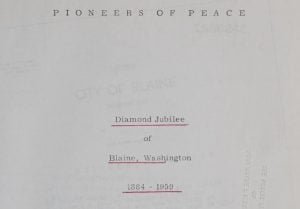
History of Blaine Washington, 1884-1959

Pioneers of peace - diamond jubilee anniversary, Blaine, Washington, 1884-1959

“History of Blaine Washington, 1884-1959” offers a comprehensive and engaging exploration of Blaine, Washington’s rich history and cultural heritage. Published in 1959 to commemorate the diamond jubilee of Blaine, this book captures the essence of a community that has thrived on the principles of peace and cooperation. Situated in Whatcom County, Blaine’s unique geographical location near the Canadian border plays a pivotal role in its identity, an aspect vividly illustrated through the symbol of the International Peace Arch.

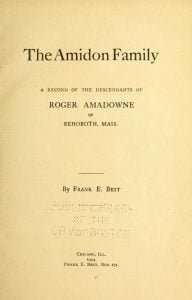
The Amidon Family of Rehoboth, MA

The Amidon Family

The Amidon Family genealogy book details the lineage of Roger Amadowne, a French Huguenot who fled to England and later to America after the revocation of the Edict of Nantes. Documented in Salem, Massachusetts in 1637, variations of his surname include Amadon, Amidown, and Ammidon. The work, organized with biographical sketches and two helpful indexes, presents the family’s history and is richly illustrated. Originally published in 1904, it serves as a valuable resource for descendants and historians alike.

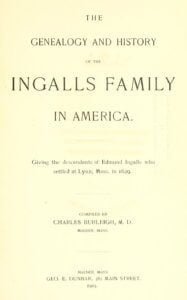
The genealogy and history of the Ingalls family in America

The genealogy and history of the Ingalls family in America

Edmund Ingalls, son of Robert, was born about 1598 in Skirbeck, Lincolnshire, England. He immigrated in 1628 to Salem, Massachusetts and with his brother, Francis, founded Lynn, Massachusetts in 1629. He married Ann, fathered nine children, and died in 1648.

Biographies of Western Nebraska

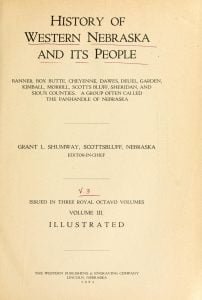
History of Western Nebraska and its People

A historical overview of western Nebraska and its pioneer settlers, this volume highlights the men who helped build counties across the Nebraska Panhandle, including Cheyenne, Box Butte, Deuel, Garden, Sioux, Kimball, Morrill, Sheridan, Scotts Bluff, Banner, and Dawes. It also points readers to biographies, history volumes, and a gallery of 143 photographs.

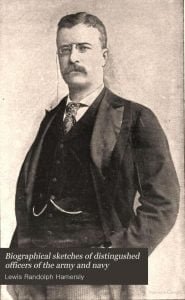
Biographical Sketches of Distingushed Officers of the Army and Navy

cover

The following seventy-five biographies feature distinguished officers from the Army and Navy during the last half of the 19th century. Included with each biography is a photograph, which we have included as a gallery at the bottom of this page. These particular men were chosen by the editor for their patriotism to the flag.

Louisiana Land Patents – Choctaw Tribe

A detailed listing of Louisiana land patents for the Choctaw Tribe, organized by patentee name, date, document number, and accession number. The record includes many Native and non-Native grantees and spans patents issued from the 1840s through the early 1900s, offering a valuable reference for historical land and genealogy research.

Abstracts of Wills on File in the City of New York Surrogate’s Office 1660-1680

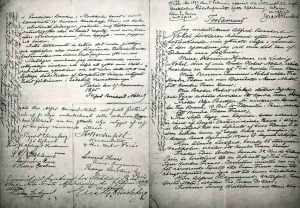
Sample Last Will and Testament

Abstracts of wills on file in the surrogate’s office city of New York 1660-1680. From May 1787 to the present, county surrogate’s courts have recorded probates. However, the court of probates and court of chancery handled estates of deceased persons who died in one county but who owned property in another. An 1823 law mandated that all probates come under the jurisdiction of the county surrogate’s courts. Each surrogate’s court has a comprehensive index to all probate records, including the unrecorded probate packets. Interestingly enough, there are wills existing and on record at the Surrogate’s Office in New York City for the time-span of 1660-1680. Genealogical extracts of these wills have been provided below.

Biographical Sketch of Robert T. Tanner

Mary Elizabeth, born on April 7, 1879, to William Peters and Rachel Louisa McClellan, received her education in Cherokee schools. She married Robert Tanner on December 26, 1906, and together they had three children: Pearl Edith, Mary Louisa, and Robert Turner Tanner. A dedicated member of the Presbyterian Church, Mary is also associated with the Eastern Star. Robert operates a furniture business and manages a successful farm. Their family lineage intertwines with notable historical figures, highlighting their rich heritage.

Biography of Thomas Tanner

Thomas Tanner, born on August 9, 1831, in Newbury, England, emigrated to the United States in 1850. After laboring as a shoemaker and in dairy, he moved to Utah in 1853, eventually settling in Union County in 1878. He transformed a homestead into a thriving 220-acre farm, focusing on agriculture and livestock. Tanner married Susana Elsie in 1853 and had several children, later marrying Catherine E. Buckley in 1883. Recognized for his integrity and hard work, he garnered respect within his community.

Biography of J. M. Tanner

J. M. Tanner, born on March 6, 1875, in the Coowescoowee district, was a prominent farmer in Nowata. Orphaned at fifteen, he lived with his sister before acquiring a 90-acre farm. His fortunes improved with the discovery of oil on his land, leading to a successful career. Tanner married L. C. Estes in 1919 and is a respected community member and Republican supporter. He is also active in local developments and owns significant residential and agricultural properties, reflecting his successful endeavors.

Biographies of the Cherokee Indians

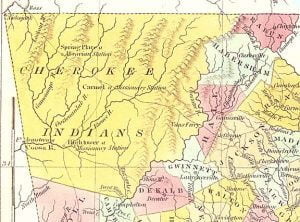
1830 Map of Cherokee Territory in Georgia

The Cherokee Indians, primarily from the Southeastern U.S., have a rich history marked by their early adoption of a written language and a government structure similar to that of the United States. Despite their forced relocation to Oklahoma in the 1830s, they maintained significant genealogical ties, often intermarrying with Whites. Emmet Starr’s “History of the Cherokee Indians and Their Legends and Folklore” emphasizes personal biographies and genealogies, providing insights into the lives and connections of many Cherokee families across generations, thereby enriching their cultural narrative.

Biography of Albert H. Tanner

Albert H. Tanner was born on September 9, 1855, in what is now Washington Territory. After his parents’ divorce, he lived with his father, working as a carpenter while pursuing education. Inspired by Professor T.F. Campbell, Tanner graduated from Christian College in 1874. He studied law in Portland, becoming a successful attorney by 1878, and engaged in politics as a Republican. Tanner served as city attorney and was known for his legal acumen and dedication to public service, exemplifying a self-made man rising from humble beginnings.