History of Rindge New Hampshire

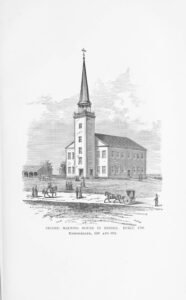
Second Meeting House in Rindge New Hampshire

The History of the Town of Rindge, New Hampshire by Ezra S. Stearns, was published in 1875, and covers the period from the original Rowley Canada grant or Massachusetts charter through the year 1874. Stearns traces the legal, territorial, and institutional development of Rindge, beginning with colonial land grants and boundary disputes and proceeding through settlement, incorporation into a town and development into a small manufacturing hub. More than half the volume is devoted to genealogical material. The genealogical register of Rindge families includes thousands of names compiled from a wide range of sources and assisted by contributions from residents and researchers beyond the town.
History of Shelburne Massachusetts

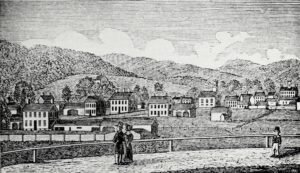
Southeastern View of Shelburne Falls Village Before 1835

The “History and Tradition of Shelburne, Massachusetts” is an account of the town’s development, initiated by a community effort in 1944. The project culminated in 1958 after various committees worked to collect and organize information across multiple aspects, including geology, early settlement, and cultural life. The book, intentionally topical rather than genealogical, features contributions from numerous writers and serves as a reference for understanding Shelburne’s heritage, institutions, and notable figures.

Vital Records of Bellingham, Massachusetts

Vital Records of Bellingham Massachusetts to the year 1850

Alphabetical indexes to the vital records of Bellingham, Massachusetts, up to the year 1850, supplemented by information from bible records, church registers, cemetery inscriptions and other private sources to include the diary kept by Samuel Wight and his daughters.

Medway Massachusetts vital records

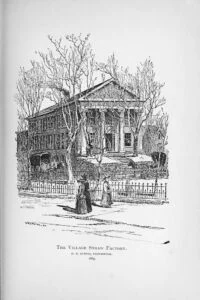
Medway Village Straw Factory

Alphabetical indexes to the vital records of Medway, Massachusetts, up to the year 1850, supplemented by information from church registers, cemetery inscriptions and other private sources to include Rev. Dr. Jacob Ide’s account of Marriages and Deaths, 1814-1849.

History of Glastonbury Connecticut, 1653-1853

Indian Map of Glastonbury

The history of Glastonbury, Connecticut, from 1653 to 1853 chronicles an account of its schools, commerce, mills, and ecclesiastical societies. The author, Alonzo Bowen Chapin, balances the general history with personal narratives, making the reading engaging for individuals tracing their ancestry. The work provides valuable insights into the town’s development, the contributions of its early ministers, and the influences of religion and learning that shaped the community. Unfortunately, the work is limited in the depths of the genealogy presented.

Vanderburgh County Indiana Will Abstracts, 1821-1873

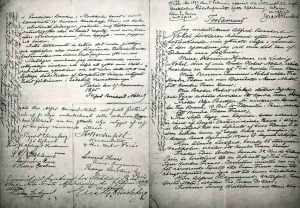
Sample Last Will and Testament

Abstracts of over 600 wills for Vanderburgh County, Indiana, extracted by Mrs. Arthur C. Bitterman. Book A was typed by Mrs. James A. Gentry, book B typed by Mrs. Marvin J. Huff, and published as one by the Vanderburgh Chapter of the DAR. Book A primarily covers wills written or filed within the time period of 1823-1849 and book B includes the years of 1849-1873. In both cases there are wills that fall outside those dates.

Logan County, Kentucky Wills – Book A, with index

Will book A, Logan County, Kentucky

The wills in this book come from Book A of the Wills found at the Logan County Court house in Russellville, Kentucky. The information was extracted in 1957 by Mrs. Vick on behalf of the DAR located in Russellville. The text in this book was done with an old manual typewriter and has the usual faint and filled-in type often found with such papers. On top of the difficulty in interpreting the print from the typewriter, the scanning process was also deficient, and led to the creation of a faint digital copy exacerbating the difficult to read text.

Brown Genealogy

Brown Genealogy

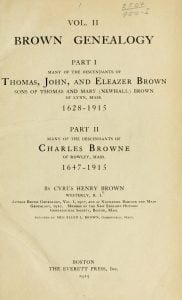
In 1895, Cyrus Henry Brown began collecting family records of the Brown family, initially with the intention of only going back to his great-grandfathers. As others became interested in the project, they decided to trace the family lineage back to Thomas Brown and his wife Mary Newhall, both born in the early 1600s in Lynn, Massachusetts. Thomas, John, and Eleazer, three of their sons, later moved to Stonington, Connecticut around 1688. When North Stonington was established in 1807, the three brothers were living in the southern part of the town. Wheeler’s “History of Stonington” contains 400 records of early descendants of the Brown family, taken from the town records of Stonington. However, many others remain unidentified, as they are not recorded in the Stonington town records. For around a century, the descendants of the three brothers lived in Stonington before eventually migrating to other towns in Connecticut and New York State, which was then mostly undeveloped. He would eventually write this second volume of his Brown Genealogy adding to and correcting the previous edition. This book is free to search, read, and/or download.

History of Littleton New Hampshire

1895 Map of Littleton New Hampshire

The History of Littleton New Hampshire is comprised of three volumes, two volumes of history, and a final volume of genealogies. Considered one of the best examples of local history written in the early 20th century, is your ancestors resided in Littleton then you need these books. Read and download for free!

Origin, history, and genealogy of the Buck family

Origin, history, and genealogy of the Buck family

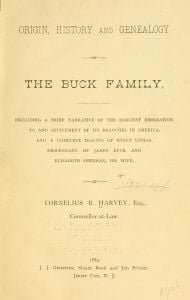
Origin, history and genealogy of the Buck family : including a brief narrative of the earliest emigration to and settlement of its branches in America and a complete tracking of every lineal descendant of James Buck and Elizabeth Sherman, his wife

The genealogy and history of the Ingalls family in America

The genealogy and history of the Ingalls family in America

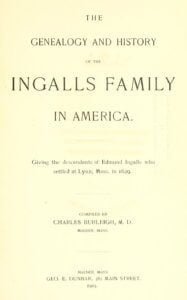
Edmund Ingalls, son of Robert, was born about 1598 in Skirbeck, Lincolnshire, England. He immigrated in 1628 to Salem, Massachusetts and with his brother, Francis, founded Lynn, Massachusetts in 1629. He married Ann, fathered nine children, and died in 1648.

Taber family of Dartmouth and New Bedford, Massachusetts

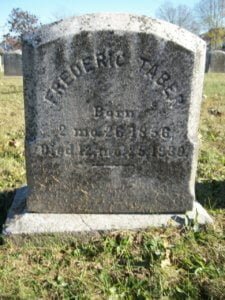
Frederic Taber 1856-1930

The Taber family of Dartmouth and New Bedford, one of the oldest families in southeastern Massachusetts, is descended from Philip Taber, who according to Savage, was born in 1605, and died in 1672. He was at Watertown in 1634, and he contributed toward building the galley for the security of the harbor. He was made a freeman at Plymouth in 1639. In 1639-40 he was a deputy from Yarmouth, and was afterward at Martha’s Vineyard, and from 1647 to 1655 was at Edgartown, going from there to New London in 1651, but probably returning soon. He was an inhabitant of Portsmouth in February, 1655, and was a representative in Providence in 1661, the commissioners being Roger Williams, William Field, Thomas Olney, Joseph Torrey, Philip Taber and John Anthony. Later he settled in Tiverton, where his death occurred. He married Lydia Masters, of Watertown, Mass., daughter of John and Jane Masters, and his second wife, Jane, born in 1605, died in 1669.

Ancestry of William H. Nelson of Plymouth, Massachusetts

William H. Nelson, a prominent figure in Plymouth, Massachusetts, descended from early settlers like William Nelson, who arrived before 1636. Active in his community, he held numerous positions, including selectman and president of various banks and manufacturing companies. Known for his integrity and public spirit, Nelson was deeply involved in addressing local commercial needs, particularly in navigation and industry. He married Hannah Coomer Weston in 1863 and left a legacy of service before his death in 1891, remembered as one of Plymouth’s most dedicated citizens.

Weymouth ways and Weymouth people

Weymouth ways and Weymouth people

Edward Hunt’s “Weymouth ways and Weymouth people: Reminiscences” takes the reader back in Weymouth Massachusetts past to the 1830s through the 1880s as he provides glimpses into the people of the community. These reminiscences were mostly printed in the Weymouth Gazette and provide a fair example of early New England village life as it occurred in the mid 1800s. Of specific interest to the genealogist will be the Hunt material scattered throughout, but most specifically 286-295, and of course, those lucky enough to have had somebody “remembered” by Edward.

Richard Dexter Genealogy, 1642-1904

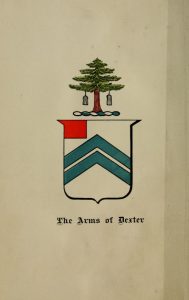
Arms of Dexter

Being a history of the descendants of Richard Dexter of Malden, Massachusetts, from the notes of John Haven Dexter and original researches. Richard Dexter, who was admitted an inhabitant of Boston (New England), Feb. 28, 1642, came from within ten miles of the town of Slane, Co. Meath, Ireland, and belonged to a branch of that family of Dexter who were descendants of Richard de Excester, the Lord Justice of Ireland. He, with his wife Bridget, and three or more children, fled to England from the great Irish Massacre of the Protestants which commenced Oct. 27, 1641. When Richard Dexter and family left England and by what vessel, we are unable to state, but he could not have remained there long, as we know he was living at Boston prior to Feb. 28, 1642.

Business Men of Northern Maine

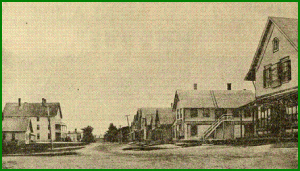
Winn Maine - Main Street looking East

A historical business directory and local history of Northern Maine from 1891, featuring sketches of nine towns including Houlton, Presque Isle, Caribou, and Fort Fairfield. The manuscript profiles businesses, owners, and civic institutions, and includes a gallery of period photographs, town views, and advertisements drawn from the era.

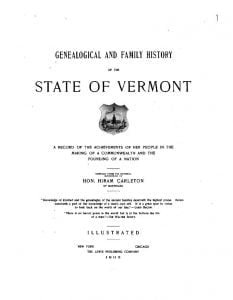
Genealogical and Family History of Vermont

Genealogical and Family History of the State of Vermont vol 1

Hiram Charlton took on the publication of the Genealogical and Family History of the State of Vermont for Lewis Publishing. In it, he enlisted the assistance of living residents of the state in providing biographical and genealogical details about their family, and then he published all 1104 family histories in two distinct volumes.

Biography of James Stratton

James Stratton, born May 22, 1830, in County Armagh, Ireland, moved to Canada at age fifteen. He initially taught school for seventeen years before purchasing the Peterborough Examiner in 1860, where he advocated for the Reform party. After a brief political candidacy in 1874, he focused on his role as Collector of Customs from 1876 onward. A lifelong teetotaler and Baptist, he was active in local reforms and community support. Stratton was married to Rosanna Armstrong, and they had nine children, with his son James Robert succeeding him at the Examiner.

Biographical Sketch of H. W. Stratton

H. W. Stratton was ordained in 1866 and began his ministry in Kansas before moving to Oregon in 1871, where he united Presbyterian and Congregational churches in Albany. He organized the first Presbyterian churches in eastern Washington, including Weston and Walla Walla, and established a church in Boise, Idaho. After serving in Seattle, he settled in Spokane Falls, where he focused on agriculture and church service. Residing at Prospect Place, he enjoys a fulfilling domestic life near his family while contributing to the community.