Genealogies of Pembroke New Hampshire

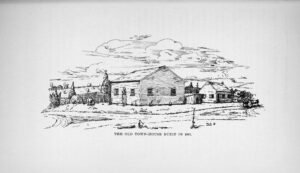
Old Pembroke NH Town House, built 1811

The “Genealogies of Pembroke, New Hampshire” is derived from the town’s second historical volume, and documents the connections of early settler families through the nineteenth century. It emphasizes families of the first settlers and families who resided in Pembroke over a long period of time. Organized alphabetically by surname, the genealogies use a consistent numbering system for easy reference. Carter draws from diverse sources, including town records and personal accounts of Pembroke’s citizens, while acknowledging possible inaccuracies in both their memory and the collection of information. However, by preserving these family lineages, Carter enhances the town’s historical narrative, complementing the first volume’s historical content. Supplementing this volume of genealogies is a compilation of marriage records which occurred in Pembroke, New Hampshire, from 1739 through 1895.
History of Rindge New Hampshire

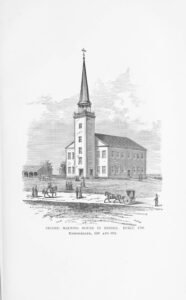
Second Meeting House in Rindge New Hampshire

The History of the Town of Rindge, New Hampshire by Ezra S. Stearns, was published in 1875, and covers the period from the original Rowley Canada grant or Massachusetts charter through the year 1874. Stearns traces the legal, territorial, and institutional development of Rindge, beginning with colonial land grants and boundary disputes and proceeding through settlement, incorporation into a town and development into a small manufacturing hub. More than half the volume is devoted to genealogical material. The genealogical register of Rindge families includes thousands of names compiled from a wide range of sources and assisted by contributions from residents and researchers beyond the town.

Collections of the New Hampshire Historical Society

1892 Map of New Hampshire

The Collections of the New Hampshire Historical Society is a 15 publication series documenting the state’s history through various primary sources, including manuscripts, letters, and public records. It collates valuable narratives that were previously difficult to access, providing insight into events, individuals, and communities in New Hampshire. Each volume offers focused topics and historical analyses, and most volumes contain individual indexes.

Samuel Lane’s Journal, 1739-1803

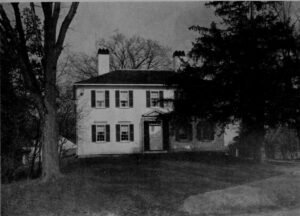
Jabez Lane House

Samuel Lane’s journal, covering 1739 to 1803, chronicles the life of a New Hampshire resident who experienced the colonial, Revolutionary, and early national periods. Lane transitioned from farming to various professions, including tanner and shoemaker, while actively participating in community roles. His meticulously kept journal captures local and national events, personal reflections, and societal changes. Edited by Charles Lane Hansen in 1937, it serves as a crucial primary source, offering insights into the daily life, hardships, and resilience of 18th-century New England.

Vital records of Stratham, New Hampshire, 1700-1867

Plan of the Town of Stratham

In 1934, Priscilla Hammond compiled vital records from Stratham, New Hampshire, covering the years 1700 to 1867, based on original town records. This compilation, transcribed with imperfect typing, was privately published and distributed to libraries and societies. The records are presented largely as found, with family members often grouped together. An index is included to assist in locating individual records. Users should be cautious with dates, especially those before 1752, as it is unclear if old dates were converted.

History of Shelburne Massachusetts

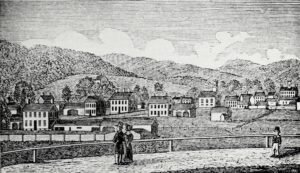
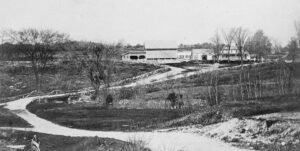
Southeastern View of Shelburne Falls Village Before 1835

The “History and Tradition of Shelburne, Massachusetts” is an account of the town’s development, initiated by a community effort in 1944. The project culminated in 1958 after various committees worked to collect and organize information across multiple aspects, including geology, early settlement, and cultural life. The book, intentionally topical rather than genealogical, features contributions from numerous writers and serves as a reference for understanding Shelburne’s heritage, institutions, and notable figures.

New Hampshire Men of Progress

1892 Map of New Hampshire

New Hampshire Men of Progress contains 289 biographical sketches and portraits of leaders in business and professional life in and of the state of New Hampshire. It was edited by the staff of the Manchester Union under the supervision of Richard Herndon.

Abington Massachusetts Marriage and Death Records

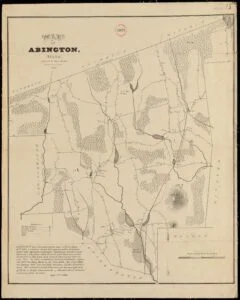
1830 Map of Abington, Massachusetts

Volume 2 of the Abington, Massachusetts vital records compiles marriage and death records up to 1850, complementing Volume 1, which contains birth records. Established in 1712, Abington’s boundaries have shifted, affecting historical jurisdiction. Extensive research from town records, cemeteries, and family Bibles ensured comprehensive documentation, including the identification of Black families recorded by given names. The volume is organized alphabetically by marriages and deaths.

New Hampshire State Builders

Birthplace of George Franklyn Willey in the Summer

State Builders, published in 1903, serves as a historical and biographical account of New Hampshire at the turn of the twentieth century. Authored by local writers, it covers the state’s development across various sectors including politics, education, and industry, while documenting the lives of notable residents. The volume reflects both continuity and change in the state’s traditions, making it a valuable reference for understanding New Hampshire’s institutions and influential figures during this pivotal period.

1932 New Hampshire Notables

1892 Map of New Hampshire

New Hampshire Notables,” published by the Concord Press in 1932, is a biographical compilation that follows a previous work by Henry H. Metcalf. It contains 474 brief sketches of notable individuals, both natives and residents of New Hampshire, recognized for their contributions across various fields such as public life, business, and education. This edition focuses on living subjects as of 1932, with an alphabetical index for easy reference. While not exhaustive, it serves as a valuable resource for researchers and libraries, preserving important biographical data.

History of Windham New Hampshire

Residence of William H Anderson of Windham, New Hampshire

Leonard A. Morrison’s *The History of Windham, New Hampshire*, published in 1883, chronicles the town’s evolution from early settlements in the 18th century to the late 19th century. It highlights Windham’s roots in the Scotch-Irish Londonderry community and examines various aspects of local life, including land grants, education, and political developments. The work also documents significant historical events and includes extensive genealogies of the area’s early settlers and their descendants, drawing from comprehensive local records and archives.

Genealogies of the Town of Goffstown New Hampshire

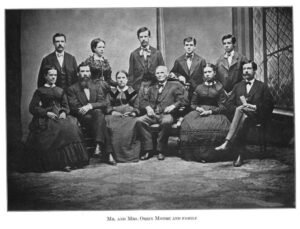
Orrin Moore and family of Goffstown, New Hampshire

The genealogical record of Goffstown, New Hampshire, was a substantial undertaking, hampered by the extinction of early families and the widespread scattering of descendants. Efforts to gather vital statistics necessitated considerable travel and correspondence, often revealing discrepancies in recorded dates across various sources. Despite challenges, contributions from former works and assistance from individuals proved invaluable in compiling this record. The comprehensive index reflects the depth of research involved in documenting the town’s heritage.

Vital Records of Bellingham, Massachusetts

Vital Records of Bellingham Massachusetts to the year 1850

Alphabetical indexes to the vital records of Bellingham, Massachusetts, up to the year 1850, supplemented by information from bible records, church registers, cemetery inscriptions and other private sources to include the diary kept by Samuel Wight and his daughters.

History of Amherst New Hampshire

Residence of Isaac Brooks in Amherst New Hampshire

The history of Amherst, New Hampshire, unfolds from its 1675 land grant to veterans of the Narraganset War, marking the impetus for settlement along the Souhegan River. From its early governance and incorporation in 1760 to territorial adjustments that birthed Mont Vernon and Milford, this narrative encompasses local geography, economy, and Indigenous presence. Key military engagements, civic institutions, and genealogical records are explored up to 1882, offering a comprehensive view of the town’s evolution and its prominent figures.

History of Hampton New Hampshire vol 2

1892 Map of Hampton NH

The original version of this monumental work was published in 2 volumes. Volume 1 contains the history of the town of Hampton, New Hampshire from its settlement in 1638 to the autumn of 1892 and can be found here. Volume 2 featured the genealogical and biographical details of the early families of Hampton, NH up to the autumn of 1892 and this is the volume shown below. This manuscript was meticulously researched by Joseph Dow up until his death in 1889. Unfortunately his death preceded the final compilation of the genealogies and his daughter, Lucy Ellen Dow, took on the task after his decease. For genealogists this is an important fact. Lucy admits in her preface that she had difficulty bringing the genealogies down to date (1892) for lack of full understanding of Josiah Page’s notes and for the lack of accurate town records. As she laments about the town records “but whole decades are passed over with scarcely an entry of birth or marriage.” Indeed they are.

History of Derby Connecticut, 1642-1880

Edmund Leavenworth of Derby, Connecticut

The book titled “History of the Old Town of Derby, Connecticut, 1642-1880” presents a comprehensive account of Derby’s development, including the town’s Indian history, early settlers, and significant events like the Revolutionary War. It emphasizes education, commerce, and church influences, while offering an extensive collection of biographies and genealogies.

Historical Sketch of Lisbon Connecticut, 1786-1900

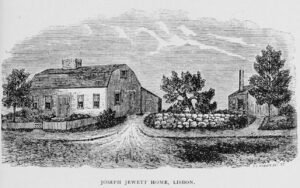
Joseph Jewett Home in Lisbon Connecticut

Though the work, Historical sketch of Lisbon, Conn., from 1786-1900, forms a modest octavo volume of only eighty-four pages, this book condenses within that limit the ecclesiastical and narrative history of the town, together with brief biographies and genealogies of its sons and daughters. The ecclesiastical history covers the sixty-eight years from 1718 to 1786 when Lisbon was a part of Norwich, and brings the record down to the 1900, embracing the Hanover parish, which celebrated its 125th anniversary in 1891. The narrative and descriptive history commences with Lisbon’s independent existence as a town, and comes down to the present day; and the brief biographical and genealogical sketches which follow occupy the last half of the book, and include lists of town officers, members of the General Assembly, and soldiers and sailors who served in the various wars of our country.

History of the town of Medford, Massachusetts

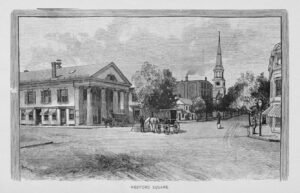
Medford Square about 1850

The History of the Town of Medford, Middlesex County, Massachusetts, from Its First Settlement in 1630 to 1885 (Boston, 1886) represents both a continuation and revision of Charles Brooks’s original 1855 history. Edited and supplemented by James M. Usher, with a genealogical register compiled by William H. Whitmore, this expanded edition incorporates Brooks’s extensive antiquarian research while extending the narrative to cover the developments of the following three decades. Drawing on scattered records, local traditions, and municipal documentation, the work preserves the character of Brooks’s text while providing a fuller account of Medford’s growth and a register of its early families.

Essex County Massachusetts Probate Records 1665-1674

Sample Last Will and Testament

The “Governor and Company of Massachusetts Bay” established a judicial system in 1628, with a General Court in Boston and quarterly courts in major towns like Salem and Ipswich by 1635. These courts managed probate matters, and after Essex County’s formation in 1643, individual probate courts were later established in 1692. These are the probate records from 1665 to 1674, sourced from various original documents, including detailed wills and estate settlements.

Essex County Massachusetts Probate Records 1635-1664

Sample Last Will and Testament

The “Governor and Company of Massachusetts Bay” established a judicial system in 1628, with a General Court in Boston and quarterly courts in major towns like Salem and Ipswich by 1635. These courts managed probate matters, and after Essex County’s formation in 1643, individual probate courts were later established in 1692. These are the probate records from 1635 to 1664, sourced from various original documents, including detailed wills and estate settlements.