Genealogies of Pembroke New Hampshire

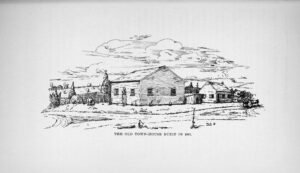
Old Pembroke NH Town House, built 1811

The “Genealogies of Pembroke, New Hampshire” is derived from the town’s second historical volume, and documents the connections of early settler families through the nineteenth century. It emphasizes families of the first settlers and families who resided in Pembroke over a long period of time. Organized alphabetically by surname, the genealogies use a consistent numbering system for easy reference. Carter draws from diverse sources, including town records and personal accounts of Pembroke’s citizens, while acknowledging possible inaccuracies in both their memory and the collection of information. However, by preserving these family lineages, Carter enhances the town’s historical narrative, complementing the first volume’s historical content. Supplementing this volume of genealogies is a compilation of marriage records which occurred in Pembroke, New Hampshire, from 1739 through 1895.

New Hampshire Men

1892 Map of New Hampshire

New Hampshire Men presents 407 biographical sketches, with portraits, of men who were active in commercial, professional, and political life in New Hampshire in 1893.

History of Francestown New Hampshire

Map of Francestown New Hampshire

History of Francestown, New Hampshire is a historic and genealogical record of the town from its first settlement in 1758 through the beginning of 1891. It records Francestown’s settlement, civic growth, religious and educational institutions, military participation, industries, and social customs, followed by an extensive genealogical register of families associated with the town.

Medway Massachusetts vital records

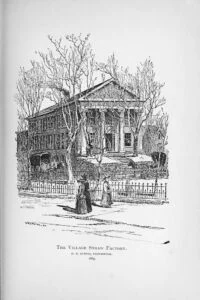
Medway Village Straw Factory

Alphabetical indexes to the vital records of Medway, Massachusetts, up to the year 1850, supplemented by information from church registers, cemetery inscriptions and other private sources to include Rev. Dr. Jacob Ide’s account of Marriages and Deaths, 1814-1849.

The history of Medway Massachusetts

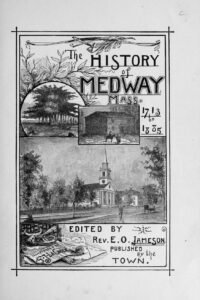
History of Medway title page

The History of Medway, Massachusetts, 1713–1885, covers the entire period of local history, embracing two hundred and twenty-five years, from 1660 to 1885; or, from the first appearance of a white settler within the territory, to the recent date of the incorporation of the town of Millis. The book is divided into ten sections, and gives, in consecutive order, an account of the first settlement, the municipal doings, the churches, the schools and other institutions, the industries, the military service, the miscellaneous matters, the cemeteries, the biographies of many persons, and the genealogies of numerous families.

Records of Ingham County Michigan Pioneer Families

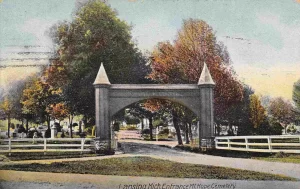
Entrance to Mt Hope Cemetery, Lansing, Michigan

These records were typed from manuscript copies of the original records made by George L. Hammell, which were willed to the Michigan State Library by Mr. Hammell of E. Lansing, Mich. who died Sept. 26, 1952. They consist of a variety of typed sources including Bible records, cemetery records, family records, and probate records for early families of Ingham County, Michigan.

Southborough Massachusetts vital records

Vital records of Southborough, Massachusetts, to the end of the year 1849 title page

The list of vital records of Southborough, Massachusetts, comprised in this volume includes all which were entered in the Town Books during the period from the earliest date there found to the end of the year 1849. Some additions and corrections of names and dates have been made from the records of the First Church, these being indicated in each instance by proper reference. There are a total of 6,267 births, marriages, and deaths recorded. This book is free to read or download.

Brown Genealogy

Brown Genealogy

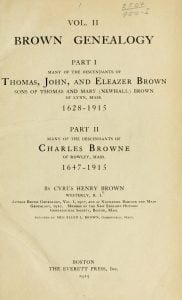
In 1895, Cyrus Henry Brown began collecting family records of the Brown family, initially with the intention of only going back to his great-grandfathers. As others became interested in the project, they decided to trace the family lineage back to Thomas Brown and his wife Mary Newhall, both born in the early 1600s in Lynn, Massachusetts. Thomas, John, and Eleazer, three of their sons, later moved to Stonington, Connecticut around 1688. When North Stonington was established in 1807, the three brothers were living in the southern part of the town. Wheeler’s “History of Stonington” contains 400 records of early descendants of the Brown family, taken from the town records of Stonington. However, many others remain unidentified, as they are not recorded in the Stonington town records. For around a century, the descendants of the three brothers lived in Stonington before eventually migrating to other towns in Connecticut and New York State, which was then mostly undeveloped. He would eventually write this second volume of his Brown Genealogy adding to and correcting the previous edition. This book is free to search, read, and/or download.

History of Littleton New Hampshire

1895 Map of Littleton New Hampshire

The History of Littleton New Hampshire is comprised of three volumes, two volumes of history, and a final volume of genealogies. Considered one of the best examples of local history written in the early 20th century, is your ancestors resided in Littleton then you need these books. Read and download for free!

The Cox family in America

The Cox family in America

Two volumes of Cox family genealogy combined as one. The first volume contains information about the various early Cox families across America. The second volume deals specifically with the descendants of James and Sarah Cock of Killingworth upon Matinecock, in the township of Oysterbay, Long Island, New York.

History of Minneapolis and Hennepin County, Minnesota

History of Minneapolis and Hennepin County, Minnesota

The aim of this history was to present in a permanent form the key incidents in the history of Minneapolis, from its earliest settlement to its publication in 1895. The primary facts and events recounted were mostly obtained from living witnesses and participants. It was rare for a city with more than two hundred thousand inhabitants to have so many of its first settlers still alive. The city’s growth had been so extraordinary and unprecedented that many of its earliest settlers remained. Some information was also gleaned from the notes left by now-deceased writers who witnessed the events described. Great care was taken to verify the accuracy of all facts and incidents mentioned. While it might have been too much to hope that the work was entirely free from errors, it was confidently believed that any such errors were few and insignificant.

Wainwright and related families

Wainwright and related families

These sketches were written primarily to trace the paternal ancestry of Mary Wainwright who was born in Somerset County, Maryland, May 11, 1818. She married, November 15, 1837, William Underwood Roberts. They became the parents of a family of six sons and five daughters, all of whom were born at Jesterville and lived to mature years. Mary Wainwright Roberts had, at the time of her death, October 11, 1904, at the age of eighty-six years, more than eighty living descendants. Her ancestry involves, besides her Wainwright forebears, the Cannons, the Bloyces, the Evanses, the Streets, the Rices, and others about whom something is said in this sketch, as well as several other ancient Somerset families.

A Genealogy of the Lake Family

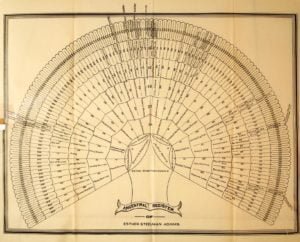
Ancestor Register of Esther Steelman Adams

A genealogy of the Lake family of Great Egg Harbour in Old Gloucester County in New Jersey : descended from John Lade of Gravesend, Long Island; with notes on the Gravesend and Staten Island branches of the family. This volume of nearly 400 pages includes a coat-of-arms in colors, two charts, and nearly fifty full page illustrations – portraits, old homes, samplers, etc. The coat-of-arms shown in the frontspiece is an unusually good example of the heraldic art!

Progressive Men of Western Colorado

Early Life in Colorado

This manuscript, in its essence, is a collection of 948 biographies of prominent men and women, all leading citizens of Western Colorado. In this context, Western Colorado encompasses the counties of Archuleta, Chaffee, Delta, Eagle, Garfield, Gunnison, Hinsdale, La Plata, Lake, Mesa, Mineral, Moffat, Montezuma, Montrose, Ouray, Pitkin, Rio Blanco, Routt, San Juan, and San Miguel.

Richard Dexter Genealogy, 1642-1904

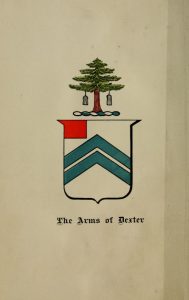
Arms of Dexter

Being a history of the descendants of Richard Dexter of Malden, Massachusetts, from the notes of John Haven Dexter and original researches. Richard Dexter, who was admitted an inhabitant of Boston (New England), Feb. 28, 1642, came from within ten miles of the town of Slane, Co. Meath, Ireland, and belonged to a branch of that family of Dexter who were descendants of Richard de Excester, the Lord Justice of Ireland. He, with his wife Bridget, and three or more children, fled to England from the great Irish Massacre of the Protestants which commenced Oct. 27, 1641. When Richard Dexter and family left England and by what vessel, we are unable to state, but he could not have remained there long, as we know he was living at Boston prior to Feb. 28, 1642.

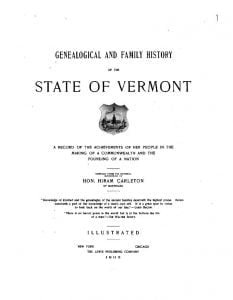
Genealogical and Family History of Vermont

Genealogical and Family History of the State of Vermont vol 1

Hiram Charlton took on the publication of the Genealogical and Family History of the State of Vermont for Lewis Publishing. In it, he enlisted the assistance of living residents of the state in providing biographical and genealogical details about their family, and then he published all 1104 family histories in two distinct volumes.

History of the Methodist Church at Norwich Vermont

Rev. Emanuel C. Charlton

Methodism in Vermont began to establish itself around 1796, with its first society formed in Vershire. The movement saw rapid growth, particularly in the early 19th century. In Norwich, Methodist meetings were initiated by circuit preachers by the early 1810s, leading to the construction of the first church around 1815. The current brick church at Union Village was built in 1836. Over the years, the community has faced population declines, yet the Methodist Episcopal Society of Norwich and Thetford continues to thrive, with about 150 families currently participating.

Biography of George J. Gale

George James Gale, born on August 1, 1819, in Hampstead, England, immigrated to Lower Canada at age fourteen. He spent years in retail before settling in Grey County in 1843, where he held numerous civic positions including Clerk of the County Council. An active politician and Orangeman, he declined a parliamentary nomination. Notably, he auctioned the Indian Peninsula, earning commendation from Sir Edmund Head. Gale was a dedicated church member and family man, married to Ann Woolrich, with one surviving son, John.