Samuel Lane’s Journal, 1739-1803

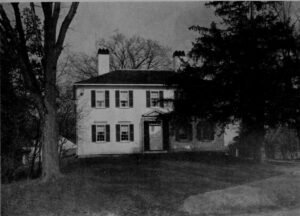
Jabez Lane House

Samuel Lane’s journal, covering 1739 to 1803, chronicles the life of a New Hampshire resident who experienced the colonial, Revolutionary, and early national periods. Lane transitioned from farming to various professions, including tanner and shoemaker, while actively participating in community roles. His meticulously kept journal captures local and national events, personal reflections, and societal changes. Edited by Charles Lane Hansen in 1937, it serves as a crucial primary source, offering insights into the daily life, hardships, and resilience of 18th-century New England.
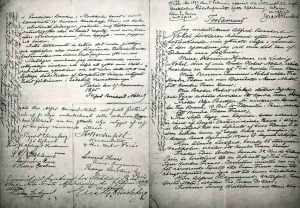
Essex County Massachusetts Probate Records 1675-1681

Sample Last Will and Testament

The “Governor and Company of Massachusetts Bay” established a judicial system in 1628, with a General Court in Boston and quarterly courts in major towns like Salem and Ipswich by 1635. These courts managed probate matters, and after Essex County’s formation in 1643, individual probate courts were later established in 1692. These are the probate records from 1675 to 1681, sourced from various original documents, including detailed wills and estate settlements.

Wintergreen Cemetery, Port Gibson, Mississippi

Wintergreen Cemetery, Port Gibson, Mississippi

This survey of Wintergreen Cemetery, Port Gibson, Mississippi, was completed in 1956 by Mr. Gordon M. Wells and published by Joyce Bridges the same year. It contains the cemetery readings Mr. Wells was able to obtain at that date. It is highly likely that not all of the gravestones had survived up to that point, and it is even more likely that a large portion of interred individuals never had a gravestone.

Stephenson County Illinois World War 1 Veterans

Honor roll of the Great War, Stephenson County, 1917-1919

This small booklet contains all the known men and women who participated in World War 1 and claimed their home of record as Stephenson County, Illinois. By participation, this record does not limit this to soldiers, but also contains the records of those men and women who served the Red Cross, Y.M.C.A., and other non-fighting positions. This book is free to read or download.

History of Adair County Iowa and its People – vol 2

History of Adair County, Iowa, and its people vol 2 title page

Back in 1915, Lucian Moody Kilburn, was engaged to write a history of Adair County Iowa by the Pioneer Publishing Company of Chicago Illinois, he then being at that time a resident of the county for 50 years. The manuscript was divided into two volumes. This volume, numbered 2, provides biographical sketches of 348 leading men and women of the County of Adair including many of its founding families. You can read or download the free eBook from this website.

Brown Genealogy

Brown Genealogy

In 1895, Cyrus Henry Brown began collecting family records of the Brown family, initially with the intention of only going back to his great-grandfathers. As others became interested in the project, they decided to trace the family lineage back to Thomas Brown and his wife Mary Newhall, both born in the early 1600s in Lynn, Massachusetts. Thomas, John, and Eleazer, three of their sons, later moved to Stonington, Connecticut around 1688. When North Stonington was established in 1807, the three brothers were living in the southern part of the town. Wheeler’s “History of Stonington” contains 400 records of early descendants of the Brown family, taken from the town records of Stonington. However, many others remain unidentified, as they are not recorded in the Stonington town records. For around a century, the descendants of the three brothers lived in Stonington before eventually migrating to other towns in Connecticut and New York State, which was then mostly undeveloped. He would eventually write this second volume of his Brown Genealogy adding to and correcting the previous edition. This book is free to search, read, and/or download.

A Genealogy of the Lake Family

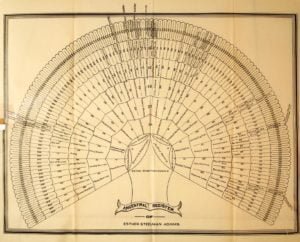
Ancestor Register of Esther Steelman Adams

A genealogy of the Lake family of Great Egg Harbour in Old Gloucester County in New Jersey : descended from John Lade of Gravesend, Long Island; with notes on the Gravesend and Staten Island branches of the family. This volume of nearly 400 pages includes a coat-of-arms in colors, two charts, and nearly fifty full page illustrations – portraits, old homes, samplers, etc. The coat-of-arms shown in the frontspiece is an unusually good example of the heraldic art!

Kansas Registrations of Enemy Aliens, 1917 – 1921

Enemy Alien Registration Affidavit for Bernhardt Vick - Cropped Photo

The series contains original affidavits of registration that record personal information about each registrant, their photograph affixed to the majority of documents, and the registrants fingerprints. All of these are specific to Kansas, and most have the actual documents attached.

Knowles Family of New Bedford, MA

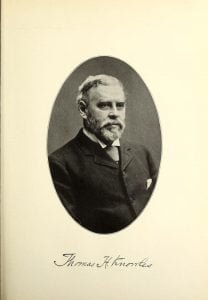
thomas knowles

The Knowles family, established in New Bedford for nearly a century, descends from the ancient lineage in Eastham, Massachusetts. Key figures include Thomas and James H. Knowles, whose firm was pivotal in the whaling industry. The family name was upheld by later generations engaged in diverse business and civic roles, greatly impacting local commerce and community welfare. Noteworthy individuals include Capt. John P. Knowles, a prominent whaling captain, and Joseph Knowles, influential in cotton manufacturing. The family’s legacy intertwines with New Bedford’s rich maritime history.

Descendants of Alexander Bisset Munro of Bristol, Maine

Munro Family

Alexander Bisset Munro was born 25 Dec. 1793 at Inverness, Scotland to Donald and Janet (Bisset) Munro. Alexander left Scotland at the age of 14, and lived in Dimecrana in the West Indies for 18 years. He owned a plantation, raising cotton, coffee and other produce. He brought produce to Boston Massachusetts on the ship of Solomon Dockendorff. To be sure he got his money, Solomon asked his to come home with him, where he met Solomon’s sister, Jane Dockendorff. Alexander went back to the West Indies, sold out, and moved to Round Pond, Maine, and married Jane. They had 14 children: Janet, Alexander, Margaret, Nancy, Jane, Mary, Solomon, Donald, John, William, Bettie, Edmund, Joseph and Lydia.

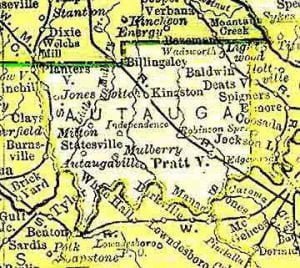
Autauga County Alabama Genealogy

Autauga County, Alabama

An extensive collection of material relating to Autauga County Alabama genealogy, includes vital records, cemeteries, census, history, and other records.

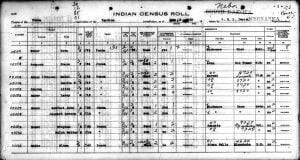
1930 Ponca Census Extraction

Ponca Census Image

An extraction of the 1930 Indian Census for the Ponca tribe of the Ponca Reservation in South Dakota. In 1930 there were 398 members that fell under the jurisdiction of the Yankton Agency. Most of them still resided within the Ponca Reservation, but some had moved elsewhere and are so indicated within the actual census images. This extraction provides their given names, surnames, sometimes the maiden name, age, and sex of each tribal member.

Wolfe, Edith May Byram – Obituary

Edith May Byram Wolfe, born May 14, 1872, in Minnesota, moved to Fremont, Iowa, in 1874. She married F. Wolfe on December 13, 1892, and they had four children. A devoted member of the Highland Church, she passed away on January 13, 19009, at the age of 26, leaving behind her husband, children, and many mourning relatives and friends. Her funeral was held at the Fremont Baptist Church, with interment at Cedar Township Cemetery, attended by numerous mourners from afar.

Montana Land Patents – Crow Tribe

A detailed list of Montana land patents for members of the Crow Tribe, showing patentee names, dates, document numbers, and accession numbers. The record includes both Native and non-Native patentees, with many entries repeated across dates, and serves as a historical reference for land ownership and federal patent records in early 20th-century Montana.

Slave Narrative of Victoria Taylor Thompson

Victoria Taylor Thompson, an 80-year-old former slave, recounts her life born to Judy Taylor in the Flint District near Caney Creek, Oklahoma. Her father was bought by the Taylors, and she details a life of relative comfort compared to other slaves. She describes her family’s labor on the farm, her mother’s cooking, and her upbringing, including learning to weave from her mistress. After the Civil War, she faced further hardships, including abduction. Thompson reflects fondly on her past, expressing a desire to revisit her childhood home.