Biographical Sketch of Monroe White

Monroe White, born on August 9, 1844, in Coles County, Illinois, cultivated a life centered around farming. After working alongside his father until the age of 21, he married Mary E. Hall on November 16, 1865. Together, they raised four children: Sarah, Hannah, Millie, and Lucy. A dedicated community member, Monroe served as School Director for five years. His family roots trace back to Ohio and Kentucky, reflecting a rich heritage in the region’s agricultural history.
Biographical Sketch of John Craig White

John Craig White, a farmer and blacksmith from Sec. 15, Campbell, owned 120 acres of land. Born in Scott County, Kentucky, on December 5, 1830, he lived on his family farm until he was 19. He first married Louisa Beckum in 1855, who passed away in 1859, and later wed Sarah Elizabeth Kemper in 1862. Together, they had eight children, though several did not survive. Both of White’s parents hailed from Kentucky, reflecting his strong familial ties to the region.

Biography of Albert S. White

Albert S. White, born in 1840 in Belfast, Maine, became a prominent horticulturist in Riverside, California. Initially involved in ship-chandlery in New York, his health led him to seek a warmer climate, ultimately finding refuge in Riverside. Here, he cultivated a successful forty-acre orange grove and became integral to the community, organizing its first citrus fair and contributing to various local enterprises, including the water supply and education. A dedicated Republican, he earned respect as a public-spirited citizen, though he remained a lifelong bachelor.

More Victims of Anti-Slavery Act – Fugitive Slave Law

In 1852, a series of arrests and violent encounters involving alleged fugitive slaves unfolded across various states, highlighting the harsh realities of the Fugitive Slave Law. William Smith was shot by a marshal during an escape attempt, while James Phillips was returned to slavery after over a decade of freedom. Other cases included multiple arrests and court decisions that enforced the return of people to slavery, often amidst violent confrontations. These incidents reflect the law’s brutal enforcement and the desperate resistance of those affected.

Carlisle Indian Industrial School Graduates 1906 – 1910

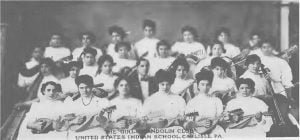
Girls Choir Carlisle Indian School

The Carlisle Indian Industrial School, located in Pennsylvania’s Cumberland Valley, served Indigenous students from 1889 to 1910. It transformed a former cavalry barrack into an educational institution where students were trained in various professions. Graduates from classes ranging from 1906 to 1910 pursued diverse careers such as housewives, teachers, and laborers. Notable alumni include law students, nurses, and mechanics, reflecting the school’s impact on Indigenous education and workforce integration during this period.

Surname Wagoner to Young

This document contains genealogical statements regarding various individuals and families of Creek, Choctaw, Chickasaw, and Mississippi Choctaw descent who sought recognition and enrollment in tribal rolls. The records, primarily from 1909 reports, detail claimants’ ancestry, enrollment issues, and tribal affiliations. Many individuals were denied enrollment due to factional disputes, legal technicalities, or failure to apply within deadlines.

Six Related Choctaw Cases

The Dawes Commission records from 1896 document the citizenship applications of multiple families—Marlow, Beal, Caldwell, Marrs, Underwood, and White—claiming Choctaw heritage through a common ancestor, John Patterson. Some applicants were admitted as citizens of the Choctaw Nation, while others were denied and later appealed to U.S. courts. Despite favorable rulings for some, a 1904 decision by the Choctaw-Chickasaw Citizenship Court overturned many approvals.

List 2, Creeks

List of Creeks and Creek Freedmen, whose names were omitted from final rolls because no application was made or by reason of mistake or oversight. Shows the names of 62 persons of Creek blood and of 2 Creek freedmen all of whom except 10 are minors. Since the approved rolls of Creek citizens by blood contain 11,967 names, and the rolls of Creek freedmen contain 6,837 names, it is seen that the percentage of omissions is remarkably small.

1910 Census of Fort Shaw Industrial Indian School

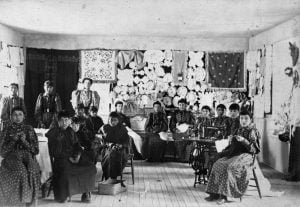
Girls at the Fort Shaw Indian School

Fort Shaw Industrial Indian Boarding School, established in Montana in 1891, ceased operations on June 30, 1910, due to decreasing enrollment. Known for its 1904 girls basketball team, which won a championship at the St. Louis World’s Fair, the school played a significant role in Indigenous education during its tenure. The 1910 census was compiled under the Department of the Interior to record enrolled students as part of Circular #448. Relevant records are preserved in the National Archives and the Family History Library.

John R. White Application Packet

John R. White, a white man married to a Choctaw woman, applied for enrollment with the Commission, following standard procedures for intermarried applicants. His application packet includes personal correspondence, examination details, character references, marriage documentation, and enrollment requests for his children. The Commission provided letters outlining their decision to enroll him based on his marriage and residence within the Choctaw Nation. The packet highlights the formalities involved in confirming his status and that of his children as citizens.

Biographies of the Cherokee Indians

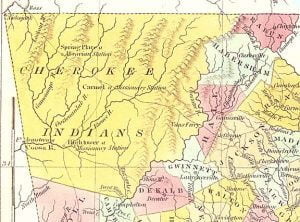
1830 Map of Cherokee Territory in Georgia

The Cherokee Indians, primarily from the Southeastern U.S., have a rich history marked by their early adoption of a written language and a government structure similar to that of the United States. Despite their forced relocation to Oklahoma in the 1830s, they maintained significant genealogical ties, often intermarrying with Whites. Emmet Starr’s “History of the Cherokee Indians and Their Legends and Folklore” emphasizes personal biographies and genealogies, providing insights into the lives and connections of many Cherokee families across generations, thereby enriching their cultural narrative.

Native Burials in Mendocino County, California

A compiled list of known burials in Mendocino County, California, documents Native American families and descendants interred in local cemeteries, including Hopland, Yokayo, Pinoleville, Laytonville, Redwood Valley, Sherwood, and others. Entries note names, dates, sources such as tombstones, obituaries, and mortuary records, plus family relationships, military service, and research-based details.

Cherokee Advocate, November 1886

A historic roundup from the Cherokee Advocate’s November 3, 1886 issue, featuring local news, council updates, hotel guest lists, and community notes from Tahlequah Indian Territory. The issue includes Chief Bushyhead’s message, a Supreme Judge election reminder, reports on notable visitors, farm produce, and the arrest of Aaron B. Ingram.

Rough Riders

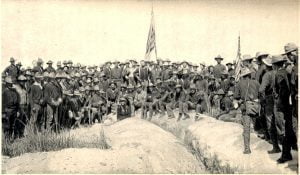
Rough Riders

The compiled military service records of 1,235 Rough Riders, including Theodore Roosevelt, have been digitized. Each record features individual jackets detailing the soldier’s name, organization, rank, and medical records. The records also contain personal information and documentation descriptions. Discharges occurred for various reasons, such as age, ability, discipline issues, or hardship. This initiative provides significant insights into the personnel of the 1st U.S. Volunteer Cavalry during the Spanish-American War.

Biography of Frebun Elwin White

Frebun Elwin White, born on February 18, 1853, in Williamsburg, Massachusetts, was a notable descendant of Captain Thomas White, an early settler and military leader in Weymouth. Educated locally, he worked in cutlery manufacturing for twenty years before acquiring a village farm and express business, which he managed for eighteen years. A respected community member, Frebun married Julia E. Webster in 1875, and they had several children. He is remembered as a steadfast citizen, maintaining a vigorous presence into retirement.

Alton Arno Schmidt – Obituary

Alton Arno Schmidt, 87, of Richland, Oregon, passed away on January 15, 2002. He requested no formal service, with a memorial to be held in the spring. Born on June 7, 1914, in Pine Valley, Alton was a multi-talented individual, engaged in various professions including ranching and construction. Known for his creativity and resourcefulness, he maintained a positive outlook despite a spinal cord injury in 1982. He is survived by his wife, daughter, grandchildren, and extended family. Memorial contributions may be made to the Richland Ambulance.

Biography of S. S. White

S.S. White, born in Franklin County, Indiana, in 1811, became a significant figure in Oregon’s early history. He migrated to Oregon in 1845, where he served as chief justice of Clackamas County and later as a state legislator. White was involved in legislative actions following the Whitman massacre and participated in the gold rush to California in 1848. He returned to Oregon to engage in various entrepreneurial ventures, including the construction of the first steamer on local waters. White remained active in Portland until his later years.

Biographical Sketch of Caleb N. White

Caleb N. White, born in Illinois in 1850, exemplifies the spirit of self-made success in the Western United States. His family journeyed across the plains in 1864 but faced hardships, including his father’s death and the theft of their cattle. Settling in Grande Ronde valley, Caleb and his brother worked to support their family. After claiming land in Indian Valley in 1871 and enduring personal loss, he built a successful cattle operation and earned respect as a community leader during the Nez Perce trouble. He is a family man with six children.