History of Newport New Hampshire

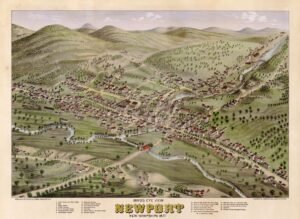
Bird's Eye View of Newport New Hampshire 1877

The History of Newport, New Hampshire, from 1766 to 1878 is a record of Newport’s growth from its early settlement through the close of the nineteenth century. It opens with the original charter and proprietary arrangements and follows the development of Newport’s physical setting, transportation routes, and economy. Particular attention is given to mills, banks, hotels, manufacturing, and the coming of the railroad, all of which shaped the town’s commercial life. The concluding genealogical section identifies families connected with Newport and other chapters provide biographical details that might otherwise be lost.
Samuel Lane’s Journal, 1739-1803

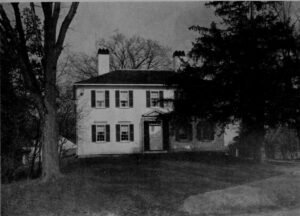
Jabez Lane House

Samuel Lane’s journal, covering 1739 to 1803, chronicles the life of a New Hampshire resident who experienced the colonial, Revolutionary, and early national periods. Lane transitioned from farming to various professions, including tanner and shoemaker, while actively participating in community roles. His meticulously kept journal captures local and national events, personal reflections, and societal changes. Edited by Charles Lane Hansen in 1937, it serves as a crucial primary source, offering insights into the daily life, hardships, and resilience of 18th-century New England.

Vital records of Stratham, New Hampshire, 1700-1867

Plan of the Town of Stratham

In 1934, Priscilla Hammond compiled vital records from Stratham, New Hampshire, covering the years 1700 to 1867, based on original town records. This compilation, transcribed with imperfect typing, was privately published and distributed to libraries and societies. The records are presented largely as found, with family members often grouped together. An index is included to assist in locating individual records. Users should be cautious with dates, especially those before 1752, as it is unclear if old dates were converted.

New Hampshire Men

1892 Map of New Hampshire

New Hampshire Men presents 407 biographical sketches, with portraits, of men who were active in commercial, professional, and political life in New Hampshire in 1893.

New Hampshire Men of Progress

1892 Map of New Hampshire

New Hampshire Men of Progress contains 289 biographical sketches and portraits of leaders in business and professional life in and of the state of New Hampshire. It was edited by the staff of the Manchester Union under the supervision of Richard Herndon.

Abington Massachusetts Marriage and Death Records

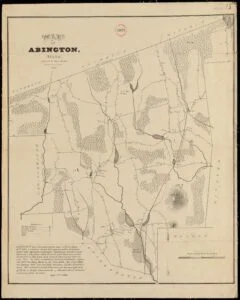
1830 Map of Abington, Massachusetts

Volume 2 of the Abington, Massachusetts vital records compiles marriage and death records up to 1850, complementing Volume 1, which contains birth records. Established in 1712, Abington’s boundaries have shifted, affecting historical jurisdiction. Extensive research from town records, cemeteries, and family Bibles ensured comprehensive documentation, including the identification of Black families recorded by given names. The volume is organized alphabetically by marriages and deaths.

Abington Massachusetts Birth Records

1830 Map of Abington, Massachusetts

Volume 1 of the Abington, Massachusetts vital records details births recorded in the town up to 1850, featuring comprehensive research from town records, cemeteries, and church documents. Established in 1712, Abington’s jurisdictional changes may affect genealogical searches. The records also include separate listings for Black families, primarily by given names. Additionally, various surnames are cataloged, emphasizing the need to consider alternate spellings. For marriages and deaths, researchers should consult Volume 2.

1932 New Hampshire Notables

1892 Map of New Hampshire

New Hampshire Notables,” published by the Concord Press in 1932, is a biographical compilation that follows a previous work by Henry H. Metcalf. It contains 474 brief sketches of notable individuals, both natives and residents of New Hampshire, recognized for their contributions across various fields such as public life, business, and education. This edition focuses on living subjects as of 1932, with an alphabetical index for easy reference. While not exhaustive, it serves as a valuable resource for researchers and libraries, preserving important biographical data.

Genealogies of the Town of Goffstown New Hampshire

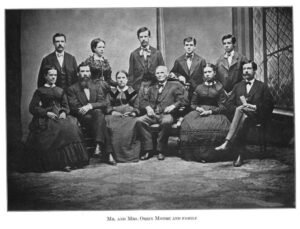
Orrin Moore and family of Goffstown, New Hampshire

The genealogical record of Goffstown, New Hampshire, was a substantial undertaking, hampered by the extinction of early families and the widespread scattering of descendants. Efforts to gather vital statistics necessitated considerable travel and correspondence, often revealing discrepancies in recorded dates across various sources. Despite challenges, contributions from former works and assistance from individuals proved invaluable in compiling this record. The comprehensive index reflects the depth of research involved in documenting the town’s heritage.

History of Hampton New Hampshire vol 2

1892 Map of Hampton NH

The original version of this monumental work was published in 2 volumes. Volume 1 contains the history of the town of Hampton, New Hampshire from its settlement in 1638 to the autumn of 1892 and can be found here. Volume 2 featured the genealogical and biographical details of the early families of Hampton, NH up to the autumn of 1892 and this is the volume shown below. This manuscript was meticulously researched by Joseph Dow up until his death in 1889. Unfortunately his death preceded the final compilation of the genealogies and his daughter, Lucy Ellen Dow, took on the task after his decease. For genealogists this is an important fact. Lucy admits in her preface that she had difficulty bringing the genealogies down to date (1892) for lack of full understanding of Josiah Page’s notes and for the lack of accurate town records. As she laments about the town records “but whole decades are passed over with scarcely an entry of birth or marriage.” Indeed they are.

Brown Genealogy

Brown Genealogy

In 1895, Cyrus Henry Brown began collecting family records of the Brown family, initially with the intention of only going back to his great-grandfathers. As others became interested in the project, they decided to trace the family lineage back to Thomas Brown and his wife Mary Newhall, both born in the early 1600s in Lynn, Massachusetts. Thomas, John, and Eleazer, three of their sons, later moved to Stonington, Connecticut around 1688. When North Stonington was established in 1807, the three brothers were living in the southern part of the town. Wheeler’s “History of Stonington” contains 400 records of early descendants of the Brown family, taken from the town records of Stonington. However, many others remain unidentified, as they are not recorded in the Stonington town records. For around a century, the descendants of the three brothers lived in Stonington before eventually migrating to other towns in Connecticut and New York State, which was then mostly undeveloped. He would eventually write this second volume of his Brown Genealogy adding to and correcting the previous edition. This book is free to search, read, and/or download.

The Amidon Family of Rehoboth, MA

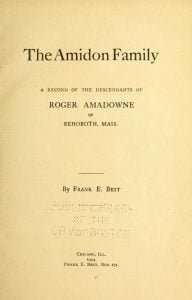
The Amidon Family

The Amidon Family genealogy book details the lineage of Roger Amadowne, a French Huguenot who fled to England and later to America after the revocation of the Edict of Nantes. Documented in Salem, Massachusetts in 1637, variations of his surname include Amadon, Amidown, and Ammidon. The work, organized with biographical sketches and two helpful indexes, presents the family’s history and is richly illustrated. Originally published in 1904, it serves as a valuable resource for descendants and historians alike.

History of Littleton New Hampshire

1895 Map of Littleton New Hampshire

The History of Littleton New Hampshire is comprised of three volumes, two volumes of history, and a final volume of genealogies. Considered one of the best examples of local history written in the early 20th century, is your ancestors resided in Littleton then you need these books. Read and download for free!

History of old Chester from 1719 to 1869

History of Old Chester title page

The *History of Old Chester from 1719 to 1869* by Benjamin Chase, published in 1869, offers a detailed account of the early settlement and development of Chester, New Hampshire. Compiled with the assistance of local historian Judge Samuel D. Bell, the book explores the town’s founding, genealogies, and significant events, using primary sources such as deeds, probate records, and personal diaries. Chase aimed to preserve the history and traditions of Chester’s early settlers while providing a comprehensive record for future generations. The work covers a broad range of topics, including religious, military, industrial, and genealogical history.

A history of Parsonsfield Maine

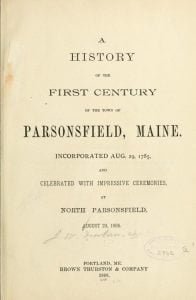
A history of Parsonsfield Maine

A history of the first century of the town of Parsonsfield, Maine. Incorporated Aug 29, 1785, and celebrated with impressive ceremonies at North Parsonfield August 29, 1885.

Abbott Genealogical Register

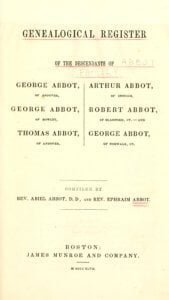
Abbott Genealogical Register

In 1847, Abiel Abbot and Ephraim Abbot compiled a comprehensive genealogical record titled “Abbott Genealogical Register,” detailing the lineage of several Abbott families originating from early New England settlers. Initially aimed to document the descendants of George Abbot, Sr. of Andover, the scope expanded to include numerous branches such as George Abbot, Jr., Thomas Abbot of Andover, Arthur Abbot of Ipswich, Robert Abbot of Branford, Ct., and George Abbot of Norwalk, Ct., among others. This volume, published by J. Munroe and Company in Boston, Massachusetts, integrates meticulously gathered data, revealing the expansive and intertwined genealogies of the Abbott families. The authors’ painstaking research and dedication to accuracy, despite challenges in data completeness, provide a valuable resource for anyone tracing the Abbott lineage or studying early American familial structures.

History of Minneapolis and Hennepin County, Minnesota

History of Minneapolis and Hennepin County, Minnesota

The aim of this history was to present in a permanent form the key incidents in the history of Minneapolis, from its earliest settlement to its publication in 1895. The primary facts and events recounted were mostly obtained from living witnesses and participants. It was rare for a city with more than two hundred thousand inhabitants to have so many of its first settlers still alive. The city’s growth had been so extraordinary and unprecedented that many of its earliest settlers remained. Some information was also gleaned from the notes left by now-deceased writers who witnessed the events described. Great care was taken to verify the accuracy of all facts and incidents mentioned. While it might have been too much to hope that the work was entirely free from errors, it was confidently believed that any such errors were few and insignificant.

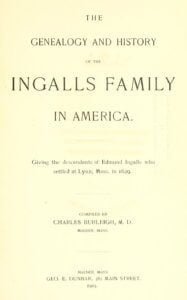
The genealogy and history of the Ingalls family in America

The genealogy and history of the Ingalls family in America

Edmund Ingalls, son of Robert, was born about 1598 in Skirbeck, Lincolnshire, England. He immigrated in 1628 to Salem, Massachusetts and with his brother, Francis, founded Lynn, Massachusetts in 1629. He married Ann, fathered nine children, and died in 1648.

Flint Family of Fall River, MA

John Dexter Flint, a prominent merchant and philanthropist of Fall River, Massachusetts, was born on April 26, 1826, in North Reading. A son of modest means, Flint’s industrious spirit led him to establish a successful business in tin and hardware, which expanded to include furniture. A devoted churchman, he contributed generously to various charitable endeavors and was a key player in local banking and mill enterprises. Flint’s death on August 28, 1907, marked the loss of a respected leader whose legacy continues to shape Fall River’s community.