Descendants of Benjamin S. Atwood of Whitman, MA
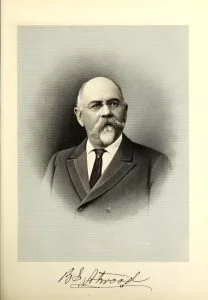
Benjamin S. Atwood

Benjamin S. Atwood, born June 25, 1840, in Carver, MA, was a prominent box manufacturer in Whitman and a respected Civil War veteran. His lineage traces back to John Atwood, an early Plymouth Colony settler. Atwood’s commitment to his community was exemplified by his role in establishing Whitman’s waterworks and his staunch defense of workers’ rights against union pressures. A Republican and active Mason, Atwood’s legacy includes a successful business and a reputation for fairness and integrity, reflecting the values of his forefathers.
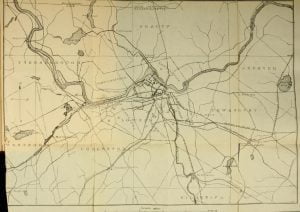
Lowell Massachusetts Genealogy

1894 Map of Lowell

Tracing ancestors in Lowell, Massachusetts online and for free has been greatly enhanced by the University of Massachusetts in Lowell which provided digitized version of a large quantity of the Lowell public records. Combined with the cemetery and census records available freely online, you should be able to easily trace your ancestors from the founding of Lowell in 1826 through 1940, the last year of available census records. To add color to the otherwise basic facts of your ancestors existence we provide free access to a wide range of manuscripts on the history of Lowell, it’s manufactures and residents.

The Settlers of Narraguagus Valley Maine

Narraguagus Valley Some Account of its Early Settlement and Settlers

The early settlement of the Narraguagus River in Washington County, Maine, involved significant developments in nearby towns such as Steuben, Milbridge, Harrington, and Cherryfield. Established between 1791 and 1816, these towns evolved from former townships. Key early settlers included Jabez Dorman, John Densmore, Ichabod Willey, and Samuel Colson, who arrived around 1757. Their families contributed to the growth of the region, establishing roots and communal records that reflect the intertwined histories of these communities. Notably, many surnames from the early settlers persist in the area today.

Atkinson Family Genealogy of Saco Valley

The Atkinson family, originally from Bury, England, emigrated to New England in 1634. Theodore Atkinson, the first of the line, settled in Boston and established a prosperous estate. His descendants include notable figures such as Hon. Theodore Atkinson of Portsmouth and various family members who became prominent in trade, religion, and community affairs across New England. The lineage continued through several generations, resulting in multiple branches in Buxton and Eaton, N.H., with individuals engaged in diverse occupations and contributing to local history.

Representative Men of Maine – Biographical Sketches and Portraits

Representative Men of Maine Title Page

A historical collection of portraits and biographical sketches of prominent Maine residents in business, industry, the professions, and politics, along with profiles of every governor since statehood in 1820. Published in 1893, it offers a rich snapshot of the people who shaped Maine’s public life and leadership.

1899 Directory for Middleboro and Lakeville Massachusetts

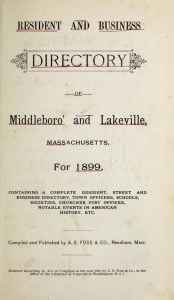
1899 Middleboro and Lakeville Massachusetts Directory Cover

The 1899 Directory for Middleboro and Lakeville, Massachusetts, compiled by A. E. Foss & Co., provides a comprehensive list of residents and businesses, alongside town officers, schools, churches, and societies. It includes notable historical events and offers a detailed account of the local community, featuring numerous surnames from both towns. This directory serves as an essential resource for understanding the demographics and social structure of Middleboro and Lakeville during that period.

History of Norwich Vermont Education

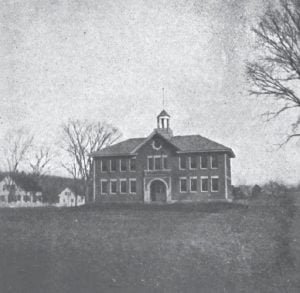
High School Building, Norwich Village, Erected in 1898

The history of education in Norwich, Vermont, traces back to efforts in 1782 to establish school districts. The first successful division occurred in 1785, creating the First School District. Over the years, multiple districts were formed, with the establishment of a committee for school supervision in 1824. Notable developments included the construction of a brick schoolhouse in 1845 and the incorporation of the Norwich Classical and English Boarding School in 1867, although it ultimately closed in 1877. The town’s education framework evolved significantly, culminating in a unified system in 1892.

History of the Bridges Between Hanover NH and Norwich VT

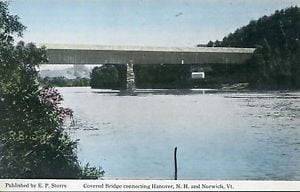
Norwich-Hanover covered bridge

The first recorded crossing of the Connecticut River between Norwich, VT, and Hanover, NH, was in 1765 using a canoe. Following this, ferry services began around 1778, with disputes over ferry rights between the two towns and Dartmouth College. By 1796, the first bridges were established, with significant community efforts aimed at creating a free bridge. Ultimately, following discussions and public support, the Ledyard Free Bridge was constructed in 1859, marking the first free bridge over the river between the two states.

Biography of Daniel B. Sanborn

Daniel B. Sanborn, born on April 12, 1840, in Webster, N.H., was a prominent farmer in East Concord, Merrimack County. The son of Daniel and Sally Batchelder Sanborn, he came from a lineage of early settlers, with his grandfather Tristam originally homesteading the land. Educated in local schools, Daniel established a successful farming and lumber business after moving to East Concord in 1876. He was politically active as a Democrat, serving as Selectman and in the New Hampshire State legislature. He married Emmeline P. Clough and had five children.

Treaty of October 28, 1867

The Treaty of October 28, 1867, established peace between the United States and the Cheyenne and Arapahoe tribes, affirming mutual commitments to cease hostilities. It defined a designated reservation for the tribes, mandated educational provisions, and outlined the establishment of agricultural support. The treaty emphasized the tribes’ right to hunt on certain lands and prohibited unauthorized settlements. It established an annual distribution of goods and services, while ensuring that no land cessions would occur without the consent of three-fourths of the adult male tribe members.

Treaty of October 17, 1865

On October 14, 1865, a treaty was established between the United States and the Cheyenne and Arapahoe tribes at Little Arkansas River, Kansas. This agreement recognized the Apache Indians’ desire to dissolve their confederation with the Kiowa and Comanche tribes, allowing them to join the Cheyenne and Arapahoe on equal terms. Following this, the tribes were united under one confederated identity, and the obligations of the original treaty would be upheld for all three tribes. The treaty was formally signed on October 17, 1865.

Treaty of October 14, 1865 – Treaty of Little Arkansas River

Page 1

The Treaty of Little Arkansas River, ratified on October 14, 1865, established a framework for perpetual peace between the United States and the Arapahoe and Cheyenne tribes. It defined their exclusive territorial rights in Kansas, mandated arbitration for grievances, and outlined their obligations, including relocation to a designated reservation. The treaty also addressed compensation for past injustices, including land grants to specific individuals affected by the Sand Creek Massacre. It further stipulates annual payments to support the tribes’ welfare for forty years.

Biographical Sketch of L.C. Sanborn

L.C. Sanborn, born April 28, 1827, in Chester, N.H., established a lumber yard and sawmill in Sioux City in 1856, transporting machinery on the first boat to arrive there. As one of the city’s early entrepreneurs, he contributed significantly to the community by voting for its first mayor and serving on the city council and school board multiple times. Sanborn also held a half interest in the city mill and elevator, highlighting his integral role in the area’s development.

Biographical Sketch of A. J. Sanborn

A. J. Sanborn, born in 1826 in Acton, Maine, became a prominent figure in railway mechanics after a childhood marked by loss. Leaving home at 11, he sailed for two years before returning to pursue a career in engineering. Sanborn honed his skills through various machine shops in Massachusetts before moving west to East St. Louis to lead departments for the O. M. R. R. and later the Vandalia R. R. By 1873, he was overseeing works for the I. St. L. R. R. in Mattoon, exemplifying a self-made man’s journey through hard work and experience.

Biography of Dr. J. H. Sanborn

Dr. J. H. Sanborn, born in Meredith, N.H. in 1830, was the son of physician John Sanborn. He pursued medical training under his father and completed his education at Berkshire Medical College. After starting his practice in Meredith, he served as an Assistant Surgeon during the Civil War. In 1874, he settled in Franklin Falls, where he continued his medical career. Married to Elizabeth H. Leach, they had four children, though many died young. Dr. Sanborn remained active in politics and community service throughout his life.

Biography of John B. Sanborn

John B. Sanborn, born in Concord on April 1, 1831, was a notable stock-raiser and influential community member. He hailed from a family of farmers, with his grandfather settling in Boscawen. Educated locally, Sanborn worked on the family farm until purchasing his own, specializing in thoroughbred Devon cattle and Shropshire and Southdown sheep. He was married three times and had several children. Active in local politics, he served in various capacities including the City Council and was a longtime Democratic committee chairman, gaining recognition for his livestock at regional fairs.