Abington Massachusetts Birth Records

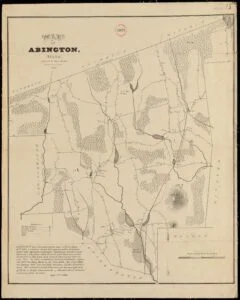
1830 Map of Abington, Massachusetts

Volume 1 of the Abington, Massachusetts vital records details births recorded in the town up to 1850, featuring comprehensive research from town records, cemeteries, and church documents. Established in 1712, Abington’s jurisdictional changes may affect genealogical searches. The records also include separate listings for Black families, primarily by given names. Additionally, various surnames are cataloged, emphasizing the need to consider alternate spellings. For marriages and deaths, researchers should consult Volume 2.
Medway Massachusetts vital records

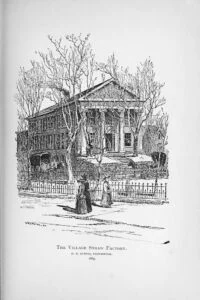
Medway Village Straw Factory

Alphabetical indexes to the vital records of Medway, Massachusetts, up to the year 1850, supplemented by information from church registers, cemetery inscriptions and other private sources to include Rev. Dr. Jacob Ide’s account of Marriages and Deaths, 1814-1849.

The history of Medway Massachusetts

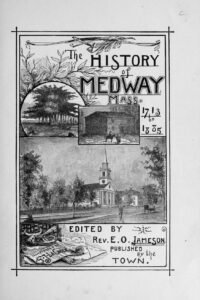
History of Medway title page

The History of Medway, Massachusetts, 1713–1885, covers the entire period of local history, embracing two hundred and twenty-five years, from 1660 to 1885; or, from the first appearance of a white settler within the territory, to the recent date of the incorporation of the town of Millis. The book is divided into ten sections, and gives, in consecutive order, an account of the first settlement, the municipal doings, the churches, the schools and other institutions, the industries, the military service, the miscellaneous matters, the cemeteries, the biographies of many persons, and the genealogies of numerous families.

History of Amherst New Hampshire

Residence of Isaac Brooks in Amherst New Hampshire

The history of Amherst, New Hampshire, unfolds from its 1675 land grant to veterans of the Narraganset War, marking the impetus for settlement along the Souhegan River. From its early governance and incorporation in 1760 to territorial adjustments that birthed Mont Vernon and Milford, this narrative encompasses local geography, economy, and Indigenous presence. Key military engagements, civic institutions, and genealogical records are explored up to 1882, offering a comprehensive view of the town’s evolution and its prominent figures.

Stephenson County Illinois World War 1 Veterans

Honor roll of the Great War, Stephenson County, 1917-1919

This small booklet contains all the known men and women who participated in World War 1 and claimed their home of record as Stephenson County, Illinois. By participation, this record does not limit this to soldiers, but also contains the records of those men and women who served the Red Cross, Y.M.C.A., and other non-fighting positions. This book is free to read or download.

Brown Genealogy

Brown Genealogy

In 1895, Cyrus Henry Brown began collecting family records of the Brown family, initially with the intention of only going back to his great-grandfathers. As others became interested in the project, they decided to trace the family lineage back to Thomas Brown and his wife Mary Newhall, both born in the early 1600s in Lynn, Massachusetts. Thomas, John, and Eleazer, three of their sons, later moved to Stonington, Connecticut around 1688. When North Stonington was established in 1807, the three brothers were living in the southern part of the town. Wheeler’s “History of Stonington” contains 400 records of early descendants of the Brown family, taken from the town records of Stonington. However, many others remain unidentified, as they are not recorded in the Stonington town records. For around a century, the descendants of the three brothers lived in Stonington before eventually migrating to other towns in Connecticut and New York State, which was then mostly undeveloped. He would eventually write this second volume of his Brown Genealogy adding to and correcting the previous edition. This book is free to search, read, and/or download.

The Amidon Family of Rehoboth, MA

The Amidon Family

The Amidon Family genealogy book details the lineage of Roger Amadowne, a French Huguenot who fled to England and later to America after the revocation of the Edict of Nantes. Documented in Salem, Massachusetts in 1637, variations of his surname include Amadon, Amidown, and Ammidon. The work, organized with biographical sketches and two helpful indexes, presents the family’s history and is richly illustrated. Originally published in 1904, it serves as a valuable resource for descendants and historians alike.

Tombstone records of eighteen cemeteries in Poundridge, New York

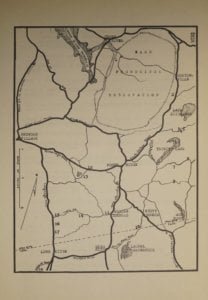
Map of cemeteries in Poundridge New York

In 1940 and 1941 Mrs. Sterling B. Jordan and Mrs. Frank W. Seth walked the 18 cemeteries in Poundridge, New York compiling the names and dates for all gravestones. Added to some of those gravestone listings were familial relationships if known. In addition, they referenced an even earlier listing of a few of the cemeteries by William Eardley taken in 1901.

Ancestors of Samuel Pearly Gates of Bridgewater Massachusetts

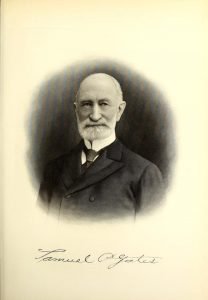
Samuel Pearl Gates

Samuel Pearly Gates, born on June 8, 1837, in Ashby, Massachusetts, has played a pivotal role in Bridgewater’s business and civic development, notably as treasurer and controlling interest of the Eagle Cotton Gin Company. A descendant of Stephen Gates, who arrived in New England in 1638, Samuel’s family has deep roots in the area. He served in the Civil War before establishing a successful career in business and banking. A respected community member, he is connected to various local institutions and remains active in his church and civic duties.

Pierce Family of North Bridgewater, MA

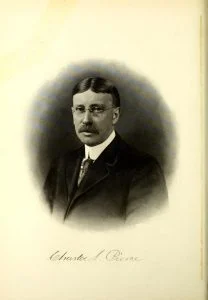
chester pierce

The Pierce family traces its lineage back to England and early New England settlers, notably Richard Pearse, who arrived in America in 1630. The family has produced numerous notable figures, including Charles S. Pierce, a respected Brockton citizen and cabinetmaker, and his sons, George R. Pierce, a successful merchant, and Charles S. Pierce, a prominent manufacturer. Their legacy continues to thrive in North Bridgewater, showcasing a rich history of industriousness, community involvement, and moral integrity, reflected in their contributions to both business and society.

Descendants of John Paull of Taunton, MA

John Paull was a prominent businessman in Taunton, leading the successful hay and grain firm, John Paull Co. for over fifty years. He was part of a well-established family, with roots tracing back to William Paull, a Scottish weaver who settled in Taunton in the 17th century. John’s lineage includes notable figures like his son, who participated in the Revolutionary War. After his death in 1908, his wife, Abbie, continued to manage the business and contributed to the community through music and charitable work.

Progressive Men of Western Colorado

Early Life in Colorado

This manuscript, in its essence, is a collection of 948 biographies of prominent men and women, all leading citizens of Western Colorado. In this context, Western Colorado encompasses the counties of Archuleta, Chaffee, Delta, Eagle, Garfield, Gunnison, Hinsdale, La Plata, Lake, Mesa, Mineral, Moffat, Montezuma, Montrose, Ouray, Pitkin, Rio Blanco, Routt, San Juan, and San Miguel.

Establishment of Fort Smith in 1817

Quapaw Cession Map

In 1817, a military post was established at Belle Point, now Fort Smith, Arkansas, to protect white settlers and the Cherokee from Osage hostilities. Major William Bradford led the detachment tasked with this, supported by Major Stephen H. Long, who surveyed the area. The post was strategically located at the junction of the Poteau and Arkansas rivers, facilitating navigation and trade. Subsequent treaties with the Osage and other tribes led to significant land cessions, shaping early relations and territorial boundaries in the region.

Indians in Mason County Michigan 1860 Census

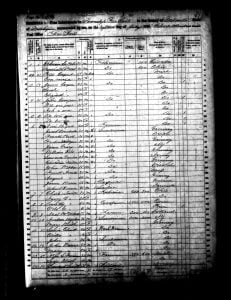
Mason County 1860 Census Reel 554 page 81

These 409 people were identified as Indians (I) in column 6 (color) of the 1860 census for Mason County Michigan. In order to have been enumerated they are believed to have renounced tribal rule, and under state law, exercised their rights as citizens.

Richard Dexter Genealogy, 1642-1904

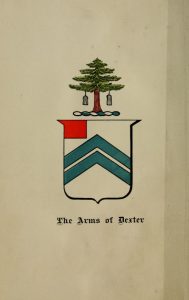
Arms of Dexter

Being a history of the descendants of Richard Dexter of Malden, Massachusetts, from the notes of John Haven Dexter and original researches. Richard Dexter, who was admitted an inhabitant of Boston (New England), Feb. 28, 1642, came from within ten miles of the town of Slane, Co. Meath, Ireland, and belonged to a branch of that family of Dexter who were descendants of Richard de Excester, the Lord Justice of Ireland. He, with his wife Bridget, and three or more children, fled to England from the great Irish Massacre of the Protestants which commenced Oct. 27, 1641. When Richard Dexter and family left England and by what vessel, we are unable to state, but he could not have remained there long, as we know he was living at Boston prior to Feb. 28, 1642.

1923 Historical and Pictorial Directory of Angola Indiana

1923 Angola Indiana Directory Book Cover

Luedders’ historical and pictorial city directory of Angola, Indiana for the year 1923, containing an historical compilation of items of local interest, a complete canvass of names in the city, which includes every member of the family, college students, families on rural lines, directory of officers of county, city, lodges, churches, societies, a directory of streets, and a classified business directory.

1899 Directory for Middleboro and Lakeville Massachusetts

1899 Middleboro and Lakeville Massachusetts Directory Cover

The 1899 Directory for Middleboro and Lakeville, Massachusetts, compiled by A. E. Foss & Co., provides a comprehensive list of residents and businesses, alongside town officers, schools, churches, and societies. It includes notable historical events and offers a detailed account of the local community, featuring numerous surnames from both towns. This directory serves as an essential resource for understanding the demographics and social structure of Middleboro and Lakeville during that period.

A History of Waterloo New York Newspapers

Masthead of the Lily in Seneca Falls

George Lewis, the first printer in Seneca County, initiated the Seneca Patriot in 1815, later renaming it The Ovid Gazette. After relocating the county seat to Waterloo in 1817, he produced The Waterloo Gazette, the village’s first newspaper. Throughout the years, various publications emerged, including The Waterloo Enunciator, The Seneca Farmer, and The Waterloo Observer, reflecting local political sentiments and events. Many of these papers are preserved in collections, offering vital insights for genealogists and historians researching the area’s history.