New Hampshire Men of Progress

1892 Map of New Hampshire

New Hampshire Men of Progress contains 289 biographical sketches and portraits of leaders in business and professional life in and of the state of New Hampshire. It was edited by the staff of the Manchester Union under the supervision of Richard Herndon.

Vital Records of Alford Massachusetts

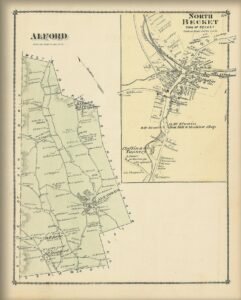
Map of Alford and North Becket Massachusetts

Alphabetical indexes to the vital records of Alford, Massachusetts, up to the year 1850. The Town of Alford, Berkshire County, was established as the District of Alford, February 16, 1773, from a part of Great Barrington and certain common lands. These vital records start about that time and run up to the year 1850. Free PDF to read or download.

History of the Town of Cornwall Connecticut

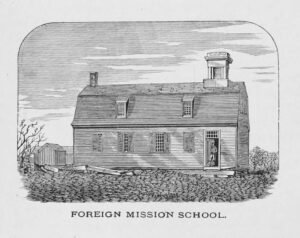
Foreign Mission School, Cornwall, Connecticut

The History of the Town of Cornwall Connecticut is a comprehensive account of the town’s evolution from colonial organization in 1731 to its involvement in national events like the Civil War. They include detailed geographical descriptions, ecclesiastical histories of local churches, and biographical sketches of families such as the Sedgwicks and Golds. The records also reflect social life, farming, early fashion, and the noteworthy Foreign Mission School.

Ashfield Massachusetts Vital Records

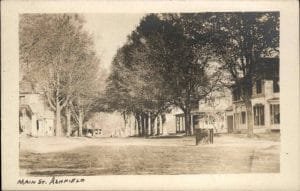
Main Street, Ashfield, Massachusetts

Alphabetical indexes to the vital records of Ashfield, Massachusetts, up to the year 1850, supplemented by information from bible records, church registers, cemetery inscriptions and other sources. PDF file is free to read and download.

Descendants of Thomas, John and Eleazor Brown

The Brown Family Reunion at Brownstown Pennsylvania

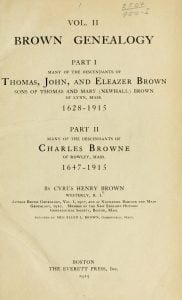
Cyrus Henry Brown’s Brown Genealogy, first published in 1907, is an essential resource for genealogists tracing the Brown family lineage. This volume, published in 1915 and labeled as “Volume II,” should be understood as a complete replacement of the original volume rather than a supplementary addition. Brown’s new research and updates make this work a standalone resource for those exploring the Brown family’s extensive history. It is fully indexed, and the content spans nearly 250 years, offering valuable insight into numerous branches of the family.

Abstractions from Huron County Ohio, Will Book A

Volume A, Huron County Wills to 1852

This volume is “Abstractions from Huron County Ohio, Will Book A.” These will abstractions cover the years from 1828 to 1852. They have been taken out of order as they appeared in the original volume and sorted by name. This abstraction was done by Henry Timman of Norwalk, Ohio, in 1960.

Brown Genealogy

Brown Genealogy

In 1895, Cyrus Henry Brown began collecting family records of the Brown family, initially with the intention of only going back to his great-grandfathers. As others became interested in the project, they decided to trace the family lineage back to Thomas Brown and his wife Mary Newhall, both born in the early 1600s in Lynn, Massachusetts. Thomas, John, and Eleazer, three of their sons, later moved to Stonington, Connecticut around 1688. When North Stonington was established in 1807, the three brothers were living in the southern part of the town. Wheeler’s “History of Stonington” contains 400 records of early descendants of the Brown family, taken from the town records of Stonington. However, many others remain unidentified, as they are not recorded in the Stonington town records. For around a century, the descendants of the three brothers lived in Stonington before eventually migrating to other towns in Connecticut and New York State, which was then mostly undeveloped. He would eventually write this second volume of his Brown Genealogy adding to and correcting the previous edition. This book is free to search, read, and/or download.

The Amidon Family of Rehoboth, MA

The Amidon Family

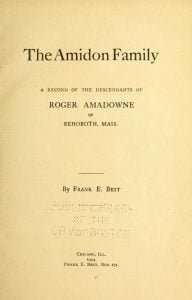
The Amidon Family genealogy book details the lineage of Roger Amadowne, a French Huguenot who fled to England and later to America after the revocation of the Edict of Nantes. Documented in Salem, Massachusetts in 1637, variations of his surname include Amadon, Amidown, and Ammidon. The work, organized with biographical sketches and two helpful indexes, presents the family’s history and is richly illustrated. Originally published in 1904, it serves as a valuable resource for descendants and historians alike.

History of Littleton New Hampshire

1895 Map of Littleton New Hampshire

The History of Littleton New Hampshire is comprised of three volumes, two volumes of history, and a final volume of genealogies. Considered one of the best examples of local history written in the early 20th century, is your ancestors resided in Littleton then you need these books. Read and download for free!

Origin, history, and genealogy of the Buck family

Origin, history, and genealogy of the Buck family

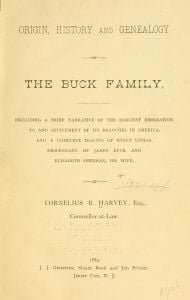
Origin, history and genealogy of the Buck family : including a brief narrative of the earliest emigration to and settlement of its branches in America and a complete tracking of every lineal descendant of James Buck and Elizabeth Sherman, his wife

The genealogy and history of the Ingalls family in America

The genealogy and history of the Ingalls family in America

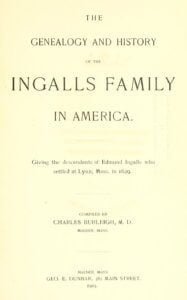
Edmund Ingalls, son of Robert, was born about 1598 in Skirbeck, Lincolnshire, England. He immigrated in 1628 to Salem, Massachusetts and with his brother, Francis, founded Lynn, Massachusetts in 1629. He married Ann, fathered nine children, and died in 1648.

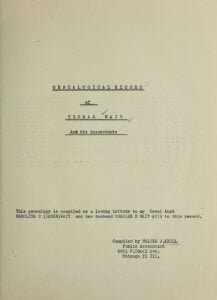
Genealogical Record of Thomas Wait and his descendants

Genealogical record of Thomas Wait and his descendants

Genealogical Record of Thomas Wait and his descendants looks at the genealogy of Thomas Wait (1601-1677) who was from Wethersfield Parish, Essex, England. On his arrival in America, landing in Rhode Island, he applied for a lot on which to build,and was granted it on 7/1/1639. On 3/l6/l641 he became a Freeman in Newport R. I. He died in Portsmouth R. I., before April 1677 intestate. This Thomas Wait was a cousin to the Richard Waite of Watertown Mass., who was a large land owner. This unpublished manuscript provides the descendants of this family.

Descendants of Hon. Horatio Leonard Cushman of Taunton, MA

The Cushman family of Taunton, MA, traces its lineage back to Robert Cushman, a key figure in the Mayflower Pilgrims’ voyage. His son, Thomas, emerged as an important church elder in Plymouth. The family continued to thrive, with Horatio Leonard Cushman serving as mayor and a dedicated public servant. His son, Seth Leonard Cushman, succeeded him in local commerce, leading the Bristol County National Bank. The Cushman lineage reflects a rich heritage of civic duty and economic contribution in New England.

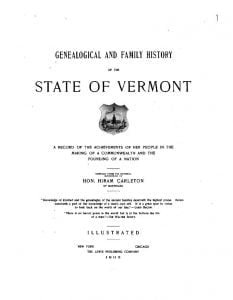
Genealogical and Family History of Vermont

Genealogical and Family History of the State of Vermont vol 1

Hiram Charlton took on the publication of the Genealogical and Family History of the State of Vermont for Lewis Publishing. In it, he enlisted the assistance of living residents of the state in providing biographical and genealogical details about their family, and then he published all 1104 family histories in two distinct volumes.

Migration of Families out of Norwich VT

In the late 18th and early 19th centuries, Norwich, Vermont, experienced significant emigration, leading to a notable decline in its population. Initially home to 40 families in 1771, the town saw many residents relocate to newer settlements, such as Royalton and Randolph, during and after the Revolutionary War. Prominent families, including the Hibbards and Carpenters, contributed to the establishment of towns in northern Vermont and beyond. By the 1800s, the trend of outmigration intensified, marking a long-term shift in the region’s demographic landscape.

History of Norwich Vermont Education

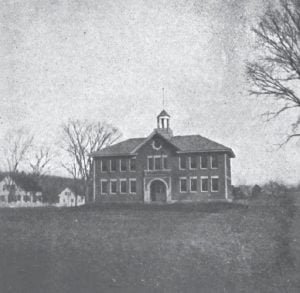
High School Building, Norwich Village, Erected in 1898

The history of education in Norwich, Vermont, traces back to efforts in 1782 to establish school districts. The first successful division occurred in 1785, creating the First School District. Over the years, multiple districts were formed, with the establishment of a committee for school supervision in 1824. Notable developments included the construction of a brick schoolhouse in 1845 and the incorporation of the Norwich Classical and English Boarding School in 1867, although it ultimately closed in 1877. The town’s education framework evolved significantly, culminating in a unified system in 1892.

Norwich Vermont in the War of 1812

In June 1812, as war with Great Britain loomed, Norwich, Vermont, convened a town meeting to express their views. A carefully crafted document was adopted, voicing support for President Madison and Congress’s war measures, while denouncing critics. The resolutions outlined grievances against both Britain and France, affirming the right to declare war for just causes. Coincidentally, Congress declared war on the same day, prompting Norwich to raise taxes to support military efforts, reflecting strong local commitment to the war.

Oregon Land Patents – Siletz Tribe

This page lists Oregon land patents associated with the Siletz Tribe, including patentee names, patent dates, document numbers, and accession numbers. The record spans late 19th and early 20th century grants to many individuals and families, offering a searchable reference for genealogical research, tribal history, and land ownership records.

Biography of Garner Miner

Garner Miner, born on November 5, 1822, in New Haven, Connecticut, moved to Idaho in 1861. He faced numerous challenges as a pioneer, including conflicts with Native Americans and harsh living conditions. Initially engaged in mining, he later shifted to farming on the Payette River. Miner and his wife, Ann, raised three daughters amidst the trials of frontier life. A dedicated Methodist, he and Ann celebrated over fifty years of marriage, leaving a lasting legacy as significant contributors to Idaho’s development.