History of Rindge New Hampshire

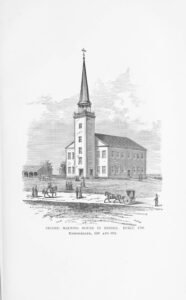
Second Meeting House in Rindge New Hampshire

The History of the Town of Rindge, New Hampshire by Ezra S. Stearns, was published in 1875, and covers the period from the original Rowley Canada grant or Massachusetts charter through the year 1874. Stearns traces the legal, territorial, and institutional development of Rindge, beginning with colonial land grants and boundary disputes and proceeding through settlement, incorporation into a town and development into a small manufacturing hub. More than half the volume is devoted to genealogical material. The genealogical register of Rindge families includes thousands of names compiled from a wide range of sources and assisted by contributions from residents and researchers beyond the town.
Genealogies of the Town of Goffstown New Hampshire

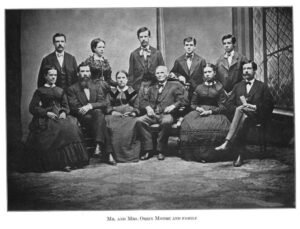
Orrin Moore and family of Goffstown, New Hampshire

The genealogical record of Goffstown, New Hampshire, was a substantial undertaking, hampered by the extinction of early families and the widespread scattering of descendants. Efforts to gather vital statistics necessitated considerable travel and correspondence, often revealing discrepancies in recorded dates across various sources. Despite challenges, contributions from former works and assistance from individuals proved invaluable in compiling this record. The comprehensive index reflects the depth of research involved in documenting the town’s heritage.

Logan County, Kentucky Wills – Book A, with index

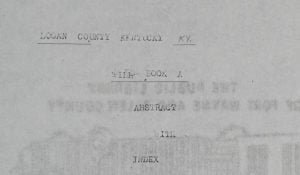
Will book A, Logan County, Kentucky

The wills in this book come from Book A of the Wills found at the Logan County Court house in Russellville, Kentucky. The information was extracted in 1957 by Mrs. Vick on behalf of the DAR located in Russellville. The text in this book was done with an old manual typewriter and has the usual faint and filled-in type often found with such papers. On top of the difficulty in interpreting the print from the typewriter, the scanning process was also deficient, and led to the creation of a faint digital copy exacerbating the difficult to read text.

History of Ontario County, New York, part 2

History of Ontario County, New York

The History of Ontario County, New York genealogical section provides an extensive array of surnames, indicating the comprehensive nature of the section in Part 2. These genealogies not only serves as a reference for individuals researching family histories but also reflects the diverse settler and immigrant populations that have contributed to the fabric of Ontario County. Each surname represents a family’s journey, struggles, and contributions to the county’s development over centuries.

History of Ontario County, New York, part 1

History of Ontario County, New York

“History of Ontario County, New York: With Illustrations and Family Sketches of Some of the Prominent Men and Families” is a comprehensive historical compilation, organized by Lewis Cass Aldrich and meticulously edited by George Stillwell Conover. Published in 1893 by D. Mason & Co., Syracuse, N.Y., this monumental work illuminates the rich tapestry of Ontario County’s past. Recognizing the voluminous nature of the original single volume, it has been thoughtfully divided into two parts for convenience and accessibility. Part 1 encompasses the historical and biographical narrative of Ontario County, laying the foundation for the genealogical treasures contained in Part 2.

Brown Genealogy

Brown Genealogy

In 1895, Cyrus Henry Brown began collecting family records of the Brown family, initially with the intention of only going back to his great-grandfathers. As others became interested in the project, they decided to trace the family lineage back to Thomas Brown and his wife Mary Newhall, both born in the early 1600s in Lynn, Massachusetts. Thomas, John, and Eleazer, three of their sons, later moved to Stonington, Connecticut around 1688. When North Stonington was established in 1807, the three brothers were living in the southern part of the town. Wheeler’s “History of Stonington” contains 400 records of early descendants of the Brown family, taken from the town records of Stonington. However, many others remain unidentified, as they are not recorded in the Stonington town records. For around a century, the descendants of the three brothers lived in Stonington before eventually migrating to other towns in Connecticut and New York State, which was then mostly undeveloped. He would eventually write this second volume of his Brown Genealogy adding to and correcting the previous edition. This book is free to search, read, and/or download.

History of Littleton New Hampshire

1895 Map of Littleton New Hampshire

The History of Littleton New Hampshire is comprised of three volumes, two volumes of history, and a final volume of genealogies. Considered one of the best examples of local history written in the early 20th century, is your ancestors resided in Littleton then you need these books. Read and download for free!

History of Bentleysville, Pennsylvania

Bentleysville title page

This book is a collection of stories, letters, and historical records detailing the brief history of Bentleysville, a rural community in southwestern Pennsylvania. Established around a mill operated by Sheshbazzar Bentley Sr. and Jr. on Pigeon Creek in 1816, the town grew to a population of 300 by 1868. The author traces the origins of Bentleysville back to the 1770s to document the earliest settlers, while also providing context through significant national events like the Whiskey Rebellion and the Civil War. Although Bentleysville’s history as a village ended before 1900, this work preserves its legacy for future generations.

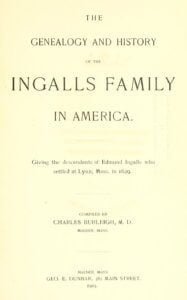
The genealogy and history of the Ingalls family in America

The genealogy and history of the Ingalls family in America

Edmund Ingalls, son of Robert, was born about 1598 in Skirbeck, Lincolnshire, England. He immigrated in 1628 to Salem, Massachusetts and with his brother, Francis, founded Lynn, Massachusetts in 1629. He married Ann, fathered nine children, and died in 1648.

Ancestors of Charles W. Milliken of Barnstable, MA

Dr. Charles Warren Milliken, a prominent physician from Barnstable, MA, traces his lineage to early settlers like Hugh Mulliken and John Milliken, revealing a rich familial history entwined with significant events in the region. His ancestors, including notable figures such as Edward Milliken, were influential in local governance and community development. The Milliken family contributed to society through professions in farming, law, and medicine, culminating in Dr. Milliken’s distinguished medical career and involvement in various professional organizations.

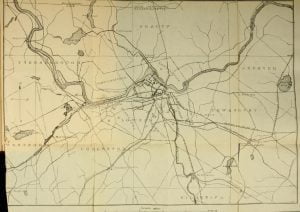
Lowell Massachusetts Genealogy

1894 Map of Lowell

Tracing ancestors in Lowell, Massachusetts online and for free has been greatly enhanced by the University of Massachusetts in Lowell which provided digitized version of a large quantity of the Lowell public records. Combined with the cemetery and census records available freely online, you should be able to easily trace your ancestors from the founding of Lowell in 1826 through 1940, the last year of available census records. To add color to the otherwise basic facts of your ancestors existence we provide free access to a wide range of manuscripts on the history of Lowell, it’s manufactures and residents.

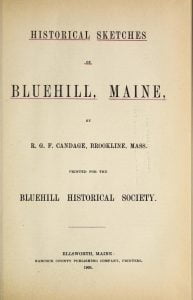
Fisk Genealogy of Blue Hill, Maine

Historical Sketches of Bluehill Maine

The Andrew A. and Abraham Fisk houses, painted red, were located adjacent to the Garland place, now the Copper and Gold hotel. Brothers Andrew and Abraham Fisk, likely shoemakers, moved to Blue Hill, though details of their origins and the construction of their homes remain unknown. Andrew married Almira Hardin in 1827, and they had several children, while Abraham married Sarah Johnson in 1834, with four unnamed children recorded. Andrew Fisk passed away in 1882, but records for the family remain sparse.

The Settlers of Narraguagus Valley Maine

Narraguagus Valley Some Account of its Early Settlement and Settlers

The early settlement of the Narraguagus River in Washington County, Maine, involved significant developments in nearby towns such as Steuben, Milbridge, Harrington, and Cherryfield. Established between 1791 and 1816, these towns evolved from former townships. Key early settlers included Jabez Dorman, John Densmore, Ichabod Willey, and Samuel Colson, who arrived around 1757. Their families contributed to the growth of the region, establishing roots and communal records that reflect the intertwined histories of these communities. Notably, many surnames from the early settlers persist in the area today.

Campbell Genealogy of Narraguagus Valley Maine

Narraguagus Valley Some Account of its Early Settlement and Settlers

Between 1766 and 1768, Alexander Campbell relocated from Damariscotta to Steuben, where he established the first mill at Tunk. Born in 1731, he married Betsey Nickels and had several children. The family moved to Shipyard Point around 1772, eventually building a house on a hill in 1790. Active in the Revolutionary War, Campbell served as an adviser to Col. John Allan. He passed away in 1807, leaving behind a large family with multiple descendants contributing to the region’s history.

Representative Men of Maine – Biographical Sketches and Portraits

Representative Men of Maine Title Page

A historical collection of portraits and biographical sketches of prominent Maine residents in business, industry, the professions, and politics, along with profiles of every governor since statehood in 1820. Published in 1893, it offers a rich snapshot of the people who shaped Maine’s public life and leadership.

A History of Seneca Falls New York Newspapers

Ovid Bee Newspaper

In 1829, O. B. Clark launched the Seneca Falls Journal, establishing the village’s first newspaper amid rising support for its anti-Masonic and anti-Jacksonian themes. Various publications followed, including the Seneca Farmer and the Seneca Falls Register, reflecting the evolving political landscape. Over the decades, numerous titles emerged and merged, including the Seneca County Courier and the Seneca Falls Reveille, each documenting significant local events and serving as valuable resources for genealogists and historians alike, preserving the community’s rich history.

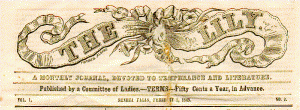
History of the Seneca County New York Press

Masthead of the Lily in Seneca Falls

The history of the press in Seneca County reflects the broader narrative of American journalism’s evolution, characterized by local newspapers that documented societal changes and opinions. The first publication, the Seneca Patriot, emerged in 1815, followed by various newspapers that reflected political trends from Federalism to Democratic ideals. Notable figures, such as Amelia Bloomer, contributed to the media landscape with publications advocating reform. Though many papers faced struggles with sustainability, they played pivotal roles in shaping public discourse and preserving local history, ultimately illustrating the press’s enduring influence in the county.

Montana Land Patents – Crow Tribe

A detailed list of Montana land patents for members of the Crow Tribe, showing patentee names, dates, document numbers, and accession numbers. The record includes both Native and non-Native patentees, with many entries repeated across dates, and serves as a historical reference for land ownership and federal patent records in early 20th-century Montana.

Biography of Benjamin H. Milliken

Benjamin H. Milliken, born in 1847 in McCracken County, Kentucky, was a prominent businessman in Riverside, California. The son of Judge John Milliken, he served in the Confederate Army during the Civil War, facing capture and a death sentence before being released. After the war, he engaged in various successful business ventures in Paducah, including manufacturing. In 1886, he moved to Riverside, where he established the Riverside Paint Store with George H. Jaques. Milliken was also active in local Democratic politics and married Mary B. Wells, with whom he had five children.

Biographical Sketch of Charles F. Milliken

Charles F. Milliken, born on August 27, 1854, in Canandaigua, New York, is an influential newspaper editor and manager of the Ontario County Times, a publication established by his father. Educated at Canandaigua Academy, Milliken married Margaret Townley in 1895, and they had three children. His extensive community involvement includes roles as chairman of the Ontario County Republican Committee, a member and president of the New York State Civil Service Commission, and leadership positions in local historical and charitable organizations. He authored “A History of Ontario County, New York, and Its People.