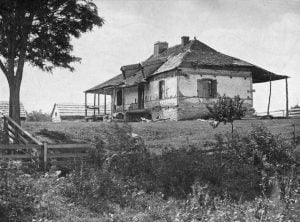
Marriages of Charlotte County Virginia, 1784-1815
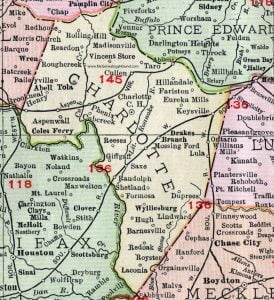
1911 Map of Charlotte County Virginia

This volume, “Marriages of Charlotte County, Virginia, 1784-1815,” compiles the marriage bonds and minister’s returns from Charlotte County during the specified period. The original work was painstakingly copied by Catherine Lindsay Knorr and published in 1951. The book spans 119 pages and includes a wealth of historical data on marriages that took place in this Virginia county. This publication presents several challenges for readers. Some pages are slightly tattered and torn, and the manuscript features irregular pagination. Additionally, there are tight or nonexistent margins, particularly at the bottom of the pages, and one page is typed on different paper than the rest.
Sevier County 1830 Tennessee Census

1830 Sevier County Census transcription

Published in Knoxville, Tennessee in 1956 and distributed by the Genealogical Publishing Company of Baltimore, Maryland, Sevier County, Tennessee: Population Schedule of the United States Census of 1830 (Fifth Census) provides a transcription of the often difficult to read, 1830 Sevier County Tennessee census. Authored by Blanche C. McMahon and Pollyanna Creekmore, this meticulous reproduction of the original census record sheds light on the people of Sevier County in 1830.

Stephenson County Illinois World War 1 Veterans

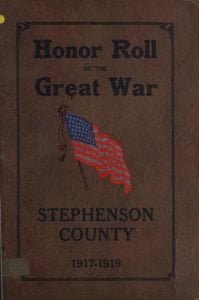
Honor roll of the Great War, Stephenson County, 1917-1919

This small booklet contains all the known men and women who participated in World War 1 and claimed their home of record as Stephenson County, Illinois. By participation, this record does not limit this to soldiers, but also contains the records of those men and women who served the Red Cross, Y.M.C.A., and other non-fighting positions. This book is free to read or download.

Alleged 1818 Chickasaw Roll – Surname Index

This is an English surname transcription of the alleged 1818 Chickasaw roll said to have been lost in the beginning of the 19th century. I expect, if this is a true roll, that it is the result of the Treaty of October 19, 1818 between the Chickasaw Nation and the United States. I have some doubts, however, as the treaty stipulates payments and land to the tribe, not to individual tribal members as later treaties would. It would be at the discretion of the tribe on how to settle the reservation and distribute the payments.

Families of Ancient New Haven

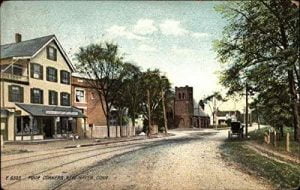
Four Corners New Haven Connecticut

The Families of Ancient New Haven compilation includes the families of the ancient town of New Haven, covering the present towns of New Haven, East Haven, North Haven, Hamden, Bethany, Woodbridge and West Haven. These families are brought down to the heads of families in the First Census (1790), and include the generation born about 1790 to 1800. Descendants in the male line who removed from this region are also given, if obtainable, to about 1800, unless they have been adequately set forth in published genealogies.

The genealogy and history of the Ingalls family in America

The genealogy and history of the Ingalls family in America

Edmund Ingalls, son of Robert, was born about 1598 in Skirbeck, Lincolnshire, England. He immigrated in 1628 to Salem, Massachusetts and with his brother, Francis, founded Lynn, Massachusetts in 1629. He married Ann, fathered nine children, and died in 1648.

Morey Genealogy of Bristol RI and Norton MA

Old Families of Southeastern Massachusetts

The Morey family, established in New England, has roots tracing back to George Morey, who settled in Bristol, Rhode Island, in 1683. The name has various spellings, including Mowry, particularly in Rhode Island. George’s son, also named George, moved to Norton, Massachusetts, where he became an innholder and served in the 1745 Louisburg expedition. His descendants continued to live in Norton, contributing to the community until modern times, with ties to the Paddock Richmond Read lineage through Belinda Copeland Morey.

Governor Houston’s Life Among the Indians

Detail from Houston at the Battle of San Jacinto

Following his failure to secure a contract for Indian rations, Sam Houston engaged in a series of contentious correspondences, criticizing officials and accusing Colonel Hugh Love of collusion. His passion led to public outbursts, including an intemperate proclamation against opponents. Despite his controversies, he was seen as an advocate for Indian rights, notably the Cherokee and Creek tribes. Houston’s deeper ambitions in Texas and his relationships with these tribes were marked by significant developments, including allegations of attempts to manipulate land settlements in their favor.

Fort Gibson Conference with the Indians, 1834

Catlin Painting a Chief at the Base of the Rocky Mountains

In September 1834, Colonel Dodge convened a significant council at Fort Gibson with chiefs from various tribes, including the Osage, Cherokee, and Kiowa, following earlier negotiations with the Comanche and others. More than 150 representatives attended amidst an atmosphere of curiosity and caution. The conference aimed to solidify peace and arrange future treaties, which were essential for the U.S. expansion into the Southwest. Despite the potential for violence, Dodge successfully navigated tensions, ensuring safe resolutions and presenting gifts to symbolize friendship.

The Osage Massacre

Kiowa Calender

In the summer of 1833, following a treaty council breakdown, Osage warriors attacked a Kiowa village, resulting in a brutal massacre where many women, children, and elderly were killed, and the heads of the victims displayed in brass buckets. Among the captives were two children, Gunpä´ñdamä and Tunkahtohye, later purchased by Colonel Hugh Love for potential diplomatic gains. The ensuing U.S. military expeditions aimed to restore order and negotiate peace, but many faced logistical challenges and poor preparation, resulting in numerous setbacks and casualties.

Peace Attempts with Western Prairie Indians, 1833

General Henry Leavenworth

In 1830, the Treaty of Dancing Rabbit Creek initiated the relocation of the Choctaw Indians to territories between the Canadian and Red rivers. However, the Choctaw faced threats from Comanche, Kiowa, and Wichita tribes, who attacked traders and settlers. In May 1833, Colonel Arbuckle sent a military expedition to protect the traveling Choctaw and assert U.S. power. Despite efforts, the expedition suffered losses, including ranger George B. Abbay, who was captured, and ultimately failed to achieve its objectives, highlighting the challenges of westward expansion.

Earliest Known Traders on Arkansas River

Country Home of Augustus Pierre Chauteau

Before the Louisiana Purchase, early French traders, notably Joseph Bogy, ventured along the Arkansas River, engaging in commerce with local Indian tribes, such as the Osage. Bogy’s expeditions included confronting Choctaw opposition in 1807, leading to government claims for losses. Prominent figures included Nathaniel Pryor and A. P. Chouteau, who established trading posts at the mouth of the Verdigris. These traders influenced the region’s economy, exchanging goods like furs and providing items such as tobacco and tools to Native Americans, fostering significant cultural exchanges.

Indian Hostilities in California and New Mexico – Indian Wars

general kearney

The condition of Indian tribes in California, particularly the Shoshonee, Blackfeet, and Crows, is dire, marked by hostility towards settlers, particularly in the Sierra Nevada region. Following the gold discovery, tensions erupted into violence as tribes attacked miners. This led to a declaration of war from settlers, resulting in numerous casualties among the Indians. In New Mexico, the Apache and Navajo tribes proved formidable, engaging in violent confrontations with U.S. troops, while the peaceful Pueblo and other tribes often fell victim to Apache raids.

Love Family Genealogy

Franklin D. Love meticulously compiled three volumes of genealogical information about the Love family in the 1940s, preserving correspondence and research accumulated over decades. This collection, which remains unpublished, offers first and second-hand accounts from relatives regarding their ancestors dating back to the mid-1800s. Along with genealogy, the records include wills, land records, and letters from notable family members, providing valuable insights into the history and lineage of the Love family.

Letter from Robert Love to Thomas D. Love – 18 April 1813

In a letter dated April 18, 1813, Robert Love expresses his pleasure at his son Thomas’s well-being and burgeoning legal practice. He emphasizes the importance of continued study and mentorship, advising Thomas to consult with knowledgeable individuals. Robert encourages Thomas to visit his aging grandmother, reminding him of her past support. He hopes for a strong bond between Thomas and his brother Sammy, emphasizing familial support. The letter conveys warmth and fatherly advice amidst practical considerations of legal career development.

Letter from Col. Robert Love to William Love – Family

Col. Robert Love writes to his brother, William, from Nearon Harpeth on November 25, 1814, expressing relief at hearing of William’s continued health despite prior reports of his demise. He updates William on his family, noting that four of his children are married, with Thomas pursuing law in East Tennessee. Col. Love invites William to return home, offering to send a horse if needed, and mentions his abstinence from spirits for health benefits. He concludes with well-wishes and gratitude for his family’s wellbeing.

Letter from Thomas Love to his Nephew, James Robert Love

In his letter dated March 10, 1843, Thomas Love expresses relief at learning about his brother’s health and updates his nephew, James Robert Love, on his family’s overall well-being, despite struggling with rheumatism. He shares plans to visit his native country by May, hoping for continued health improvements. Thomas also mentions his son’s successful relocation to Missouri and shares remedies for a friend’s health issue. He concludes with warm regards for his brother and friends, promising to write again soon.

Address of Col. Allen T. Davidson at Lyceum Asheville, North Carolina

In his address at the Lyceum in Asheville, Col. Allen T. Davidson highlighted prominent figures from Haywood County, notably John Welch, General Thomas Love, and Col. Robert Love. Thomas Love, who served in the Legislature for three decades, was renowned for his engaging campaign style and memorable anecdotes, including his humorous interactions with voters. Robert Love, a Revolutionary War veteran and influential community leader, also contributed significantly to the county’s development and left a lasting legacy. Both men were respected and influential in their time.