1899 Directory for Middleboro and Lakeville Massachusetts
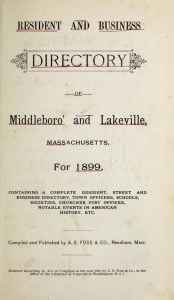
1899 Middleboro and Lakeville Massachusetts Directory Cover

The 1899 Directory for Middleboro and Lakeville, Massachusetts, compiled by A. E. Foss & Co., provides a comprehensive list of residents and businesses, alongside town officers, schools, churches, and societies. It includes notable historical events and offers a detailed account of the local community, featuring numerous surnames from both towns. This directory serves as an essential resource for understanding the demographics and social structure of Middleboro and Lakeville during that period.
General History of the Western Indian Tribes 1851-1870 – Indian Wars

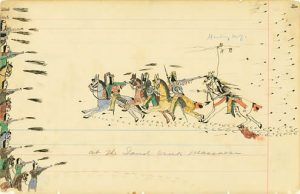
At the Sand Creek Massacre

From 1851, vast territories east of the Rockies were designated as Indian Territory, where numerous tribes roamed. The discovery of gold in California sparked emigration, leading to treaties that confined tribes like the Cheyennes and Arapahoes to specific areas while promising annual payments. Tensions escalated, culminating in the Sand Creek Massacre in 1864, followed by ongoing conflicts. By 1868, efforts to negotiate peace resulted in treaties relocating tribes to reservations, as Indian populations dwindled and government policies shifted to assert control and promote their civilization.

Treaty of October 11, 1842

Treaty of October 11, 1842

The Treaty of October 11, 1842, involved the Confederated tribes of the Sac and Fox Indians ceding their lands west of the Mississippi River to the United States, while reserving a right to occupy these lands for three years. The treaty stipulated annual payments to the tribes and provisions for their relocation, including assistance during their move and the establishment of blacksmith and gunsmith shops. An agreement for necessary funds for the tribes’ welfare and charitable purposes was also included. The treaty required Senate ratification and consent from the tribes for any amendments.

Biographical Sketch of W. H. Hancock

W. H. Hancock, born March 29, 1864, in Chicago, is a prominent broom-corn broker in Tuscola. He was educated in the Cook County normal school and initially worked as a Pullman conductor for seven years. After joining the broom-corn business with his father, he partnered with W. Avery Howard in 1899. The firm became a leading brokerage, managing around fifteen hundred tons of broom corn annually. Hancock married Tillie Brogan in 1895, and they have two children, now well-respected members of Tuscola’s social community.

A List of Choctaw Claims allowed in Mingo Mushulatubbe’s District

A September 7, 1831 true copy of Choctaw claims in Mingo Mushulatubbe’s District lists names, acreage, and outcomes such as relinquished, sold, kept, or provided for in treaty. Compiled by Special Agent F. W. Armstrong, the record documents land claims, captains’ allowances, cultivation rights, and transfers to individuals including Grant and Clement.

World War 1 Troup County Georgia Soldiers Who Died in Service

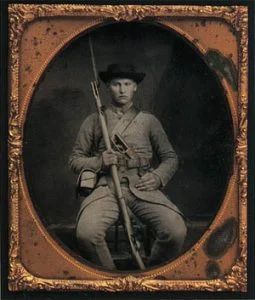
Civil War Soldier from Troup County GA

The post lists soldiers from Troup County, Georgia, who died in service during World War I, specifying that they predominantly served in the army. It notes that these individuals are not included in the official World War I Soldiers and Sailors Roster for the county.

Biographical Sketch of J. J. Hancock

J.J. Hancock, born in England in 1830, immigrated to America in 1851 and initially settled in London, Canada. He moved to Buffalo, New York, in 1853 to work in the boot and shoe industry. In 1858, he relocated to Dubuque, Iowa, and later to Sioux Falls, South Dakota, in 1871, where he continued in the same trade. By 1878, Hancock worked for the American Express Company and in 1879 moved to Missouri Valley.

Biography of Robert M. Hancock

Robert M. Hancock, born on February 11, 1847, in Coffee County, Tennessee, distinguished himself as a capable circuit and county clerk known for his diligence and integrity. His father, William A. Hancock, a prominent Democrat and Civil War veteran, influenced his early life. After serving in the cavalry and sustaining a near-fatal injury, Robert transitioned from farming to carpentry before entering public office. Married to Sarah Moody, they raised five children. He is an active member of several fraternal organizations, reflecting his commitment to community service and politics.

Biographical Sketch of William Hancock

William Hancock was a pioneering figure in both Kentucky and Missouri, known for his role in early settler defense and community building. As the first settler in Warren County, Missouri, he faced the hardships of frontier life. He married Miss McClain and had three children, with two daughters marrying notable men. Hancock was known for his jovial nature and love of pranks, notably staging a humorous “wild man” act in Natchez. He also ran for the Legislature, ultimately allowing his opponent to take the position after a tie.

Biography of W. M. Hancock

W. M. Hancock, a prominent agriculturist in Nowata County, was born on December 8, 1860, in Lebanon, Missouri. He began farming with his father and moved to Oklahoma in 1881, establishing himself in Coowescoowee district. Hancock owns a well-cultivated ranch along the Verdigris River, raising various crops and livestock. Married to Maggie Ironside, they have four children. A Baptist and Republican, Hancock is also a Mason and actively supports community development, notably in road improvements and infrastructure. His ranch is recognized as a notable area feature.

Hancock, Robert – Obituary

Robert Brooks Hancock, 82, of York, Montana, and formerly of Cove, passed away on June 1, 2004, at St. Peters Hospital in Helena. Born on December 10, 1921, he served in the Navy during World War II and married Jean Horner in 1945. After her death, he wed Lorraine Reese in 1985. Hancock was known for his love of camping, fishing, and woodworking, as well as his deep interest in World War II history. He is survived by his wife, stepchildren, grandchildren, and great-grandchildren.

Joseph Hancock

Private 1st Class Joseph Hancock, of Durham County, enlisted on February 1, 1915, and served with the 30th Division, 120th Regiment. After training at Camp Sevier, he sailed for France on May 17, 1918. Hancock was severely wounded at the Somme on September 29, 1918, losing his right leg and suffering multiple injuries. He had previously served on the Mexican border for nine months. Hancock returned to the U.S. on December 30, 1918, and was mustered out on November 12, 1919.

Biographical Sketch of Richard J. Hancock

Richard J. Hancock, born on October 20, 1838, is a lifelong farmer who manages 150 acres in Loxa. His marriage to Mary E. Snitt took place on November 30, 1865, and they had six children together. Hancock hails from a family rooted in agricultural heritage; his father, originally from North Carolina, moved to this region in 1830 after settling in Indiana. Richard has two surviving siblings out of ten, and he honors the memory of two brothers who served in the Civil War.

Biography of Joseph Hancock

Joseph Hancock was born in Ohio in 1822 and later became a rancher near San Bernardino, California. His family, with roots in Massachusetts and Vermont, faced numerous hardships as pioneers. After moving through various states, they encountered perilous conditions while crossing rivers and deserts. Hancock’s perseverance led to successful land ownership and farming in California, supported by his second wife, Nancy Bemis. They had seven children and preserved historical artifacts from their journeys, reflecting on their challenging yet enriching pioneer experiences.

Biography of Garland Hancock

Garland Hancock, born in 1887 in Madison County, Indiana, is an accomplished educator currently serving as superintendent of the north Anderson Schools. He graduated from Anderson High School and the University of Indiana, later becoming a leading figure in Madison County education. Garland’s family includes two sisters who also teach, and he is married to Cora Groundyke, with whom he has a son, Donald. In addition to his educational responsibilities, he manages a 140-acre farm, reflecting his commitment to both teaching and agriculture.