Genealogies of the Town of Goffstown New Hampshire
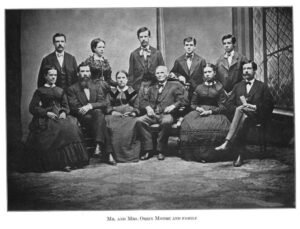
Orrin Moore and family of Goffstown, New Hampshire

The genealogical record of Goffstown, New Hampshire, was a substantial undertaking, hampered by the extinction of early families and the widespread scattering of descendants. Efforts to gather vital statistics necessitated considerable travel and correspondence, often revealing discrepancies in recorded dates across various sources. Despite challenges, contributions from former works and assistance from individuals proved invaluable in compiling this record. The comprehensive index reflects the depth of research involved in documenting the town’s heritage.

History of New Boston New Hampshire

Map of New Boston, New Hampshire

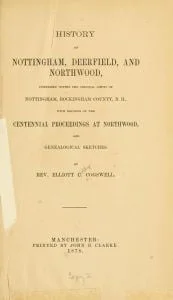
In 1864, Rev. Elliott Colby Cogswell compiled a comprehensive history of New Boston, New Hampshire, in honor of the town’s Centennial. This undertaking, prompted by a community vote during the July 4, 1863, celebrations, aimed to preserve the town’s rich history, including its civil, ecclesiastical, and educational development, as well as biographical accounts of early settlers. Funded by local subscriptions, the volume documented the events of the Centennial and served as an important record of the town’s first hundred years.

Brown Genealogy

Brown Genealogy

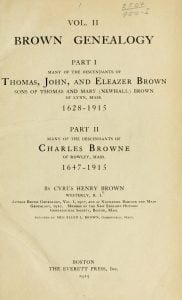
In 1895, Cyrus Henry Brown began collecting family records of the Brown family, initially with the intention of only going back to his great-grandfathers. As others became interested in the project, they decided to trace the family lineage back to Thomas Brown and his wife Mary Newhall, both born in the early 1600s in Lynn, Massachusetts. Thomas, John, and Eleazer, three of their sons, later moved to Stonington, Connecticut around 1688. When North Stonington was established in 1807, the three brothers were living in the southern part of the town. Wheeler’s “History of Stonington” contains 400 records of early descendants of the Brown family, taken from the town records of Stonington. However, many others remain unidentified, as they are not recorded in the Stonington town records. For around a century, the descendants of the three brothers lived in Stonington before eventually migrating to other towns in Connecticut and New York State, which was then mostly undeveloped. He would eventually write this second volume of his Brown Genealogy adding to and correcting the previous edition. This book is free to search, read, and/or download.

History of old Chester from 1719 to 1869

History of Old Chester title page

The *History of Old Chester from 1719 to 1869* by Benjamin Chase, published in 1869, offers a detailed account of the early settlement and development of Chester, New Hampshire. Compiled with the assistance of local historian Judge Samuel D. Bell, the book explores the town’s founding, genealogies, and significant events, using primary sources such as deeds, probate records, and personal diaries. Chase aimed to preserve the history and traditions of Chester’s early settlers while providing a comprehensive record for future generations. The work covers a broad range of topics, including religious, military, industrial, and genealogical history.

Weymouth ways and Weymouth people

Weymouth ways and Weymouth people

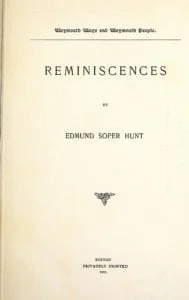
Edward Hunt’s “Weymouth ways and Weymouth people: Reminiscences” takes the reader back in Weymouth Massachusetts past to the 1830s through the 1880s as he provides glimpses into the people of the community. These reminiscences were mostly printed in the Weymouth Gazette and provide a fair example of early New England village life as it occurred in the mid 1800s. Of specific interest to the genealogist will be the Hunt material scattered throughout, but most specifically 286-295, and of course, those lucky enough to have had somebody “remembered” by Edward.

Richard Dexter Genealogy, 1642-1904

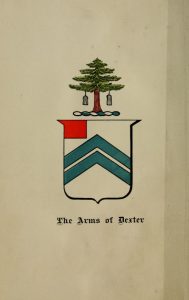
Arms of Dexter

Being a history of the descendants of Richard Dexter of Malden, Massachusetts, from the notes of John Haven Dexter and original researches. Richard Dexter, who was admitted an inhabitant of Boston (New England), Feb. 28, 1642, came from within ten miles of the town of Slane, Co. Meath, Ireland, and belonged to a branch of that family of Dexter who were descendants of Richard de Excester, the Lord Justice of Ireland. He, with his wife Bridget, and three or more children, fled to England from the great Irish Massacre of the Protestants which commenced Oct. 27, 1641. When Richard Dexter and family left England and by what vessel, we are unable to state, but he could not have remained there long, as we know he was living at Boston prior to Feb. 28, 1642.

Business Men of Northern Maine

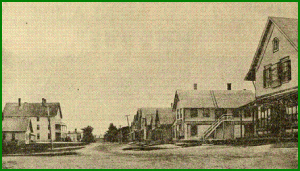
Winn Maine - Main Street looking East

A historical business directory and local history of Northern Maine from 1891, featuring sketches of nine towns including Houlton, Presque Isle, Caribou, and Fort Fairfield. The manuscript profiles businesses, owners, and civic institutions, and includes a gallery of period photographs, town views, and advertisements drawn from the era.

Bartlett Family Genealogy

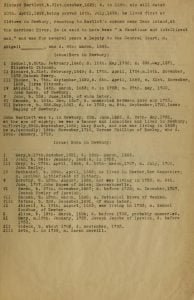
3rd Page of Bartlett Family Genealogy

Typing on six onion skinned papers, Ralph Sylvester Bartlett presented his lineage in the early 1900’s. His Bartlett family were early pioneers in Kittery Maine in the section later known as Eliot Maine. Whether he ever meant to compile these pages into book form is left for you to interpret, but somebody did eventually compile the 6 pages they had of his family tree. We provide the entire 6 pages in digital format below the transcription.

Genealogical and Family History of Vermont

Genealogical and Family History of the State of Vermont vol 1

Hiram Charlton took on the publication of the Genealogical and Family History of the State of Vermont for Lewis Publishing. In it, he enlisted the assistance of living residents of the state in providing biographical and genealogical details about their family, and then he published all 1104 family histories in two distinct volumes.

Biography of Honorable Reuben Hatch

Reuben Hatch, born on July 7, 1763, in Preston, Connecticut, moved to Norwich with his father early in life. He attended Dartmouth College but left due to health issues, later becoming a successful farmer in Tunbridge, Chelsea, and Weathersfield. Hatch owned significant properties, including a large brick house and a tavern. He represented Tunbridge and Chelsea in the General Assembly and married Eunice Dennison, with whom he had ten children. Hatch passed away on January 5, 1818, in Norwich.