Biographical and Portrait Cyclopedia of Chester County, PA

Title Page for Biographical and Portrait Cyclopedia of Chester County Pennsylvania

An introductory page for the Biographical and Portrait Cyclopedia of Chester County, Pennsylvania, this volume includes a historical sketch of the county by Samuel T. Wiley and more than 500 biographical sketches of prominent local men and leading citizens. It also outlines Chester County’s colonial origins, early boundaries, and its role in the formation of neighboring counties.
Brookfield Massachusetts Warnings 1737-1788

Worcester County MA Warnings

The document lists warnings issued in Brookfield, Massachusetts from 1737 to 1788, detailing names and dates of individuals and families warned out of town. Under the 1692-3 act, towns could warn newcomers not residing for three months to avoid supporting them if they proved to be burdensome. The returns include various residents, many of whom became notable citizens, emphasizing that being warned did not necessarily indicate poverty or need. Each entry is organized by names and dates, reflecting local governance practices.

Biographies of Western Nebraska

History of Western Nebraska and its People

A historical overview of western Nebraska and its pioneer settlers, this volume highlights the men who helped build counties across the Nebraska Panhandle, including Cheyenne, Box Butte, Deuel, Garden, Sioux, Kimball, Morrill, Sheridan, Scotts Bluff, Banner, and Dawes. It also points readers to biographies, history volumes, and a gallery of 143 photographs.

Muster Roll of Captain Benjamin Beals’ Company

Title page to the Aroostook War

Muster Roll of Captain Benjamin Beals’ Company of Infantry in the Detachment of drafted Militia of Maine, called into actual service by the State, for the protection of its Northeastern Frontier, from the twenty-fifth day of February, 1839, the time of its rendezvous at Augusta, Maine, to the seventeenth day of April, 1839, when mustered.

Representative Men of Maine – Biographical Sketches and Portraits

Representative Men of Maine Title Page

A historical collection of portraits and biographical sketches of prominent Maine residents in business, industry, the professions, and politics, along with profiles of every governor since statehood in 1820. Published in 1893, it offers a rich snapshot of the people who shaped Maine’s public life and leadership.

History of Kossuth, Hancock, and Winnebago Counties, Iowa

History of Kossuth, Hancock, and Winnebago counties, Iowa

History of Kossuth, Hancock, and Winnebago Counties, Iowa together with sketches of their cities, villages and townships, educational, civil, military and political history; portraits of prominent persons, and 638 biographies of representative citizens. Also included is a history of Iowa embracing accounts of the pre-historic races, and a brief review of its civil and military history.

Gleanings from English Records about New England Families

Gleanings from English Records about New England Families

The classic work often cited by more contemporaneous authors on early New England families and the records of them found within the Principal Probate Registry, Somerset House, Strand, the Public Record Office, Fetter Lane, and the British Museum, Bloomsbury, while on a visit in London during the summer and fall of 1879.

1923 Historical and Pictorial Directory of Angola Indiana

1923 Angola Indiana Directory Book Cover

Luedders’ historical and pictorial city directory of Angola, Indiana for the year 1923, containing an historical compilation of items of local interest, a complete canvass of names in the city, which includes every member of the family, college students, families on rural lines, directory of officers of county, city, lodges, churches, societies, a directory of streets, and a classified business directory.

Portrait and Biographical Record of Seneca and Schuyler Counties, NY

Portrait and Biographical Record of Seneca and Schuyler Counties New York

An online index to the Portrait and Biographical Record of Seneca and Schuyler Counties, New York, this volume preserves portraits and biographical sketches of prominent local citizens, including many overlooked by public records. Compiled with care for accuracy, it offers valuable material for genealogists and historians, along with biographies of all U.S. presidents.

History of Norwich Vermont Education

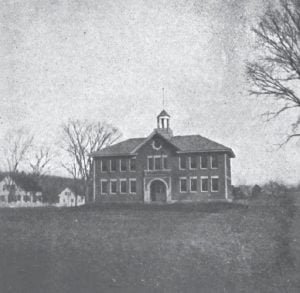
High School Building, Norwich Village, Erected in 1898

The history of education in Norwich, Vermont, traces back to efforts in 1782 to establish school districts. The first successful division occurred in 1785, creating the First School District. Over the years, multiple districts were formed, with the establishment of a committee for school supervision in 1824. Notable developments included the construction of a brick schoolhouse in 1845 and the incorporation of the Norwich Classical and English Boarding School in 1867, although it ultimately closed in 1877. The town’s education framework evolved significantly, culminating in a unified system in 1892.

Norwich Vermont in the Revolutionary War

Norwich, Vermont provided modest participation in the Revolutionary War, highlighted by its formation of a Committee of Safety in March 1777. Evidence suggests a militia was established as early as 1774. The town contributed to regiments under Colonels Warner and Bedell. Local militias organized for defense amid threats from British forces in 1776, further demonstrating Norwich’s involvement. Despite lacking comprehensive records, the enlistment of local soldiers was significant, along with efforts to protect the community from loyalist activities and contribute to the war effort.

Church History of Norwich Vermont

The first generation of Norwich settlers accomplished a significant community milestone by constructing a meeting house for public worship within a decade of settlement. This project involved the entire community, showcasing their determination despite limited resources. A committee ultimately selected the location after significant debate, with the cornerstone laid in 1778. Delays due to the Revolutionary War slowed progress, but by 1785, the building was completed and became a site for various civic activities, including sessions of the Vermont Legislature. The meeting house served the town until 1817 when a new structure was erected due to growing needs.

Narrative of the Captivity of Mrs. Mary Rowlandson – Indian Captivities

In February 1676, during King Philip’s War, Mrs. Mary Rowlandson was captured by Native Americans after her home in Lancaster was attacked. She witnessed horrific violence and loss, including the deaths of family members and friends, as the assailants burned homes and killed indiscriminately. Throughout her captivity, she endured immense physical and emotional suffering, facing starvation and constant fear. Yet, she found strength in her faith, documenting her ordeal and reflecting on God’s providence. Ultimately, she was redeemed after many harrowing weeks, reuniting with her husband but mourning the loss of her child and other relatives.

1850 Census of Croydon New Hampshire

An extracted 1850 census of Croydon, Sullivan County, New Hampshire, listing every resident with names, ages, sex, occupation, and birthplaces. Compiled by Dennis Partridge, the transcription adds surnames for searchability and notes identity corrections where the original handwriting was unclear. Researchers are encouraged to consult the original census for verification.

Louisiana Land Patents – Choctaw Tribe

A detailed listing of Louisiana land patents for the Choctaw Tribe, organized by patentee name, date, document number, and accession number. The record includes many Native and non-Native grantees and spans patents issued from the 1840s through the early 1900s, offering a valuable reference for historical land and genealogy research.

Biographical Sketch of G.M. Gilbert

G.M. Gilbert, born in 1844 in Brattleboro, Vermont, served in the Civil War with Co. B, 16th V.V. After his enlistment ended shortly before the Battle of Gettysburg, he moved to Illinois in 1864 and settled in Sioux City in 1870. In 1873, he established a successful merchant tailoring business, gaining a broad customer base that included regions beyond Iowa, such as Dakota, Nebraska, Minnesota, and Missouri, thanks to his skill and commitment to customer satisfaction.

Biographical Sketch of Dexter W. Gilbert

Dexter W. Gilbert, born on July 19, 1832, in Walpole, received education at various institutions and worked as a teacher and carpenter. He lived in several states, including Massachusetts and New York, before settling in Keene in 1864. Gilbert served as superintendent of Keene’s suburban schools from 1874 to 1878 and held various city government positions until 1882. A Republican and Freethinker, Gilbert valued education and was married to Eliza J. Cooley in 1856, with whom he had two sons.