History and Genealogy of Baltimore Vermont
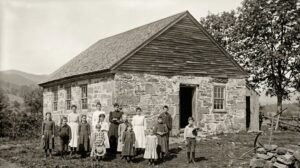
Old Stone Schoolhouse, Baltimore, Vermont

Annie M. Pollard’s 1954 work provides a detailed examination of Baltimore, Vermont’s history, tracing its origins as a part of Cavendish until its independence in 1793 due to geographic challenges. The book explores the town’s early years, highlighting the development of industry, education, infrastructure, and social welfare through town records and personal narratives. Pollard’s dedication as a public servant and her interest in local genealogy enrich the account, painting a picture of a resilient rural community with a unique identity shaped by its small size and self-reliance.

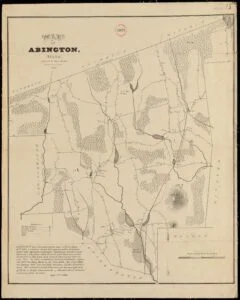
New Hampshire Men

1892 Map of New Hampshire

New Hampshire Men presents 407 biographical sketches, with portraits, of men who were active in commercial, professional, and political life in New Hampshire in 1893.

Abington Massachusetts Marriage and Death Records

1830 Map of Abington, Massachusetts

Volume 2 of the Abington, Massachusetts vital records compiles marriage and death records up to 1850, complementing Volume 1, which contains birth records. Established in 1712, Abington’s boundaries have shifted, affecting historical jurisdiction. Extensive research from town records, cemeteries, and family Bibles ensured comprehensive documentation, including the identification of Black families recorded by given names. The volume is organized alphabetically by marriages and deaths.

Abington Massachusetts Birth Records

1830 Map of Abington, Massachusetts

Volume 1 of the Abington, Massachusetts vital records details births recorded in the town up to 1850, featuring comprehensive research from town records, cemeteries, and church documents. Established in 1712, Abington’s jurisdictional changes may affect genealogical searches. The records also include separate listings for Black families, primarily by given names. Additionally, various surnames are cataloged, emphasizing the need to consider alternate spellings. For marriages and deaths, researchers should consult Volume 2.

History of Francestown New Hampshire

Map of Francestown New Hampshire

History of Francestown, New Hampshire is a historic and genealogical record of the town from its first settlement in 1758 through the beginning of 1891. It records Francestown’s settlement, civic growth, religious and educational institutions, military participation, industries, and social customs, followed by an extensive genealogical register of families associated with the town.

Vital Records of Bellingham, Massachusetts

Vital Records of Bellingham Massachusetts to the year 1850

Alphabetical indexes to the vital records of Bellingham, Massachusetts, up to the year 1850, supplemented by information from bible records, church registers, cemetery inscriptions and other private sources to include the diary kept by Samuel Wight and his daughters.

Medway Massachusetts vital records

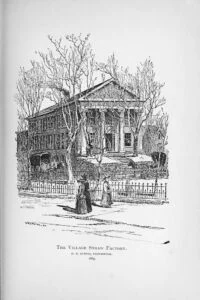
Medway Village Straw Factory

Alphabetical indexes to the vital records of Medway, Massachusetts, up to the year 1850, supplemented by information from church registers, cemetery inscriptions and other private sources to include Rev. Dr. Jacob Ide’s account of Marriages and Deaths, 1814-1849.

History of Amherst New Hampshire

Residence of Isaac Brooks in Amherst New Hampshire

The history of Amherst, New Hampshire, unfolds from its 1675 land grant to veterans of the Narraganset War, marking the impetus for settlement along the Souhegan River. From its early governance and incorporation in 1760 to territorial adjustments that birthed Mont Vernon and Milford, this narrative encompasses local geography, economy, and Indigenous presence. Key military engagements, civic institutions, and genealogical records are explored up to 1882, offering a comprehensive view of the town’s evolution and its prominent figures.

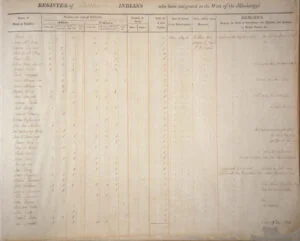
1832 Cherokee Muster Roll

1834 Cherokee Muster Roll - page 1

This Muster Roll details Cherokee Indians who migrated west of the Mississippi River under B. F. Curry’s supervision. It includes payments made by Capt. Vashon, outlining the number of individuals and slaves receiving subsistence. Each Indian received $32.50, with payments occurring in April or May 1832. The document lists heads of families and their respective counts of males, females, and slaves, totaling 231 men, 193 women, and 157 slaves, with a cumulative total of 561 individuals.

Genealogies of Cornish New Hampshire

History of Cornish New Hampshire

Volume II of History of the Town of Cornish, New Hampshire, with Genealogical Record, 1763–1910, compiled by William Henry Child and published in 1911, presents a detailed genealogical account of the families who settled in Cornish from its founding through the early 20th century.

History of Randleman North Carolina

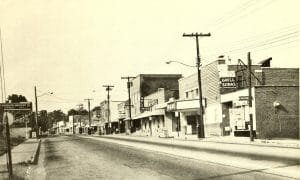
Randleman Main Street in 1962

The Rotary Club of Randleman compiled a History of Randleman in 1944. The History, together with a reprint of “The Story of Naomi Wise” and “Reminiscences of Randolph County” was published in the interest of preserving the early life of Randolph County, and as a club project. Free to read or download.

History of Buffalo New York

Buffalo Village from the Light House, 1828

“History of the City of Buffalo and Erie County” by Henry Perry Smith offers a comprehensive account of the development and significant events in Buffalo and Erie County, New York. Published in 1884 by D. Mason & Co. in Syracuse, New York, this two-volume work delves into the early settlement, growth, and transformation of the area. Volume II focuses on the history of Buffalo, New York. For the detailed history of Erie County, readers should refer to Volume I.

Marriages of Charlotte County Virginia, 1784-1815

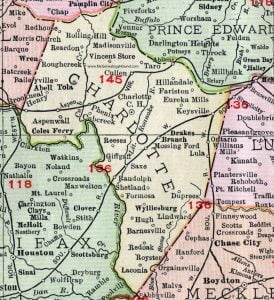
1911 Map of Charlotte County Virginia

This volume, “Marriages of Charlotte County, Virginia, 1784-1815,” compiles the marriage bonds and minister’s returns from Charlotte County during the specified period. The original work was painstakingly copied by Catherine Lindsay Knorr and published in 1951. The book spans 119 pages and includes a wealth of historical data on marriages that took place in this Virginia county. This publication presents several challenges for readers. Some pages are slightly tattered and torn, and the manuscript features irregular pagination. Additionally, there are tight or nonexistent margins, particularly at the bottom of the pages, and one page is typed on different paper than the rest.

Logan County, Kentucky Wills – Book A, with index

Will book A, Logan County, Kentucky

The wills in this book come from Book A of the Wills found at the Logan County Court house in Russellville, Kentucky. The information was extracted in 1957 by Mrs. Vick on behalf of the DAR located in Russellville. The text in this book was done with an old manual typewriter and has the usual faint and filled-in type often found with such papers. On top of the difficulty in interpreting the print from the typewriter, the scanning process was also deficient, and led to the creation of a faint digital copy exacerbating the difficult to read text.

Orange County, Virginia, will book I, 1735-1743

Orange County, Virginia, will book I, 1735-1743

In the heart of Virginia, amidst the rolling hills and rich history, lies Orange County. Established in 1734, this vast expanse of land, originally stretching from the Rappahannock River to the Blue Ridge and further west to encompass what would become West Virginia and Kentucky, has been a witness to the early stories of America. “Orange County, Virginia, Will Book I, 1735-1743,” meticulously compiled by John Frederick Dorman and published in Washington, D.C., in 1958, serves as a crucial link to this foundational past.

Pioneer Women of Lake County, Indiana 1834 – 1850

Pioneer Women of Lake County, Indiana 1834 - 1850

This small manuscript features biographical sketches of pioneer women of Lake County, Indiana who lived within the county in 1834-1850. These 45 sketches were written by their direct descendants and compiled by historians Avis Bryant Brown of Crown Point, Indiana, and Ethel Alice Vinnedge of Creston, Indiana. These biographies will provide insight for the genealogist into the lives of the women and are listed below the digital book.

Brown Genealogy

Brown Genealogy

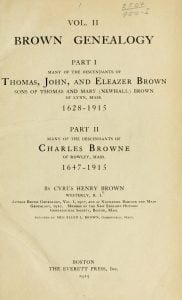
In 1895, Cyrus Henry Brown began collecting family records of the Brown family, initially with the intention of only going back to his great-grandfathers. As others became interested in the project, they decided to trace the family lineage back to Thomas Brown and his wife Mary Newhall, both born in the early 1600s in Lynn, Massachusetts. Thomas, John, and Eleazer, three of their sons, later moved to Stonington, Connecticut around 1688. When North Stonington was established in 1807, the three brothers were living in the southern part of the town. Wheeler’s “History of Stonington” contains 400 records of early descendants of the Brown family, taken from the town records of Stonington. However, many others remain unidentified, as they are not recorded in the Stonington town records. For around a century, the descendants of the three brothers lived in Stonington before eventually migrating to other towns in Connecticut and New York State, which was then mostly undeveloped. He would eventually write this second volume of his Brown Genealogy adding to and correcting the previous edition. This book is free to search, read, and/or download.

The Amidon Family of Rehoboth, MA

The Amidon Family

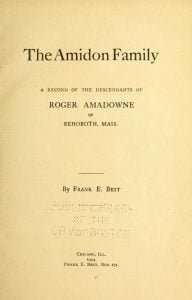
The Amidon Family genealogy book details the lineage of Roger Amadowne, a French Huguenot who fled to England and later to America after the revocation of the Edict of Nantes. Documented in Salem, Massachusetts in 1637, variations of his surname include Amadon, Amidown, and Ammidon. The work, organized with biographical sketches and two helpful indexes, presents the family’s history and is richly illustrated. Originally published in 1904, it serves as a valuable resource for descendants and historians alike.