History of Rindge New Hampshire

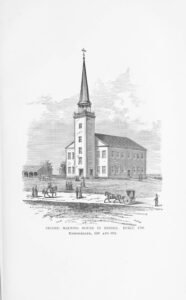
Second Meeting House in Rindge New Hampshire

The History of the Town of Rindge, New Hampshire by Ezra S. Stearns, was published in 1875, and covers the period from the original Rowley Canada grant or Massachusetts charter through the year 1874. Stearns traces the legal, territorial, and institutional development of Rindge, beginning with colonial land grants and boundary disputes and proceeding through settlement, incorporation into a town and development into a small manufacturing hub. More than half the volume is devoted to genealogical material. The genealogical register of Rindge families includes thousands of names compiled from a wide range of sources and assisted by contributions from residents and researchers beyond the town.

Vital records of Stratham, New Hampshire, 1700-1867

Plan of the Town of Stratham

In 1934, Priscilla Hammond compiled vital records from Stratham, New Hampshire, covering the years 1700 to 1867, based on original town records. This compilation, transcribed with imperfect typing, was privately published and distributed to libraries and societies. The records are presented largely as found, with family members often grouped together. An index is included to assist in locating individual records. Users should be cautious with dates, especially those before 1752, as it is unclear if old dates were converted.

History of Francestown New Hampshire

Map of Francestown New Hampshire

History of Francestown, New Hampshire is a historic and genealogical record of the town from its first settlement in 1758 through the beginning of 1891. It records Francestown’s settlement, civic growth, religious and educational institutions, military participation, industries, and social customs, followed by an extensive genealogical register of families associated with the town.

Essex County Massachusetts Probate Records 1675-1681

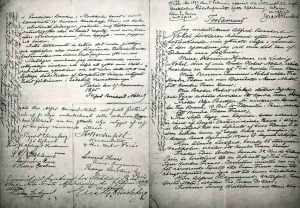
Sample Last Will and Testament

The “Governor and Company of Massachusetts Bay” established a judicial system in 1628, with a General Court in Boston and quarterly courts in major towns like Salem and Ipswich by 1635. These courts managed probate matters, and after Essex County’s formation in 1643, individual probate courts were later established in 1692. These are the probate records from 1675 to 1681, sourced from various original documents, including detailed wills and estate settlements.

Brown Genealogy

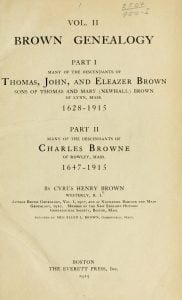
Brown Genealogy

In 1895, Cyrus Henry Brown began collecting family records of the Brown family, initially with the intention of only going back to his great-grandfathers. As others became interested in the project, they decided to trace the family lineage back to Thomas Brown and his wife Mary Newhall, both born in the early 1600s in Lynn, Massachusetts. Thomas, John, and Eleazer, three of their sons, later moved to Stonington, Connecticut around 1688. When North Stonington was established in 1807, the three brothers were living in the southern part of the town. Wheeler’s “History of Stonington” contains 400 records of early descendants of the Brown family, taken from the town records of Stonington. However, many others remain unidentified, as they are not recorded in the Stonington town records. For around a century, the descendants of the three brothers lived in Stonington before eventually migrating to other towns in Connecticut and New York State, which was then mostly undeveloped. He would eventually write this second volume of his Brown Genealogy adding to and correcting the previous edition. This book is free to search, read, and/or download.

The genealogy and history of the Ingalls family in America

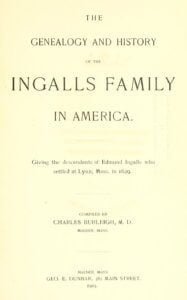
The genealogy and history of the Ingalls family in America

Edmund Ingalls, son of Robert, was born about 1598 in Skirbeck, Lincolnshire, England. He immigrated in 1628 to Salem, Massachusetts and with his brother, Francis, founded Lynn, Massachusetts in 1629. He married Ann, fathered nine children, and died in 1648.

Biography of Benjamin W. Breed

Benjamin W. Breed, born on February 12, 1830, in Nelson, N.H., was a dedicated farmer and Civil War veteran, who survived a serious gunshot wound sustained in battle. His family history is notable, with ties to early Massachusetts settlers and involvement in the Revolutionary War. After the war, Breed returned to farming in Franklin, enhancing his homestead significantly. Married twice, he was actively involved in his community and politics as a Republican, earning respect as a diligent farmer and citizen. He passed a bullet in his leg for 16 years before its eventual removal.

Biographical Sketch of Whitney Breed

Whitney Breed, born in Nelson in 1810 to Nathaniel and Nancy Breed, moved to Alstead in 1832. He married Persis Hatch on October 26, 1837, with whom he had six children. Breed served as a justice of the peace for forty years and as a deacon of the Congregational church at Alstead Center for thirty-five years. He is the great-grandson of Dr. Nathaniel Breed, the first settler in Nelson.

Biographical Sketch of Leslie A. and H. G. Breed

Leslie A. Breed, born December 11, 1855, in Erie County, Pennsylvania, relocated to various counties before settling in Jewell County, Kansas, in 1873, where he acquired 320 acres of land. He and his father manage a farm with 60 cattle and 120 hogs. Leslie served as Township Clerk for four years and married Elizabeth Morgan on December 4, 1879, in Jewell County, with whom he has one child, Otto.