History of Bedford, New Hampshire

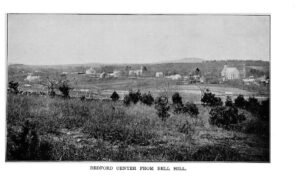
Bedford Center from Bell Hill

This volume, titled History of Bedford, New Hampshire, from 1737, was compiled by Peter P. Woodbury, Thomas Savage, and William Patten. It was published in Concord, N.H., by The Rumford Printing Co. in 1903. The primary objective of this edition was to incorporate all facts from the predecessor’s work, along with additional details and events that occurred since its publication, documenting the town’s history up to the occasion of the one hundred and fiftieth anniversary of its incorporation on May 15, 1900. A significant portion of the work is dedicated to Genealogies of 157 families, furnished largely by family representatives and compiled by Miss Mary E. Manning. The book also includes Biographies of notable figures associated with Bedford and a chapter on Vital Statistics (births, deaths, and marriages) compiled from town records, with recognized limitations due to the incompleteness of earlier record-keeping.

History of Francestown New Hampshire

Map of Francestown New Hampshire

History of Francestown, New Hampshire is a historic and genealogical record of the town from its first settlement in 1758 through the beginning of 1891. It records Francestown’s settlement, civic growth, religious and educational institutions, military participation, industries, and social customs, followed by an extensive genealogical register of families associated with the town.

The history of Medway Massachusetts

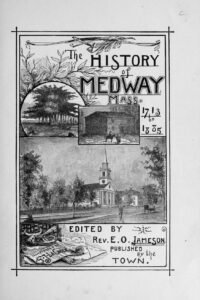
History of Medway title page

The History of Medway, Massachusetts, 1713–1885, covers the entire period of local history, embracing two hundred and twenty-five years, from 1660 to 1885; or, from the first appearance of a white settler within the territory, to the recent date of the incorporation of the town of Millis. The book is divided into ten sections, and gives, in consecutive order, an account of the first settlement, the municipal doings, the churches, the schools and other institutions, the industries, the military service, the miscellaneous matters, the cemeteries, the biographies of many persons, and the genealogies of numerous families.

History of Antrim New Hampshire

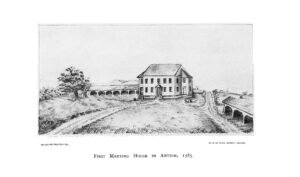
First Meeting-House in Antrim, New Hampshire, 1785

Rev. W. R. Cochrane’s exhaustive chronicle of Antrim, New Hampshire, spans from its founding to the 1877 centennial, crafted over five years of meticulous research. Commissioned by the town, the history encompasses settlement, vital records, and the genealogies of 581 families. It documents the town’s growth through various facets, such as education, military contributions, and local industries. Drawing on community contributions and earlier histories, the work aims to preserve Antrim’s legacy for future generations, featuring illustrations and detailed genealogical data.

History of Amherst New Hampshire

Residence of Isaac Brooks in Amherst New Hampshire

The history of Amherst, New Hampshire, unfolds from its 1675 land grant to veterans of the Narraganset War, marking the impetus for settlement along the Souhegan River. From its early governance and incorporation in 1760 to territorial adjustments that birthed Mont Vernon and Milford, this narrative encompasses local geography, economy, and Indigenous presence. Key military engagements, civic institutions, and genealogical records are explored up to 1882, offering a comprehensive view of the town’s evolution and its prominent figures.

History of New Boston New Hampshire

Map of New Boston, New Hampshire

In 1864, Rev. Elliott Colby Cogswell compiled a comprehensive history of New Boston, New Hampshire, in honor of the town’s Centennial. This undertaking, prompted by a community vote during the July 4, 1863, celebrations, aimed to preserve the town’s rich history, including its civil, ecclesiastical, and educational development, as well as biographical accounts of early settlers. Funded by local subscriptions, the volume documented the events of the Centennial and served as an important record of the town’s first hundred years.

History of Hampton New Hampshire vol 2

1892 Map of Hampton NH

The original version of this monumental work was published in 2 volumes. Volume 1 contains the history of the town of Hampton, New Hampshire from its settlement in 1638 to the autumn of 1892 and can be found here. Volume 2 featured the genealogical and biographical details of the early families of Hampton, NH up to the autumn of 1892 and this is the volume shown below. This manuscript was meticulously researched by Joseph Dow up until his death in 1889. Unfortunately his death preceded the final compilation of the genealogies and his daughter, Lucy Ellen Dow, took on the task after his decease. For genealogists this is an important fact. Lucy admits in her preface that she had difficulty bringing the genealogies down to date (1892) for lack of full understanding of Josiah Page’s notes and for the lack of accurate town records. As she laments about the town records “but whole decades are passed over with scarcely an entry of birth or marriage.” Indeed they are.

History of Glastonbury Connecticut, 1653-1853

Indian Map of Glastonbury

The history of Glastonbury, Connecticut, from 1653 to 1853 chronicles an account of its schools, commerce, mills, and ecclesiastical societies. The author, Alonzo Bowen Chapin, balances the general history with personal narratives, making the reading engaging for individuals tracing their ancestry. The work provides valuable insights into the town’s development, the contributions of its early ministers, and the influences of religion and learning that shaped the community. Unfortunately, the work is limited in the depths of the genealogy presented.

History of Derby Connecticut, 1642-1880

Edmund Leavenworth of Derby, Connecticut

The book titled “History of the Old Town of Derby, Connecticut, 1642-1880” presents a comprehensive account of Derby’s development, including the town’s Indian history, early settlers, and significant events like the Revolutionary War. It emphasizes education, commerce, and church influences, while offering an extensive collection of biographies and genealogies.

History of the Town of Cornwall Connecticut

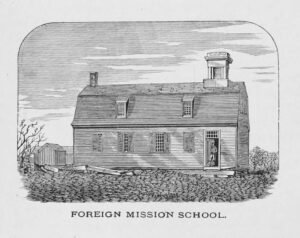
Foreign Mission School, Cornwall, Connecticut

The History of the Town of Cornwall Connecticut is a comprehensive account of the town’s evolution from colonial organization in 1731 to its involvement in national events like the Civil War. They include detailed geographical descriptions, ecclesiastical histories of local churches, and biographical sketches of families such as the Sedgwicks and Golds. The records also reflect social life, farming, early fashion, and the noteworthy Foreign Mission School.

Ancestry and Descendants of Dea. Gregory Stone of Cambridge, Massachusetts

Stone of Ardleigh and Great Bromley

Gregory Stone Genealogy: Ancestry and Descendants of Dea. Gregory Stone of Cambridge, Mass. 1320–1917 was compiled by Bartlett J. Gardner and published in Boston in 1918 under the auspices of the Stone Family Association. It represented the first comprehensive genealogical study of all known descendants of Deacon Gregory Stone. Gregory was an early settler of New England who arrived in 1635 from Great Bromley and Nayland, England. Gardner includes detailed research into Gregory’s English ancestry. PDF is free to read or download.

Putnam, Wyandt and Snyder Families of Maryland, Ohio and Pennsylvania

The Putnam-Wyand-Snyder Homestead, 1909

E. Clayton Wyand’s A Brief History of the Andrew Putman (Buttman, Putnam), Christian Wyandt (Weyandt, Weygandt, Voint, Wyand), and Adam Snyder Families (Schneider) of Washington County, Maryland (Hagerstown Bookbinding and Printing Co., 1909) is a compiled family history tracing the interrelated lineages of the Putman, Wyandt, and Snyder families. Drawn from sixteen years of research, the work includes transcriptions of wills, land deeds, letters, and genealogical sketches, supplemented by photographs of family members and associated homesteads in Maryland, Pennsylvania, and Ohio. Wyand’s research was based on extensive fieldwork in courthouses, libraries, churchyards, and family Bible records across Maryland and neighboring states. The volume is organized into sections detailing the principal families and their descendants, with supporting documents and an illustrated record of their heritage.

Historical Sketch of Lisbon Connecticut, 1786-1900

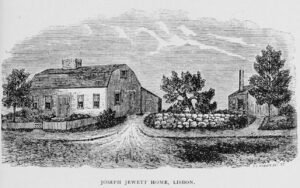
Joseph Jewett Home in Lisbon Connecticut

Though the work, Historical sketch of Lisbon, Conn., from 1786-1900, forms a modest octavo volume of only eighty-four pages, this book condenses within that limit the ecclesiastical and narrative history of the town, together with brief biographies and genealogies of its sons and daughters. The ecclesiastical history covers the sixty-eight years from 1718 to 1786 when Lisbon was a part of Norwich, and brings the record down to the 1900, embracing the Hanover parish, which celebrated its 125th anniversary in 1891. The narrative and descriptive history commences with Lisbon’s independent existence as a town, and comes down to the present day; and the brief biographical and genealogical sketches which follow occupy the last half of the book, and include lists of town officers, members of the General Assembly, and soldiers and sailors who served in the various wars of our country.

History of Montville, Connecticut 1640-1896

Samson Occum House in Montville, Connecticut

This history of Montville, Connecticut spans from 1640 to 1896, highlighting the interactions between early colonial settlers and the Mohegan tribe, particularly regarding land disputes and legal challenges. The text, largely genealogical, traces the ancestry of local families across over 500 pages while detailing the region’s evolution from native subsistence to a burgeoning Colonial economy complete with industries like grist-mills, saw-mills, and the manufacturers of bog-iron and textiles.

William Patten of Cambridge 1635 and his descendants

Map of Cambridge as it would have been in 1638

The Patten genealogy is quite expansive in its 290 pages, as it presents known descendants of William Patten of Cambridge down through nine generation. Published in 1908 it lacks the source and quality control of more recent professional genealogies, but still provides Patten descendants with plenty of material for their genealogical research. Early descendants of William Patten resided in Amesbury, Billerica, Cambridge, and Tewksbury, Massachusetts; as well as Killingly, Stafford, and Windham, Connecticut and Lincoln County, Maine.

Michael Bacon of Dedham Massachusetts and his descendants

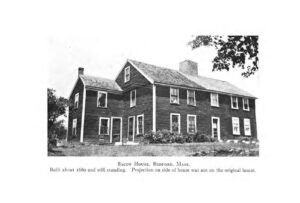
Bacon House in Bedford Massachusetts

This is a genealogy of Michael Bacon of Dedham and his descendants. Michael arrived in Dedham, Massachusetts in 1640 after sailing aboard an unnamed ship, likely from County of Suffolk, England, but possibly from Ireland. Baldwin treats the descendants of each of the three sons of Michael—Michael Jr., Daniel, and John—in a separate chapter, the first chapter being devoted to Michael Sr. and his English roots. The early descendants settled in Bedford, Billerica, Bridgewater, Cambridge, Dedham, Newton, Salem, Watertown, and Woburn Massachusetts.

A sketch of John Page Woodbury

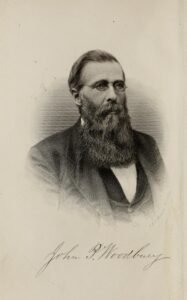
John Page Woodward

This book contains a sketch of John Page Woodbury and his direct ancestry back to John Woodward of Salem, Massachusetts. While it is woefully short on facts in its printed form, it does present a brief compiled genealogy of the descendants of John Page Woodbury down to the eighth generation on the direct line of John, Peter, Peter, Peter, Joseph, John, John, John Page.

The Iowa Nugen Family

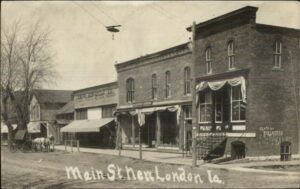
Main Street, New London, Iowa

This genealogy starts at about 1750 with the birth of Richard Nugen who first settled on the Kanawha River in what is now West Virginia, and then settled in Indiana where he raised a son named John Nugen. John married Mary See and raised a large family in Indiana of fourteen children, all who lived to adulthood. This genealogy traces the four sons of John and Mary See who settled in Iowa: David, Charles, Jarrett and Silas. This PDF is free to read and download.

History of the town of Medford, Massachusetts

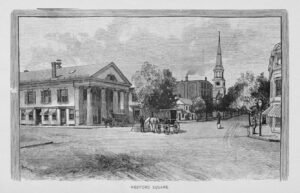
Medford Square about 1850

The History of the Town of Medford, Middlesex County, Massachusetts, from Its First Settlement in 1630 to 1885 (Boston, 1886) represents both a continuation and revision of Charles Brooks’s original 1855 history. Edited and supplemented by James M. Usher, with a genealogical register compiled by William H. Whitmore, this expanded edition incorporates Brooks’s extensive antiquarian research while extending the narrative to cover the developments of the following three decades. Drawing on scattered records, local traditions, and municipal documentation, the work preserves the character of Brooks’s text while providing a fuller account of Medford’s growth and a register of its early families.

Fay Family in Bremer County Iowa

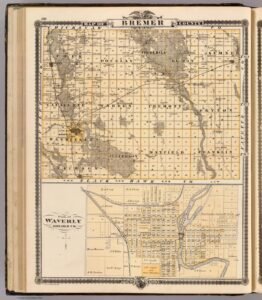
1875 Map of Bremer County Iowa

The Fay family in Bremer County, Iowa, traces its lineage back to John Fay, who arrived in Boston from England in 1656. The family has roots in Massachusetts, New Hampshire, New York, and Illinois over 204 years. John settled in Marlborough, where he had eight children and was a significant landowner. The Fays are believed to have French origins, with some traditions suggesting they fled from France due to religious persecution. Key genealogical sources include Orlin P. Fay’s genealogy and John F. Horton’s historical records.