History of Pembroke New Hampshire

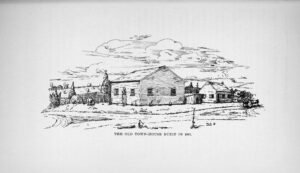
Old Pembroke NH Town House, built 1811

Nathan Carter and Trueworthy Ladd’s “History of Pembroke, N.H. 1730-1895” chronicles the town’s journey from its early settlement as Suncook to the close of the nineteenth century. Documenting key events and societal developments year by year, the authors emphasize accuracy and detail, covering land divisions, local conflicts, and the town’s involvement in the Revolutionary and Civil Wars. The volume preserves vital records and offers insight into Pembroke’s public life, industries, religious institutions, and education, establishing a comprehensive reference for its historical narrative.
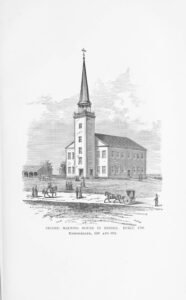
History of Rindge New Hampshire

Second Meeting House in Rindge New Hampshire

The History of the Town of Rindge, New Hampshire by Ezra S. Stearns, was published in 1875, and covers the period from the original Rowley Canada grant or Massachusetts charter through the year 1874. Stearns traces the legal, territorial, and institutional development of Rindge, beginning with colonial land grants and boundary disputes and proceeding through settlement, incorporation into a town and development into a small manufacturing hub. More than half the volume is devoted to genealogical material. The genealogical register of Rindge families includes thousands of names compiled from a wide range of sources and assisted by contributions from residents and researchers beyond the town.

History of Newport New Hampshire

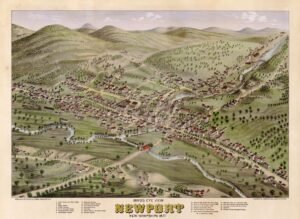
Bird's Eye View of Newport New Hampshire 1877

The History of Newport, New Hampshire, from 1766 to 1878 is a record of Newport’s growth from its early settlement through the close of the nineteenth century. It opens with the original charter and proprietary arrangements and follows the development of Newport’s physical setting, transportation routes, and economy. Particular attention is given to mills, banks, hotels, manufacturing, and the coming of the railroad, all of which shaped the town’s commercial life. The concluding genealogical section identifies families connected with Newport and other chapters provide biographical details that might otherwise be lost.

History of Shelburne Massachusetts

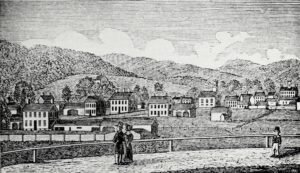
Southeastern View of Shelburne Falls Village Before 1835

The “History and Tradition of Shelburne, Massachusetts” is an account of the town’s development, initiated by a community effort in 1944. The project culminated in 1958 after various committees worked to collect and organize information across multiple aspects, including geology, early settlement, and cultural life. The book, intentionally topical rather than genealogical, features contributions from numerous writers and serves as a reference for understanding Shelburne’s heritage, institutions, and notable figures.

History of the town of Acton Massachusetts

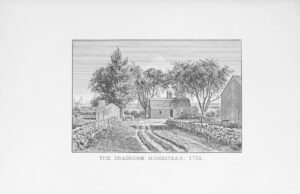
1751 The Brabrook Homestead in Acton Massachusetts

Acton’s story is laid out here as a careful account of how the town grew from a 17th century land grant tied to Concord into an independent community by 1735. Rather than listing events and dates, the author looks closely at the lives of leading families and early freemen, showing how daily concerns shaped the town’s course. The narrative gives special attention to the role of the church, disputes over land and authority during the time of royal governors such as Sir Edmund Andros, and the practical work of putting up meetinghouses and schools in a frontier setting. Drawing on deeds, ministerial agreements, and other early records, and mixing in bits of local tradition such as the tale of the “Count of the Rocky Guzzle,” the book captures something of the character and customs of the period.

Acton Massachusetts History

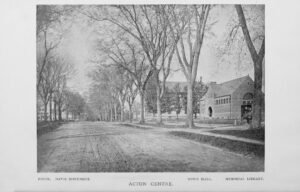
Acton Center,Acton Massachusetts

Acton in History traces the town’s development from its beginnings as Concord Village in the seventeenth century through its emergence as a modest industrial community. It gives particular attention to the religious life of the town, including the building of early meetinghouses and the long ministries of figures such as the Rev. John Swift and the Rev. James T. Woodbury. The work devotes substantial space to Acton’s role in the Revolution, especially the events at the North Bridge in 1775 and the loss of Captain Isaac Davis and his company of minute-men. It also follows the growth of local industries, from blacksmithing and cooperage to the far-reaching effects of the Fitchburg Railroad after its arrival in 1844. Later chapters include brief sketches of notable residents in the 1880s. Throughout, the narrative weaves in discussions of Acton’s everyday life, civic engagement, and social values.

Notable events in the history of Dover, New Hampshire

The old meeting house on Dover Neck

Notable events in the history of Dover, New Hampshire chronicles the evolution of Dover from its initial colonial roots in 1623 through the conclusion of the American Civil War. The text serves as a connected and accessible archive of local milestones, beginning with the obscurity of the first settlement at Hilton’s Point and moving through the town’s early reliance on fishing, trading, and agriculture. Structurally, the source follows a chronological timeline that highlights shifting governance, including the town’s voluntary union with the Massachusetts colony and its eventual integration into the Province of New Hampshire.

Builders of Pope County Minnesota

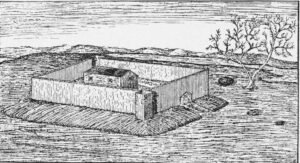
Pope County Minnesota First Court House

The historical book “Builders of Pope County” chronicles the pioneering and civil development of Pope County, Minnesota, from the Traverse des Sioux treaty to the establishment of its county seat. It details the evolution of public infrastructure, including courthouses, and features biographies of early settlers. The narrative highlights the formation of townships such as Glenwood and Starbuck, the founding of churches and schools, and the military service of residents. This work commemorates the community’s cultural growth and was released during the dedication of the new courthouse in 1930.

History of Windham New Hampshire

Residence of William H Anderson of Windham, New Hampshire

Leonard A. Morrison’s *The History of Windham, New Hampshire*, published in 1883, chronicles the town’s evolution from early settlements in the 18th century to the late 19th century. It highlights Windham’s roots in the Scotch-Irish Londonderry community and examines various aspects of local life, including land grants, education, and political developments. The work also documents significant historical events and includes extensive genealogies of the area’s early settlers and their descendants, drawing from comprehensive local records and archives.

History of the Town of Goffstown New Hampshire

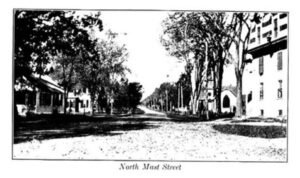
North Mast Street, Goffstown, New Hampshire

The “History of the Town of Goffstown, New Hampshire” chronicles the town’s development from its early territorial origins until the early twentieth century. Emerging from local preservation efforts, the book was formally initiated in 1908, with a dedicated committee tasked with organizing extensive records from various sources. It documents Goffstown’s civic, religious, and industrial life, along with genealogical records and maps. This historical account serves as a vital reference for current and future generations, preserving the town’s legacy and the contributions of its inhabitants.

History of Bedford, New Hampshire

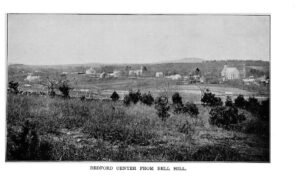
Bedford Center from Bell Hill

This volume, titled History of Bedford, New Hampshire, from 1737, was compiled by Peter P. Woodbury, Thomas Savage, and William Patten. It was published in Concord, N.H., by The Rumford Printing Co. in 1903. The primary objective of this edition was to incorporate all facts from the predecessor’s work, along with additional details and events that occurred since its publication, documenting the town’s history up to the occasion of the one hundred and fiftieth anniversary of its incorporation on May 15, 1900. A significant portion of the work is dedicated to Genealogies of 157 families, furnished largely by family representatives and compiled by Miss Mary E. Manning. The book also includes Biographies of notable figures associated with Bedford and a chapter on Vital Statistics (births, deaths, and marriages) compiled from town records, with recognized limitations due to the incompleteness of earlier record-keeping.

The history of Medway Massachusetts

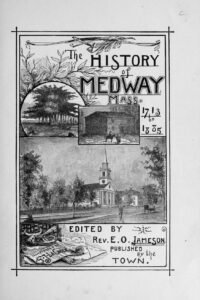
History of Medway title page

The History of Medway, Massachusetts, 1713–1885, covers the entire period of local history, embracing two hundred and twenty-five years, from 1660 to 1885; or, from the first appearance of a white settler within the territory, to the recent date of the incorporation of the town of Millis. The book is divided into ten sections, and gives, in consecutive order, an account of the first settlement, the municipal doings, the churches, the schools and other institutions, the industries, the military service, the miscellaneous matters, the cemeteries, the biographies of many persons, and the genealogies of numerous families.

History of Amherst New Hampshire

Residence of Isaac Brooks in Amherst New Hampshire

The history of Amherst, New Hampshire, unfolds from its 1675 land grant to veterans of the Narraganset War, marking the impetus for settlement along the Souhegan River. From its early governance and incorporation in 1760 to territorial adjustments that birthed Mont Vernon and Milford, this narrative encompasses local geography, economy, and Indigenous presence. Key military engagements, civic institutions, and genealogical records are explored up to 1882, offering a comprehensive view of the town’s evolution and its prominent figures.

History of Hampton New Hampshire vol 1

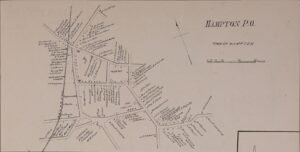
1892 Map of the town of Hampton NH

The original version of this monumental work was published in 2 volumes. Volume 1, here presented, contains the history of the town of Hampton, New Hampshire from its settlement in 1638 to the autumn of 1892. Volume 2 features the genealogical and biographical details of the early families of Hampton, NH up to the autumn of 1892. There is every indication that Joseph Dow had completed the first volume before his death in 1889, and was compiling the material needed for the second volume which his daughter finished for him.

History of Derby Connecticut, 1642-1880

Edmund Leavenworth of Derby, Connecticut

The book titled “History of the Old Town of Derby, Connecticut, 1642-1880” presents a comprehensive account of Derby’s development, including the town’s Indian history, early settlers, and significant events like the Revolutionary War. It emphasizes education, commerce, and church influences, while offering an extensive collection of biographies and genealogies.

History of the Town of Cornwall Connecticut

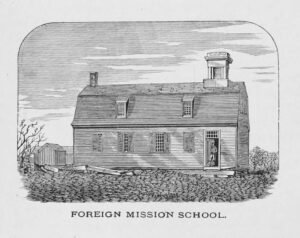
Foreign Mission School, Cornwall, Connecticut

The History of the Town of Cornwall Connecticut is a comprehensive account of the town’s evolution from colonial organization in 1731 to its involvement in national events like the Civil War. They include detailed geographical descriptions, ecclesiastical histories of local churches, and biographical sketches of families such as the Sedgwicks and Golds. The records also reflect social life, farming, early fashion, and the noteworthy Foreign Mission School.

History of Montville, Connecticut 1640-1896

Samson Occum House in Montville, Connecticut

This history of Montville, Connecticut spans from 1640 to 1896, highlighting the interactions between early colonial settlers and the Mohegan tribe, particularly regarding land disputes and legal challenges. The text, largely genealogical, traces the ancestry of local families across over 500 pages while detailing the region’s evolution from native subsistence to a burgeoning Colonial economy complete with industries like grist-mills, saw-mills, and the manufacturers of bog-iron and textiles.

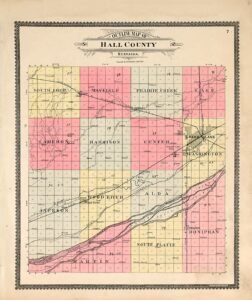
History of Hall County, Nebraska

1904 Map of Hall County Nebraska

When the Union Pacific Railroad stretched its iron rails across Nebraska in the 1860s, it opened the prairie to settlement in ways the earlier trails and rivers never could. The editors of this history researched and documented the stories of the families who shaped Hall County, Nebraska. They didn’t just write, though, they also listened. Listened to the remembrances of the elders in their region that remembered Hall County in its infancy. These historical narratives span from the pre-county exploration days to the growth of towns like Grand Island and Wood River, up to 1920. While recognizing gaps in the historical record, the manuscript honors those who contributed to Hall County’s development through their stories and challenges.

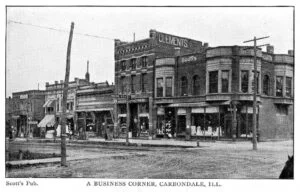
History of Carbondale, Illinois, 1852-1905

A Business Corner, Carbondale

Carbondale, Illinois, spans about 6,000 acres, primarily in the southwest quarter of Carbondale Township, established following congressional guidelines. Early settlers settled near Little Crab Orchard and Piles Fork creeks. The city’s growth is intertwined with the contributions of its founders, highlighted through 330 biographical sketches in the book, which offer details into their lives during challenging times. Carbondale’s history reflects the influence of individual leadership on municipal progress, celebrated here in the context of the nation’s bicentennial.

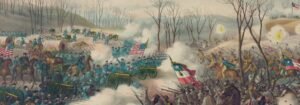
Names of Cherokee Soldiers in the Civil War

Pea Ridge Battle

In 1861, Stand Watie organized the Cherokee Mounted Rifle Regiment to support the Confederacy, becoming its Colonel. The regiment included various officers and multiple companies, each with distinguished ranks and privates. A notable military structure was established, reflecting the Cherokee commitment to the Southern cause, despite initial neutrality. Over time, several battles occurred, and controversies arose regarding supply and compensation for Cherokee soldiers. Ultimately, Stand Watie negotiated a treaty with the U.S. in 1865, marking the end of hostilities and the return to peace for the Cherokee Nation.