New Hampshire Men

New Hampshire Men presents 407 biographical sketches, with portraits, of men who were active in commercial, professional, and political life in New Hampshire in 1893.

New Hampshire Men presents 407 biographical sketches, with portraits, of men who were active in commercial, professional, and political life in New Hampshire in 1893.
New Hampshire Men of Progress contains 289 biographical sketches and portraits of leaders in business and professional life in and of the state of New Hampshire. It was edited by the staff of the Manchester Union under the supervision of Richard Herndon.
New Hampshire Notables,” published by the Concord Press in 1932, is a biographical compilation that follows a previous work by Henry H. Metcalf. It contains 474 brief sketches of notable individuals, both natives and residents of New Hampshire, recognized for their contributions across various fields such as public life, business, and education. This edition focuses on living subjects as of 1932, with an alphabetical index for easy reference. While not exhaustive, it serves as a valuable resource for researchers and libraries, preserving important biographical data.
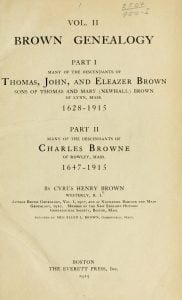
In 1895, Cyrus Henry Brown began collecting family records of the Brown family, initially with the intention of only going back to his great-grandfathers. As others became interested in the project, they decided to trace the family lineage back to Thomas Brown and his wife Mary Newhall, both born in the early 1600s in Lynn, Massachusetts. Thomas, John, and Eleazer, three of their sons, later moved to Stonington, Connecticut around 1688. When North Stonington was established in 1807, the three brothers were living in the southern part of the town. Wheeler’s “History of Stonington” contains 400 records of early descendants of the Brown family, taken from the town records of Stonington. However, many others remain unidentified, as they are not recorded in the Stonington town records. For around a century, the descendants of the three brothers lived in Stonington before eventually migrating to other towns in Connecticut and New York State, which was then mostly undeveloped. He would eventually write this second volume of his Brown Genealogy adding to and correcting the previous edition. This book is free to search, read, and/or download.
The “Abbe-Abbey Genealogy” serves as a comprehensive and meticulously compiled homage to the heritage of the Abbe and Abbey families, tracing its roots back to John Abbe and his descendants. Initiated by the life-long passion of Professor Cleveland Abbe, this genealogical exploration began in his youth and expanded throughout his illustrious career, despite numerous challenges. It encapsulates the collaborative efforts of numerous family members and researchers, including significant contributions from individuals such as Charles E. Abbe, Norah D. Abbe, and many others, each bringing invaluable insights and data to enrich the family’s narrative.

Two volumes of Cox family genealogy combined as one. The first volume contains information about the various early Cox families across America. The second volume deals specifically with the descendants of James and Sarah Cock of Killingworth upon Matinecock, in the township of Oysterbay, Long Island, New York.
History of Kossuth, Hancock, and Winnebago Counties, Iowa together with sketches of their cities, villages and townships, educational, civil, military and political history; portraits of prominent persons, and 638 biographies of representative citizens. Also included is a history of Iowa embracing accounts of the pre-historic races, and a brief review of its civil and military history.
Hiram Charlton took on the publication of the Genealogical and Family History of the State of Vermont for Lewis Publishing. In it, he enlisted the assistance of living residents of the state in providing biographical and genealogical details about their family, and then he published all 1104 family histories in two distinct volumes.
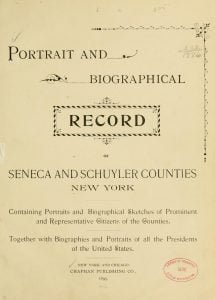
An online index to the Portrait and Biographical Record of Seneca and Schuyler Counties, New York, this volume preserves portraits and biographical sketches of prominent local citizens, including many overlooked by public records. Compiled with care for accuracy, it offers valuable material for genealogists and historians, along with biographies of all U.S. presidents.
Albert Bingham Woodworth, born on April 7, 1843, in Dorchester, New Hampshire, was a prominent merchant and the Mayor of Concord. His lineage included Revolutionary War veteran Sylvanus Woodworth. Raised in Hebron, he completed his education at Boscawen Academy. Woodworth’s business career began at a young age, eventually leading to the formation of Woodworth Brothers in Concord. Politically active, he served as Alderman and represented Concord in the state legislature before his mayoral election in 1896. He was married to Mary Parker and had three children.
Thomas I. Woodworth, born on April 5, 1810, in Weybridge, Vermont, was educated in local schools. After losing his mother at twelve, he became an apprentice in the gilding trade and later worked as a journeyman. He married Betsey C. Albro in 1835 and owned a business making looking-glasses and picture frames. A pioneer during the California gold rush in 1849, he faced challenges with Native Americans before returning to Vermont after mining for two and a half years. He eventually turned to farming and raised three children.
Charles Woodworth, born on February 16, 1815, in Weybridge, Vermont, was the son of Guy and Abigail Woodworth. His father, a scythe manufacturer and active community member, instilled a strong work ethic in him. After receiving a basic education, Charles took over the family farming business, eventually selling the water privilege to the Middlebury Pulp Company in 1880. He was also involved in military service and married Ruth Page in 1865, with whom he had a son, Charles Guy, born in 1871.
Fred J. Woodworth, born on September 22, 1871, in New Haven, Ohio, was a prominent banker. Son of Jonathan and Martha Welch Woodworth, he received a public education and married Nellie F. Patton in 1905. Woodworth began his banking career as a bookkeeper at First National Bank in 1886 and progressed through various roles at Euclid Avenue National Bank, ultimately becoming vice president of the consolidated First National Bank. He also served as treasurer of the Forest City Live Stock Fair Company and was active in several local clubs.