History of Newport New Hampshire

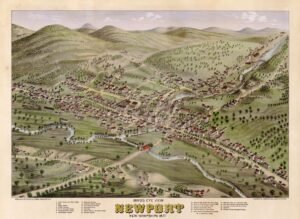
Bird's Eye View of Newport New Hampshire 1877

The History of Newport, New Hampshire, from 1766 to 1878 is a record of Newport’s growth from its early settlement through the close of the nineteenth century. It opens with the original charter and proprietary arrangements and follows the development of Newport’s physical setting, transportation routes, and economy. Particular attention is given to mills, banks, hotels, manufacturing, and the coming of the railroad, all of which shaped the town’s commercial life. The concluding genealogical section identifies families connected with Newport and other chapters provide biographical details that might otherwise be lost.

Vital Records of Sheffield Massachusetts, 1733-1792

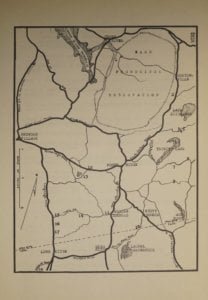
Map of Sheffield, Harstville, Southfield and New Marlborough Massachusetts

The vital records of Sheffield, Massachusetts from 1733 to 1792 detail the town’s historical births, marriages, and deaths. While names and dates are transcribed accurately, some wording has been abbreviated for clarity. Marriage records often specify the union of couples, while birth records typically include parental names. Notably, some families lack marriage entries, starting instead with a child’s birth. The records also document a few out-of-wedlock births, emphasizing lineage through parental names, even in adult death records.

Biographical and Historical Memoirs of Story County, Iowa

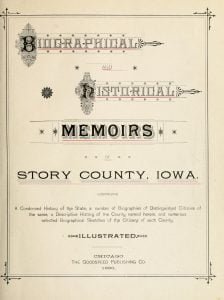
Title Page for Biographical and Historical Memoirs of Story County, Iowa

This manuscript offers a broad survey of Iowa’s development and the individuals who shaped it. It opens with a concise history of the state, followed by a series of biographical sketches highlighting notable Iowans whose careers influenced law, politics, commerce, and community life. A substantial section is devoted to Story County, providing a descriptive account of its formation, settlement patterns, and early growth. This county history is supplemented by an extensive collection of personal profiles documenting the lives of its leading residents.

The Amidon Family of Rehoboth, MA

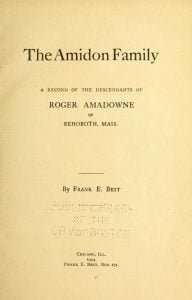
The Amidon Family

The Amidon Family genealogy book details the lineage of Roger Amadowne, a French Huguenot who fled to England and later to America after the revocation of the Edict of Nantes. Documented in Salem, Massachusetts in 1637, variations of his surname include Amadon, Amidown, and Ammidon. The work, organized with biographical sketches and two helpful indexes, presents the family’s history and is richly illustrated. Originally published in 1904, it serves as a valuable resource for descendants and historians alike.

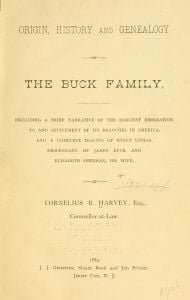
Origin, history, and genealogy of the Buck family

Origin, history, and genealogy of the Buck family

Origin, history and genealogy of the Buck family : including a brief narrative of the earliest emigration to and settlement of its branches in America and a complete tracking of every lineal descendant of James Buck and Elizabeth Sherman, his wife

Families of Ancient New Haven

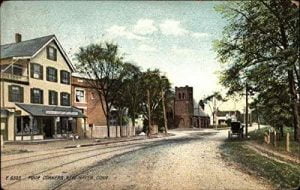
Four Corners New Haven Connecticut

The Families of Ancient New Haven compilation includes the families of the ancient town of New Haven, covering the present towns of New Haven, East Haven, North Haven, Hamden, Bethany, Woodbridge and West Haven. These families are brought down to the heads of families in the First Census (1790), and include the generation born about 1790 to 1800. Descendants in the male line who removed from this region are also given, if obtainable, to about 1800, unless they have been adequately set forth in published genealogies.

Tombstone records of eighteen cemeteries in Poundridge, New York

Map of cemeteries in Poundridge New York

In 1940 and 1941 Mrs. Sterling B. Jordan and Mrs. Frank W. Seth walked the 18 cemeteries in Poundridge, New York compiling the names and dates for all gravestones. Added to some of those gravestone listings were familial relationships if known. In addition, they referenced an even earlier listing of a few of the cemeteries by William Eardley taken in 1901.

Descendants of John and Mary Howes of Montgomery County, Maryland

Descendants of John and Mary Howes of Montgomery County, Maryland

John Howes of Montgomery County, Maryland, was born ” … after 1740, m[arried] Mary_____, and d[ied] between November, 1808 and March 1809. He is buried in Laytonsville, Maryland with his mother, his brother James and daughter Sarah. About a year after his death his widow, Mary, went to Bucks County, Kentucky.”–P. 8. Descendants and relatives lived in Maryland, Kentucky, New York, Michigan, Ohio, California, Illinois, Massachusetts, Washington, D. C., Missouri, Nebraska, Colorado, California, Maine, Pennsylvania, and elsewhere.

Huet Genealogy of Brockton, Massachusetts

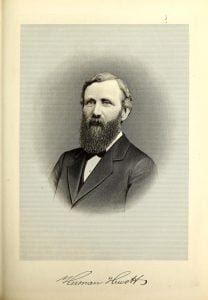
Herman Hewett

Reference is here made to the branch of this family to which belonged the late Joseph Hewett, who for a period of thirty years was an honored resident of Brockton, and his posterity, numbered among whom have been men prominently identified with the business interests of the city for many years. Thomas Huet, born in 1609, was an early inhabitant of Hingham and a landholder. Probably Huet’s Cove in that vicinity took its name from him. He married (first) Elizabeth, daughter of William Chapman, who died in 1639, leaving most of his property to his daughter just named. She died May 22, 1649,” in Hingham. He married (second) Mrs. Mary Cutler, widow of John Cutler. Mr. Huet was a tailor and resided in West Hingham. He was made a freeman May 26, 1647. He died May 24, 1670, in Hingham, aged about sixty-one. His wife outlived him and removed to Charlestown.

Weymouth ways and Weymouth people

Weymouth ways and Weymouth people

Edward Hunt’s “Weymouth ways and Weymouth people: Reminiscences” takes the reader back in Weymouth Massachusetts past to the 1830s through the 1880s as he provides glimpses into the people of the community. These reminiscences were mostly printed in the Weymouth Gazette and provide a fair example of early New England village life as it occurred in the mid 1800s. Of specific interest to the genealogist will be the Hunt material scattered throughout, but most specifically 286-295, and of course, those lucky enough to have had somebody “remembered” by Edward.

Ancestors of Charles Jarvis Holmes of Marshfield and Rochester MA

Charles Jarvis Holmes

The Holmes family has a storied lineage in both New England and England, dating back to 1066 when John Holmes, a captain in William the Conqueror’s army, was granted land in Yorkshire. The family emigrated to New England, with notable descendants including Charles Jarvis Holmes of Marshfield and Rochester, a distinguished lawyer and public servant. His lineage includes several generations of influential figures, contributing to the legal, financial, and public life of the region, fostering a legacy of honor and service.

Descendancts of John Remington of Haverhill, MA

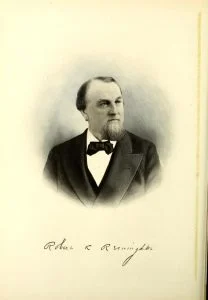
Robert Knight Remington

Robert Knight Remington, born in 1826 in Grafton, MA, was a prominent philanthropist and businessman in Fall River, known for his integrity and dedication to community service. His ancestors, including John Remington, settled in Haverhill, MA, in 1661 before establishing roots in Rhode Island. Throughout his life, Remington championed temperance and youth education, contributing significantly to local missions and religious efforts. He was married twice and left behind a legacy through his children, influencing business and civic life in Fall River.

Progressive Men of Western Colorado

Early Life in Colorado

This manuscript, in its essence, is a collection of 948 biographies of prominent men and women, all leading citizens of Western Colorado. In this context, Western Colorado encompasses the counties of Archuleta, Chaffee, Delta, Eagle, Garfield, Gunnison, Hinsdale, La Plata, Lake, Mesa, Mineral, Moffat, Montezuma, Montrose, Ouray, Pitkin, Rio Blanco, Routt, San Juan, and San Miguel.

Representative Men of Maine – Biographical Sketches and Portraits

Representative Men of Maine Title Page

A historical collection of portraits and biographical sketches of prominent Maine residents in business, industry, the professions, and politics, along with profiles of every governor since statehood in 1820. Published in 1893, it offers a rich snapshot of the people who shaped Maine’s public life and leadership.

1899 Directory for Middleboro and Lakeville Massachusetts

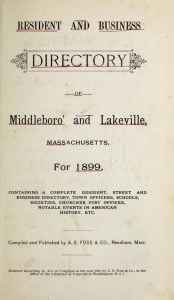
1899 Middleboro and Lakeville Massachusetts Directory Cover

The 1899 Directory for Middleboro and Lakeville, Massachusetts, compiled by A. E. Foss & Co., provides a comprehensive list of residents and businesses, alongside town officers, schools, churches, and societies. It includes notable historical events and offers a detailed account of the local community, featuring numerous surnames from both towns. This directory serves as an essential resource for understanding the demographics and social structure of Middleboro and Lakeville during that period.

Migration of Families out of Norwich VT

In the late 18th and early 19th centuries, Norwich, Vermont, experienced significant emigration, leading to a notable decline in its population. Initially home to 40 families in 1771, the town saw many residents relocate to newer settlements, such as Royalton and Randolph, during and after the Revolutionary War. Prominent families, including the Hibbards and Carpenters, contributed to the establishment of towns in northern Vermont and beyond. By the 1800s, the trend of outmigration intensified, marking a long-term shift in the region’s demographic landscape.

Norwich Vermont in the Revolutionary War

Norwich, Vermont provided modest participation in the Revolutionary War, highlighted by its formation of a Committee of Safety in March 1777. Evidence suggests a militia was established as early as 1774. The town contributed to regiments under Colonels Warner and Bedell. Local militias organized for defense amid threats from British forces in 1776, further demonstrating Norwich’s involvement. Despite lacking comprehensive records, the enlistment of local soldiers was significant, along with efforts to protect the community from loyalist activities and contribute to the war effort.

Church History of Norwich Vermont

The first generation of Norwich settlers accomplished a significant community milestone by constructing a meeting house for public worship within a decade of settlement. This project involved the entire community, showcasing their determination despite limited resources. A committee ultimately selected the location after significant debate, with the cornerstone laid in 1778. Delays due to the Revolutionary War slowed progress, but by 1785, the building was completed and became a site for various civic activities, including sessions of the Vermont Legislature. The meeting house served the town until 1817 when a new structure was erected due to growing needs.

The Ministerial Act of Vermont

The Ministerial Act, enacted by Vermont’s legislature in October 1783, mandated local taxation for building meeting houses and supporting ministers. In 1785, Norwich decided to assume the cost of its meeting house via taxation, raising £694 from its citizens. This tax, payable in various forms, equalized expenses for all, regardless of prior contributions. The meeting house became a town property, leading to new seating arrangements based on age and contribution. The Act remained until 1801, fostering a unified religious practice among Norwich’s residents.

Norwich Vermont and Dartmouth College

Norwich, Vermont, and Dartmouth College share a significant historical bond. Founded around the same time, both institutions benefited from mutual support, with Norwich contributing land and donations for the college’s establishment in Hanover. The founders of Norwich had personal ties with Dartmouth’s founder, Rev. Dr. Wheelock, who nearly chose Norwich as the college’s location. Over the years, Norwich supplied a substantial number of students to Dartmouth, highlighting a close relationship that fostered mutual growth and education amidst the challenges of their early settlements.