Vital records of Stratham, New Hampshire, 1700-1867

Plan of the Town of Stratham

In 1934, Priscilla Hammond compiled vital records from Stratham, New Hampshire, covering the years 1700 to 1867, based on original town records. This compilation, transcribed with imperfect typing, was privately published and distributed to libraries and societies. The records are presented largely as found, with family members often grouped together. An index is included to assist in locating individual records. Users should be cautious with dates, especially those before 1752, as it is unclear if old dates were converted.

History of Amherst New Hampshire

Residence of Isaac Brooks in Amherst New Hampshire

The history of Amherst, New Hampshire, unfolds from its 1675 land grant to veterans of the Narraganset War, marking the impetus for settlement along the Souhegan River. From its early governance and incorporation in 1760 to territorial adjustments that birthed Mont Vernon and Milford, this narrative encompasses local geography, economy, and Indigenous presence. Key military engagements, civic institutions, and genealogical records are explored up to 1882, offering a comprehensive view of the town’s evolution and its prominent figures.

History of Hampton New Hampshire vol 2

1892 Map of Hampton NH

The original version of this monumental work was published in 2 volumes. Volume 1 contains the history of the town of Hampton, New Hampshire from its settlement in 1638 to the autumn of 1892 and can be found here. Volume 2 featured the genealogical and biographical details of the early families of Hampton, NH up to the autumn of 1892 and this is the volume shown below. This manuscript was meticulously researched by Joseph Dow up until his death in 1889. Unfortunately his death preceded the final compilation of the genealogies and his daughter, Lucy Ellen Dow, took on the task after his decease. For genealogists this is an important fact. Lucy admits in her preface that she had difficulty bringing the genealogies down to date (1892) for lack of full understanding of Josiah Page’s notes and for the lack of accurate town records. As she laments about the town records “but whole decades are passed over with scarcely an entry of birth or marriage.” Indeed they are.

Genealogies of Cornish New Hampshire

History of Cornish New Hampshire

Volume II of History of the Town of Cornish, New Hampshire, with Genealogical Record, 1763–1910, compiled by William Henry Child and published in 1911, presents a detailed genealogical account of the families who settled in Cornish from its founding through the early 20th century.

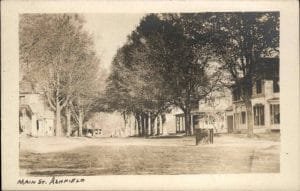
Ashfield Massachusetts Vital Records

Main Street, Ashfield, Massachusetts

Alphabetical indexes to the vital records of Ashfield, Massachusetts, up to the year 1850, supplemented by information from bible records, church registers, cemetery inscriptions and other sources. PDF file is free to read and download.

Brown Genealogy

Brown Genealogy

In 1895, Cyrus Henry Brown began collecting family records of the Brown family, initially with the intention of only going back to his great-grandfathers. As others became interested in the project, they decided to trace the family lineage back to Thomas Brown and his wife Mary Newhall, both born in the early 1600s in Lynn, Massachusetts. Thomas, John, and Eleazer, three of their sons, later moved to Stonington, Connecticut around 1688. When North Stonington was established in 1807, the three brothers were living in the southern part of the town. Wheeler’s “History of Stonington” contains 400 records of early descendants of the Brown family, taken from the town records of Stonington. However, many others remain unidentified, as they are not recorded in the Stonington town records. For around a century, the descendants of the three brothers lived in Stonington before eventually migrating to other towns in Connecticut and New York State, which was then mostly undeveloped. He would eventually write this second volume of his Brown Genealogy adding to and correcting the previous edition. This book is free to search, read, and/or download.

History of Littleton New Hampshire

1895 Map of Littleton New Hampshire

The History of Littleton New Hampshire is comprised of three volumes, two volumes of history, and a final volume of genealogies. Considered one of the best examples of local history written in the early 20th century, is your ancestors resided in Littleton then you need these books. Read and download for free!

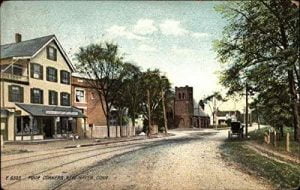
Families of Ancient New Haven

Four Corners New Haven Connecticut

The Families of Ancient New Haven compilation includes the families of the ancient town of New Haven, covering the present towns of New Haven, East Haven, North Haven, Hamden, Bethany, Woodbridge and West Haven. These families are brought down to the heads of families in the First Census (1790), and include the generation born about 1790 to 1800. Descendants in the male line who removed from this region are also given, if obtainable, to about 1800, unless they have been adequately set forth in published genealogies.

Abbe-Abbey Genealogy

A genealogical dictionary of the first settlers of New England vol 1

The “Abbe-Abbey Genealogy” serves as a comprehensive and meticulously compiled homage to the heritage of the Abbe and Abbey families, tracing its roots back to John Abbe and his descendants. Initiated by the life-long passion of Professor Cleveland Abbe, this genealogical exploration began in his youth and expanded throughout his illustrious career, despite numerous challenges. It encapsulates the collaborative efforts of numerous family members and researchers, including significant contributions from individuals such as Charles E. Abbe, Norah D. Abbe, and many others, each bringing invaluable insights and data to enrich the family’s narrative.

Genealogical Record of Thomas Wait and his descendants

Genealogical record of Thomas Wait and his descendants

Genealogical Record of Thomas Wait and his descendants looks at the genealogy of Thomas Wait (1601-1677) who was from Wethersfield Parish, Essex, England. On his arrival in America, landing in Rhode Island, he applied for a lot on which to build,and was granted it on 7/1/1639. On 3/l6/l641 he became a Freeman in Newport R. I. He died in Portsmouth R. I., before April 1677 intestate. This Thomas Wait was a cousin to the Richard Waite of Watertown Mass., who was a large land owner. This unpublished manuscript provides the descendants of this family.

Descendants of Matthew Watson of Leicester, Massachusetts

Watson Coat of arms

Matthew Watson (d. 1720), of English lineage, married Mary Orr in 1695, and in 1718 the family immigrated from Ireland to Boston, Massachusetts and settled in Leicester, Massachusetts. Descendants and relatives lived in New England, New York, New Jersey, Pennsylvania, Ohio, Nebraska, Rhode Island, California, Nevada, Michigan and elsewhere. Includes Watson, Armington, Bemis, Denny, Draper, Kent, Washburn, Bailey, Barnard, Belcher, Bent, Biscoe, Bolles, Breckenridge, Bright, Browning, Bryant, Bullock, Burrage, Dennis, Fisher, Foster, Green, Hayward, Hobbs, Hodgkins, Holman, Howard, Jenks, Jones, Kellogg, Kitchell, Knight, Lazelle, Livermore, Loring, Mason, Maynard, Munger, Patrick, Prouty, Remington, Reed, Rice, Richardson, Rogers, Sadler, Sibley, Snow, Sprague, Stone, Studley, Symonds, Taitt, Thomas, Thompson, Trask, Tucker, Waite, Webster, Westcott, Wheeler, Whittermore, Wilson, Woods and related families.

1st Mississippi Light Artillery

The 1st Mississippi Light Artillery, also known as Withers’ Light Artillery, comprised several companies raised across Mississippi, participating in key battles during the Civil War. Initially assembled in May 1862, the regiment played a crucial role in the defense of Vicksburg against Union forces, with notable contributions at Chickasaw Bayou and the Vicksburg campaign. Throughout its service, the artillery faced significant casualties and challenges, ultimately surrendering at Vicksburg in July 1863. Afterward, surviving members regrouped as infantry before continuing their service in various capacities.

Weymouth ways and Weymouth people

Weymouth ways and Weymouth people

Edward Hunt’s “Weymouth ways and Weymouth people: Reminiscences” takes the reader back in Weymouth Massachusetts past to the 1830s through the 1880s as he provides glimpses into the people of the community. These reminiscences were mostly printed in the Weymouth Gazette and provide a fair example of early New England village life as it occurred in the mid 1800s. Of specific interest to the genealogist will be the Hunt material scattered throughout, but most specifically 286-295, and of course, those lucky enough to have had somebody “remembered” by Edward.

Ashley Family of New Bedford, MA

The Ashley family, among Rochester’s early settlers, traces its roots to Joseph Ashley and his descendants. Key figures in this lineage include Joshua B. Ashley, a prominent New Bedford businessman, and his son, Charles Sumner Ashley, who served multiple terms as mayor. Charles’s political career showcased his dedication to public service, earning him considerable popularity and influence in the community. His leadership spanned over a decade, reflecting his commitment to New Bedford’s growth and prosperity, as well as his strong connections within social circles.

Richard Dexter Genealogy, 1642-1904

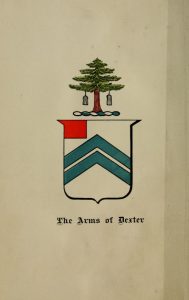
Arms of Dexter

Being a history of the descendants of Richard Dexter of Malden, Massachusetts, from the notes of John Haven Dexter and original researches. Richard Dexter, who was admitted an inhabitant of Boston (New England), Feb. 28, 1642, came from within ten miles of the town of Slane, Co. Meath, Ireland, and belonged to a branch of that family of Dexter who were descendants of Richard de Excester, the Lord Justice of Ireland. He, with his wife Bridget, and three or more children, fled to England from the great Irish Massacre of the Protestants which commenced Oct. 27, 1641. When Richard Dexter and family left England and by what vessel, we are unable to state, but he could not have remained there long, as we know he was living at Boston prior to Feb. 28, 1642.

Descendants of Alexander Bisset Munro of Bristol, Maine

Munro Family

Alexander Bisset Munro was born 25 Dec. 1793 at Inverness, Scotland to Donald and Janet (Bisset) Munro. Alexander left Scotland at the age of 14, and lived in Dimecrana in the West Indies for 18 years. He owned a plantation, raising cotton, coffee and other produce. He brought produce to Boston Massachusetts on the ship of Solomon Dockendorff. To be sure he got his money, Solomon asked his to come home with him, where he met Solomon’s sister, Jane Dockendorff. Alexander went back to the West Indies, sold out, and moved to Round Pond, Maine, and married Jane. They had 14 children: Janet, Alexander, Margaret, Nancy, Jane, Mary, Solomon, Donald, John, William, Bettie, Edmund, Joseph and Lydia.

Portrait and Biographical Record of Seneca and Schuyler Counties, NY

Portrait and Biographical Record of Seneca and Schuyler Counties New York

An online index to the Portrait and Biographical Record of Seneca and Schuyler Counties, New York, this volume preserves portraits and biographical sketches of prominent local citizens, including many overlooked by public records. Compiled with care for accuracy, it offers valuable material for genealogists and historians, along with biographies of all U.S. presidents.

First Settlements in Norwich Vermont

The early settlement of Norwich, Vermont, began in 1762 when Samuel Slafter’s son, John, explored the area, reporting its fertile land and water sources. In 1763, after receiving his father’s rights, he commenced clearing lots but faced challenges, as his initial choice proved unsuitable. By 1765-66, a few families settled permanently, including the Hutchinsons and Manns, establishing homes and farms. Pioneers endured various hardships, yet they built foundations for a thriving community, characterized by a homogeneous population primarily from Connecticut.

Biography of Rev. Joseph E. Sanderson, M.A.,

Rev. Joseph E. Sanderson was born on January 13, 1830, in Toronto. He pursued an illustrious educational path, graduating from Toronto University in 1855 with multiple academic accolades. Ordained in 1856, he served in various Methodist ministries before becoming the first Principal and Governor of Ontario Ladies College in Whitby in 1874, an institution he helped establish. His leadership contributed to its rapid growth as a premier educational facility for women. Sanderson married Maggie E. Richmond in 1860 and fathered six children.