History of Rindge New Hampshire

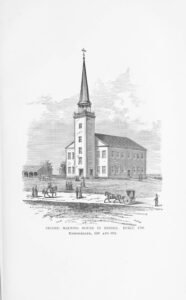
Second Meeting House in Rindge New Hampshire

The History of the Town of Rindge, New Hampshire by Ezra S. Stearns, was published in 1875, and covers the period from the original Rowley Canada grant or Massachusetts charter through the year 1874. Stearns traces the legal, territorial, and institutional development of Rindge, beginning with colonial land grants and boundary disputes and proceeding through settlement, incorporation into a town and development into a small manufacturing hub. More than half the volume is devoted to genealogical material. The genealogical register of Rindge families includes thousands of names compiled from a wide range of sources and assisted by contributions from residents and researchers beyond the town.
History of Newport New Hampshire

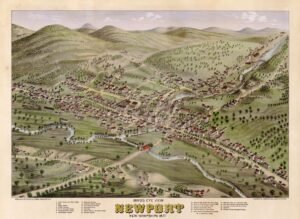
Bird's Eye View of Newport New Hampshire 1877

The History of Newport, New Hampshire, from 1766 to 1878 is a record of Newport’s growth from its early settlement through the close of the nineteenth century. It opens with the original charter and proprietary arrangements and follows the development of Newport’s physical setting, transportation routes, and economy. Particular attention is given to mills, banks, hotels, manufacturing, and the coming of the railroad, all of which shaped the town’s commercial life. The concluding genealogical section identifies families connected with Newport and other chapters provide biographical details that might otherwise be lost.

Abington Massachusetts Marriage and Death Records

1830 Map of Abington, Massachusetts

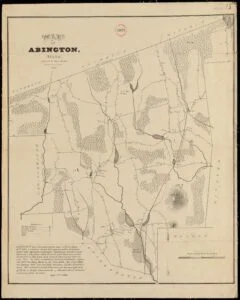
Volume 2 of the Abington, Massachusetts vital records compiles marriage and death records up to 1850, complementing Volume 1, which contains birth records. Established in 1712, Abington’s boundaries have shifted, affecting historical jurisdiction. Extensive research from town records, cemeteries, and family Bibles ensured comprehensive documentation, including the identification of Black families recorded by given names. The volume is organized alphabetically by marriages and deaths.

Abington Massachusetts Birth Records

1830 Map of Abington, Massachusetts

Volume 1 of the Abington, Massachusetts vital records details births recorded in the town up to 1850, featuring comprehensive research from town records, cemeteries, and church documents. Established in 1712, Abington’s jurisdictional changes may affect genealogical searches. The records also include separate listings for Black families, primarily by given names. Additionally, various surnames are cataloged, emphasizing the need to consider alternate spellings. For marriages and deaths, researchers should consult Volume 2.

Vital Records of Sheffield Massachusetts, 1733-1792

Map of Sheffield, Harstville, Southfield and New Marlborough Massachusetts

The vital records of Sheffield, Massachusetts from 1733 to 1792 detail the town’s historical births, marriages, and deaths. While names and dates are transcribed accurately, some wording has been abbreviated for clarity. Marriage records often specify the union of couples, while birth records typically include parental names. Notably, some families lack marriage entries, starting instead with a child’s birth. The records also document a few out-of-wedlock births, emphasizing lineage through parental names, even in adult death records.

History of Amherst New Hampshire

Residence of Isaac Brooks in Amherst New Hampshire

The history of Amherst, New Hampshire, unfolds from its 1675 land grant to veterans of the Narraganset War, marking the impetus for settlement along the Souhegan River. From its early governance and incorporation in 1760 to territorial adjustments that birthed Mont Vernon and Milford, this narrative encompasses local geography, economy, and Indigenous presence. Key military engagements, civic institutions, and genealogical records are explored up to 1882, offering a comprehensive view of the town’s evolution and its prominent figures.

History of Montville, Connecticut 1640-1896

Samson Occum House in Montville, Connecticut

This history of Montville, Connecticut spans from 1640 to 1896, highlighting the interactions between early colonial settlers and the Mohegan tribe, particularly regarding land disputes and legal challenges. The text, largely genealogical, traces the ancestry of local families across over 500 pages while detailing the region’s evolution from native subsistence to a burgeoning Colonial economy complete with industries like grist-mills, saw-mills, and the manufacturers of bog-iron and textiles.

Genealogies of Cornish New Hampshire

History of Cornish New Hampshire

Volume II of History of the Town of Cornish, New Hampshire, with Genealogical Record, 1763–1910, compiled by William Henry Child and published in 1911, presents a detailed genealogical account of the families who settled in Cornish from its founding through the early 20th century.

Abstractions from Huron County Ohio, Will Book A

Volume A, Huron County Wills to 1852

This volume is “Abstractions from Huron County Ohio, Will Book A.” These will abstractions cover the years from 1828 to 1852. They have been taken out of order as they appeared in the original volume and sorted by name. This abstraction was done by Henry Timman of Norwalk, Ohio, in 1960.

History of Bland County Virginia

History of Bland County Virginia

The History of Bland County was compiled in 1961 and published to coincide with the 100th Anniversary of the formation of Bland County. Largely comprised of interesting anecdotes concerning early settlers, it is one of the most valuable secondary source available for researchers of Bland County Virginia ancestry. Free to read and download.

The Amidon Family of Rehoboth, MA

The Amidon Family

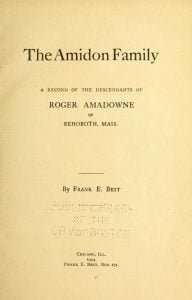
The Amidon Family genealogy book details the lineage of Roger Amadowne, a French Huguenot who fled to England and later to America after the revocation of the Edict of Nantes. Documented in Salem, Massachusetts in 1637, variations of his surname include Amadon, Amidown, and Ammidon. The work, organized with biographical sketches and two helpful indexes, presents the family’s history and is richly illustrated. Originally published in 1904, it serves as a valuable resource for descendants and historians alike.

Abbe-Abbey Genealogy

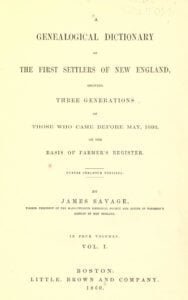
A genealogical dictionary of the first settlers of New England vol 1

The “Abbe-Abbey Genealogy” serves as a comprehensive and meticulously compiled homage to the heritage of the Abbe and Abbey families, tracing its roots back to John Abbe and his descendants. Initiated by the life-long passion of Professor Cleveland Abbe, this genealogical exploration began in his youth and expanded throughout his illustrious career, despite numerous challenges. It encapsulates the collaborative efforts of numerous family members and researchers, including significant contributions from individuals such as Charles E. Abbe, Norah D. Abbe, and many others, each bringing invaluable insights and data to enrich the family’s narrative.

Tombstone records of eighteen cemeteries in Poundridge, New York

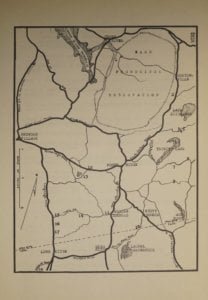
Map of cemeteries in Poundridge New York

In 1940 and 1941 Mrs. Sterling B. Jordan and Mrs. Frank W. Seth walked the 18 cemeteries in Poundridge, New York compiling the names and dates for all gravestones. Added to some of those gravestone listings were familial relationships if known. In addition, they referenced an even earlier listing of a few of the cemeteries by William Eardley taken in 1901.

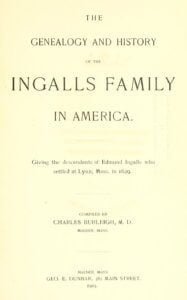
The genealogy and history of the Ingalls family in America

The genealogy and history of the Ingalls family in America

Edmund Ingalls, son of Robert, was born about 1598 in Skirbeck, Lincolnshire, England. He immigrated in 1628 to Salem, Massachusetts and with his brother, Francis, founded Lynn, Massachusetts in 1629. He married Ann, fathered nine children, and died in 1648.

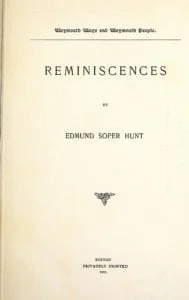
Weymouth ways and Weymouth people

Weymouth ways and Weymouth people

Edward Hunt’s “Weymouth ways and Weymouth people: Reminiscences” takes the reader back in Weymouth Massachusetts past to the 1830s through the 1880s as he provides glimpses into the people of the community. These reminiscences were mostly printed in the Weymouth Gazette and provide a fair example of early New England village life as it occurred in the mid 1800s. Of specific interest to the genealogist will be the Hunt material scattered throughout, but most specifically 286-295, and of course, those lucky enough to have had somebody “remembered” by Edward.

A Genealogy of the Lake Family

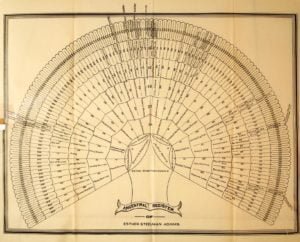
Ancestor Register of Esther Steelman Adams

A genealogy of the Lake family of Great Egg Harbour in Old Gloucester County in New Jersey : descended from John Lade of Gravesend, Long Island; with notes on the Gravesend and Staten Island branches of the family. This volume of nearly 400 pages includes a coat-of-arms in colors, two charts, and nearly fifty full page illustrations – portraits, old homes, samplers, etc. The coat-of-arms shown in the frontspiece is an unusually good example of the heraldic art!

Richard Dexter Genealogy, 1642-1904

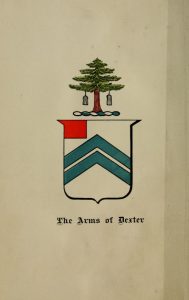
Arms of Dexter

Being a history of the descendants of Richard Dexter of Malden, Massachusetts, from the notes of John Haven Dexter and original researches. Richard Dexter, who was admitted an inhabitant of Boston (New England), Feb. 28, 1642, came from within ten miles of the town of Slane, Co. Meath, Ireland, and belonged to a branch of that family of Dexter who were descendants of Richard de Excester, the Lord Justice of Ireland. He, with his wife Bridget, and three or more children, fled to England from the great Irish Massacre of the Protestants which commenced Oct. 27, 1641. When Richard Dexter and family left England and by what vessel, we are unable to state, but he could not have remained there long, as we know he was living at Boston prior to Feb. 28, 1642.

Gallery of Western Nebraska’s People

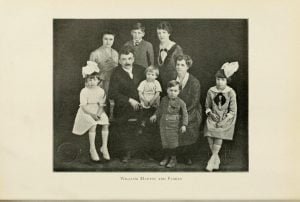
William Maupin and Family

143 full page photographs of families, couples, group photographs, individual people, and homesteads found within the manuscript History Of Western Nebraska & It’s People, Volume 3.

Biographies of Western Nebraska

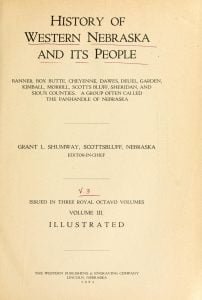
History of Western Nebraska and its People

A historical overview of western Nebraska and its pioneer settlers, this volume highlights the men who helped build counties across the Nebraska Panhandle, including Cheyenne, Box Butte, Deuel, Garden, Sioux, Kimball, Morrill, Sheridan, Scotts Bluff, Banner, and Dawes. It also points readers to biographies, history volumes, and a gallery of 143 photographs.

Business Men of Northern Maine

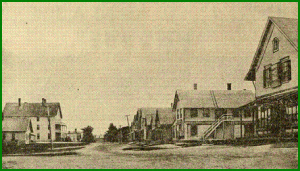
Winn Maine - Main Street looking East

A historical business directory and local history of Northern Maine from 1891, featuring sketches of nine towns including Houlton, Presque Isle, Caribou, and Fort Fairfield. The manuscript profiles businesses, owners, and civic institutions, and includes a gallery of period photographs, town views, and advertisements drawn from the era.