
Hicks
Baldwin County Georgia Marriages 1806-1850
This index compiles 1,352 Baldwin County, Georgia marriage records from court documents covering 1806 to 1850. It lists groom, bride, and marriage date entries in chronological order, offering a valuable genealogical resource for tracing family history, local relationships, and early county residents across more than four decades.
Abstracts of Wills on File in the City of New York Surrogate’s Office 1660-1680
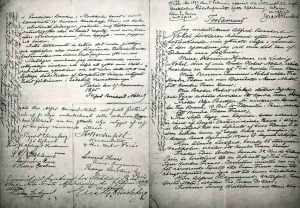
Abstracts of wills on file in the surrogate’s office city of New York 1660-1680. From May 1787 to the present, county surrogate’s courts have recorded probates. However, the court of probates and court of chancery handled estates of deceased persons who died in one county but who owned property in another. An 1823 law mandated that all probates come under the jurisdiction of the county surrogate’s courts. Each surrogate’s court has a comprehensive index to all probate records, including the unrecorded probate packets. Interestingly enough, there are wills existing and on record at the Surrogate’s Office in New York City for the time-span of 1660-1680. Genealogical extracts of these wills have been provided below.
Biographical Sketch of Herbert W. Hicks
Abijah Hicks, born March 2, 1819, married Hannah Worcester in 1852, and they had five children, including Herbert Worcester Hicks, born May 18, 1861. Herbert married Rachel Cardwell in 1886, and they had six children, among them Ethel Inez and Homer Wilton. Herbert’s Cherokee name is E-no-li; he descends from notable Cherokee figures, including his mother, the daughter of early missionary Reverend Samuel A. Worcester, and his father, a descendant of Chief Charles Hicks.
Biography of E. D. Hicks
The 1852 Laws of the Cherokee Nation includes the tribe’s first law, approved by Principal Chief Enola and Second Chief Pathkiller, with Secretary Charles Hicks’ signature. Born circa 1760-1770, Hicks was a half-breed Cherokee educated through missionary efforts. He served as Treasurer and Second Chief, known for his intelligence and integrity. He was involved in Cherokee governance until his death around 1827. His descendants, notably Elijah and Daniel Ross Hicks, held significant positions in the Cherokee Nation, contributing to its legacy and governance.
Will of John Hicks – 1672
In his 1672 will, John Hicks of Hempstead, despite his frail health, demonstrated clarity in his intentions. He appointed his son Thomas as executor, mandating him to pay £100 to his wife Rachel in livestock. Rachel was also granted household items and her personal belongings. Hicks bequeathed colts to his daughter Haviland’s children and £100 to his daughter Hannah, divided between horses and cattle. Additional legacies were designated for his son Thomas’s children and son-in-law Josyas Starr. The will was witnessed and later proved in court.
Biographical Sketch of C. P. Hicks
C.P. Hicks, born in Philadelphia in October 1848, graduated from Bryant Straton College and worked for several years as a bookkeeper in a commission house. In 1874, he relocated to Cedar County, Iowa, before moving to Sac County in March 1881. He later purchased land near Fletcher and established his business, during which time he and his firm shipped sixty cars of grain between August 1881 and February 1882.
Slave Narrative of Sophie D. Belle
Sophie D. Belle, born near Knoxville, Georgia, reflects on her life as the daughter of a house slave, raised by the Hicks family. Although she never witnessed the sale of slaves, she recalls the effects of the Civil War and emancipation on her community. Belle recounts her childhood, education, and two marriages, noting her lack of children. After moving to Forrest City in 1874, she worked various domestic jobs and is now reliant on Social Welfare at age 77. Throughout her life, she has maintained a connection to her Baptist faith.
Biography of Edward D. Hicks
Edward D. Hicks, born on January 1, 1866, in Fort Gibson, Indian Territory, was a prominent businessman in Tahlequah. He was the only child of Cherokee leaders Daniel R. and Nancy J. Hicks. Educated in the Cherokee Nation and the University of Arkansas, he began his career in a mercantile business before founding the Cherokee Telephone Company in 1895. Hicks became manager when it merged with Southwest Bell in 1905. A committed community member, he actively supported local initiatives and served as a Republican. He married Lizzie Musgrove and had several children.
Charles H. Hicks
Charles H. Hicks served in the Wagoner Company of the 120th Infantry Regiment, 30th Division. Born to W. A. and Dora Hicks and husband to Clyda Hopkins Hicks, he enlisted on June 19, 1916, in Thomasville, N.C. His military journey included deployments to the Mexican border and various camps, ultimately arriving in Europe on May 25, 1918. He participated in all battles with his division and returned to the United States on April 3, 1919, being mustered out a few days later.
List 3, Cherokees
List of Cherokees and Cherokee Freedmen whose names were omitted from final rolls because no application was made or by reason of mistake or oversight. Shows the names of 125 Cherokees by blood and 2 Cherokee freedmen all except 5 being minors, and most of them less than 4 years of age March 4, 1906.
Biographies of the Cherokee Indians
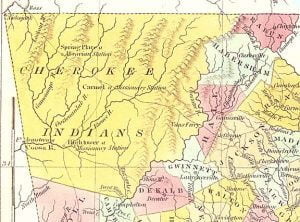
The Cherokee Indians, primarily from the Southeastern U.S., have a rich history marked by their early adoption of a written language and a government structure similar to that of the United States. Despite their forced relocation to Oklahoma in the 1830s, they maintained significant genealogical ties, often intermarrying with Whites. Emmet Starr’s “History of the Cherokee Indians and Their Legends and Folklore” emphasizes personal biographies and genealogies, providing insights into the lives and connections of many Cherokee families across generations, thereby enriching their cultural narrative.