
History of Jefferson County Oklahoma

History of Jefferson County, Oklahoma

In “History of Jefferson County, Oklahoma,” Jim M. Dyer provides a comprehensive account of the development and heritage of Jefferson County within the broader context of Oklahoma’s growth since its inception as a state in the Union. This work is particularly significant as it commemorates Oklahoma’s Semi-Centennial, marking fifty years of statehood filled with rich productivity and development. Dyer’s exploration is driven by a multifaceted purpose: to celebrate the state’s achievements, to preserve the memory of Jefferson County’s “birth and growth” for future generations, and to honor the pioneers whose resilience and dedication laid the foundations for the county’s prosperity.
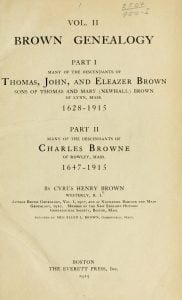
Brown Genealogy

Brown Genealogy

In 1895, Cyrus Henry Brown began collecting family records of the Brown family, initially with the intention of only going back to his great-grandfathers. As others became interested in the project, they decided to trace the family lineage back to Thomas Brown and his wife Mary Newhall, both born in the early 1600s in Lynn, Massachusetts. Thomas, John, and Eleazer, three of their sons, later moved to Stonington, Connecticut around 1688. When North Stonington was established in 1807, the three brothers were living in the southern part of the town. Wheeler’s “History of Stonington” contains 400 records of early descendants of the Brown family, taken from the town records of Stonington. However, many others remain unidentified, as they are not recorded in the Stonington town records. For around a century, the descendants of the three brothers lived in Stonington before eventually migrating to other towns in Connecticut and New York State, which was then mostly undeveloped. He would eventually write this second volume of his Brown Genealogy adding to and correcting the previous edition. This book is free to search, read, and/or download.

Biography of Job Francis Dye

Job Francis Dye, born in 1807 in Kentucky, exemplified the spirit of pioneering on the Pacific coast. He ventured westward, enduring the challenges of wilderness life, and became an adept trapper and hunter in the Rocky Mountains. After significant experiences in California’s early days, he established a successful ranch and engaged in various businesses, including merchandising. Dye played a key role in the region’s transition from Mexican to American governance, known for his hospitality and contributions to his community. He passed away in 1883, leaving behind a remarkable legacy.

Biography of George Crook Dye

George Crook Dye, born on February 12, 1879, in Niotaze, Kansas, is a notable figure in Chautauqua County. He serves as mayor, runs a thriving mercantile business, and is a director at the local bank. A dedicated agriculturist, he manages 530 acres of land. Dye comes from a distinguished lineage, with roots tracing back to early American settlers. His father, Enoch Dye, was a Civil War veteran and a successful farmer. George Dye is active in local politics and community service, embodying strong personal values and commitment to his town.

Biography of Augustus T. Dye

Augustus T. Dye, born on July 27, 1864, in Clermont County, Ohio, had a significant impact on Madison County as a former County recorder and a key figure in Anderson’s financial sector. He was instrumental in founding the Farmers Trust Company, serving as assistant secretary and treasurer. Dye’s career included roles as a traveling salesman and mercantile businessman before his political and financial success. He married twice and had three children from his first marriage. Active in various Masonic and fraternal organizations, he resided at 920 West Fifth Street in Anderson.