History and Genealogy of Baltimore Vermont
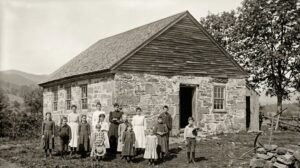
Old Stone Schoolhouse, Baltimore, Vermont

Annie M. Pollard’s 1954 work provides a detailed examination of Baltimore, Vermont’s history, tracing its origins as a part of Cavendish until its independence in 1793 due to geographic challenges. The book explores the town’s early years, highlighting the development of industry, education, infrastructure, and social welfare through town records and personal narratives. Pollard’s dedication as a public servant and her interest in local genealogy enrich the account, painting a picture of a resilient rural community with a unique identity shaped by its small size and self-reliance.
History of Rindge New Hampshire

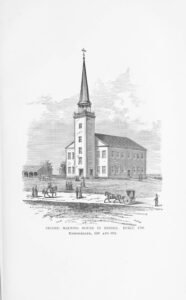
Second Meeting House in Rindge New Hampshire

The History of the Town of Rindge, New Hampshire by Ezra S. Stearns, was published in 1875, and covers the period from the original Rowley Canada grant or Massachusetts charter through the year 1874. Stearns traces the legal, territorial, and institutional development of Rindge, beginning with colonial land grants and boundary disputes and proceeding through settlement, incorporation into a town and development into a small manufacturing hub. More than half the volume is devoted to genealogical material. The genealogical register of Rindge families includes thousands of names compiled from a wide range of sources and assisted by contributions from residents and researchers beyond the town.

History of Newport New Hampshire

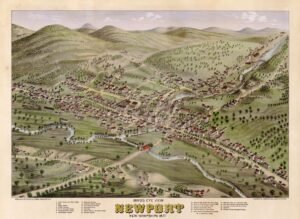
Bird's Eye View of Newport New Hampshire 1877

The History of Newport, New Hampshire, from 1766 to 1878 is a record of Newport’s growth from its early settlement through the close of the nineteenth century. It opens with the original charter and proprietary arrangements and follows the development of Newport’s physical setting, transportation routes, and economy. Particular attention is given to mills, banks, hotels, manufacturing, and the coming of the railroad, all of which shaped the town’s commercial life. The concluding genealogical section identifies families connected with Newport and other chapters provide biographical details that might otherwise be lost.

Collections of the New Hampshire Historical Society

1892 Map of New Hampshire

The Collections of the New Hampshire Historical Society is a 15 publication series documenting the state’s history through various primary sources, including manuscripts, letters, and public records. It collates valuable narratives that were previously difficult to access, providing insight into events, individuals, and communities in New Hampshire. Each volume offers focused topics and historical analyses, and most volumes contain individual indexes.

Samuel Lane’s Journal, 1739-1803

Jabez Lane House

Samuel Lane’s journal, covering 1739 to 1803, chronicles the life of a New Hampshire resident who experienced the colonial, Revolutionary, and early national periods. Lane transitioned from farming to various professions, including tanner and shoemaker, while actively participating in community roles. His meticulously kept journal captures local and national events, personal reflections, and societal changes. Edited by Charles Lane Hansen in 1937, it serves as a crucial primary source, offering insights into the daily life, hardships, and resilience of 18th-century New England.

New Hampshire Men

1892 Map of New Hampshire

New Hampshire Men presents 407 biographical sketches, with portraits, of men who were active in commercial, professional, and political life in New Hampshire in 1893.

History of Hampton New Hampshire vol 2

1892 Map of Hampton NH

The original version of this monumental work was published in 2 volumes. Volume 1 contains the history of the town of Hampton, New Hampshire from its settlement in 1638 to the autumn of 1892 and can be found here. Volume 2 featured the genealogical and biographical details of the early families of Hampton, NH up to the autumn of 1892 and this is the volume shown below. This manuscript was meticulously researched by Joseph Dow up until his death in 1889. Unfortunately his death preceded the final compilation of the genealogies and his daughter, Lucy Ellen Dow, took on the task after his decease. For genealogists this is an important fact. Lucy admits in her preface that she had difficulty bringing the genealogies down to date (1892) for lack of full understanding of Josiah Page’s notes and for the lack of accurate town records. As she laments about the town records “but whole decades are passed over with scarcely an entry of birth or marriage.” Indeed they are.

History of Asheboro North Carolina

Sunset Avenue looking West about 1900, Asheboro

Historical sketches by Sidney Swaim Robins concerning Asheboro North Carolina between the years of 1880 and 1910. Taken from memory and the young age at which he resided in Asheboro, they were subject to some errors, but in general seem quite active. Some interesting tidbits of history on the people and place of Asheboro. Free to read or download.

The Wilson Family, Somerset and Barter Hill Branch

The Wilson family, Somerset and Barter Hill branch

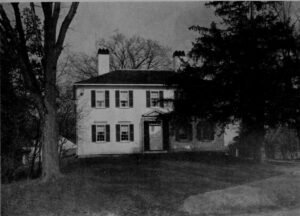
In the preparation of “The Wilson family, Somerset and Barter Hill branch” I have discovered two lists of the names of the sons and daughters of Col. Ben and Ann Seay Wilson of “Somerset” in Cumberland County, Virginia, in addition to the list found in my father’s notes. None of these was arranged in the same chronological order. It was my good fortune in 1915 to find the Bible, claimed to be the Bible of Col. Ben and Ann Seay Wilson of “Somerset” in Cumberland County, Virginia. At that time this was in the hands of Miss Clementine Reid Wilson, Col. Ben’s great-granddaughter, and it was my privilege to copy, with the aid of a reading glass, for the ink was badly faded, the names of their children from that Bible in the same chronological order in which they were recorded. This chronological order, and military records found, support each other. I therefore believe that this sketch contains the most accurate chronological list of Col. Ben’s and Ann Seay Wilson’s children to be found outside of his Bible.

The Descendants of Franklin Mary Noyes Rowe of Humboldt County, Iowa

Home of Franklin and Mary Noyes Rowe 1887-1905

This book, “The Descendants of Franklin Mary Noyes Rowe of Humboldt County, Iowa, with Some Notes on Their Ancestors,” authored by Velma Rowe Coffin in Storm Lake, Iowa, in 1955, is a meticulously researched genealogical record spanning 87 pages. It traces the lineage of Franklin Rowe, born December 30, 1836, in Onondaga County, New York, and provides insights into his ancestry and descendants. Free to read or download.

Weymouth ways and Weymouth people

Weymouth ways and Weymouth people

Edward Hunt’s “Weymouth ways and Weymouth people: Reminiscences” takes the reader back in Weymouth Massachusetts past to the 1830s through the 1880s as he provides glimpses into the people of the community. These reminiscences were mostly printed in the Weymouth Gazette and provide a fair example of early New England village life as it occurred in the mid 1800s. Of specific interest to the genealogist will be the Hunt material scattered throughout, but most specifically 286-295, and of course, those lucky enough to have had somebody “remembered” by Edward.

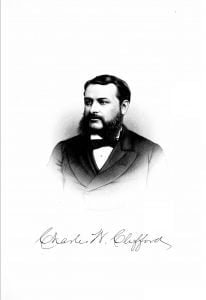
Clifford Family of New Bedford, MA

Charles Warren Clifford

The Clifford family of New Bedford, MA, has played a significant role in southern Massachusetts law for nearly a century. Beginning with Timothy Gardner Coffin and John H. Clifford, who became influential figures in the Commonwealth, the firm evolved through various partnerships, reflecting generations of legal expertise. John H. Clifford, deeply involved in public service, served as attorney general and governor, while his descendants continued the family legacy in law and civic duty. This rich lineage traces back to George Clifford, an early settler from England, linking the family’s esteemed heritage to significant historical figures.

Hussey and Morgan Families of New Bedford MA

The Hussey and Morgan families have a significant history in New Bedford, dating back nearly a century. Key figures include George Hussey and Charles Wain Morgan, both influential in the whaling and shipping industries during the early nineteenth century. Christopher Hussey, their ancestor, was among the early settlers in New England, while George Hussey and his son were prominent ship merchants. Charles Morgan, who also established a successful shipping business, contributed to community institutions and left an enduring legacy in New Bedford’s wealthy society.

Richard Dexter Genealogy, 1642-1904

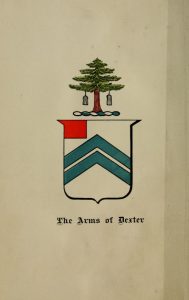
Arms of Dexter

Being a history of the descendants of Richard Dexter of Malden, Massachusetts, from the notes of John Haven Dexter and original researches. Richard Dexter, who was admitted an inhabitant of Boston (New England), Feb. 28, 1642, came from within ten miles of the town of Slane, Co. Meath, Ireland, and belonged to a branch of that family of Dexter who were descendants of Richard de Excester, the Lord Justice of Ireland. He, with his wife Bridget, and three or more children, fled to England from the great Irish Massacre of the Protestants which commenced Oct. 27, 1641. When Richard Dexter and family left England and by what vessel, we are unable to state, but he could not have remained there long, as we know he was living at Boston prior to Feb. 28, 1642.

Sawyer Genealogy of Narraguagus Valley Maine

Narraguagus Valley Some Account of its Early Settlement and Settlers

Josiah Sawyer settled near the Narraguagus River in Milbridge, Maine, around 1757, along with his wife Elizabeth Brown. They had eight children, including Josiah Jr., who married Rebecca Grindle and had numerous descendants. Other notable family branches include William Sawyer, who married Sarah Dyer, and Joseph Sawyer, who settled in Dyers Bay. The Sawyer lineage expanded significantly, with various members marrying into other families and spreading across the region, including into Augusta and Addison, Maine.

Campbell Genealogy of Narraguagus Valley Maine

Narraguagus Valley Some Account of its Early Settlement and Settlers

Between 1766 and 1768, Alexander Campbell relocated from Damariscotta to Steuben, where he established the first mill at Tunk. Born in 1731, he married Betsey Nickels and had several children. The family moved to Shipyard Point around 1772, eventually building a house on a hill in 1790. Active in the Revolutionary War, Campbell served as an adviser to Col. John Allan. He passed away in 1807, leaving behind a large family with multiple descendants contributing to the region’s history.

Muster Roll of Captain John D. Barnard’s Company

Title page to the Aroostook War

Muster Roll of Captain John D. Barnard’s Company of Infantry in the Detachment of drafted Militia of Maine, called into actual service by the State, for the protection of its Northeastern Frontier, from the sixth day of March, 1839, the time of its rendezvous at Augusta, Maine, to the twenty-eighth day of March, 1839, when discharged or mustered.

Muster Roll of Captain Nathan Barker’s Company

Title page to the Aroostook War

Muster Roll of Captain Nathan Barker’s Company of Light Infantry in the Detachment of drafted Militia of Maine, called into actual service by the State, for the protection of its Northeastern Frontier, from the sixth day of March, 1839, the time of its rendezvous at Augusta Maine, to the twenty-sixth day of March, 1839, when discharged or mustered.

Muster Roll of Captain Benjamin Beals’ Company

Title page to the Aroostook War

Muster Roll of Captain Benjamin Beals’ Company of Infantry in the Detachment of drafted Militia of Maine, called into actual service by the State, for the protection of its Northeastern Frontier, from the twenty-fifth day of February, 1839, the time of its rendezvous at Augusta, Maine, to the seventeenth day of April, 1839, when mustered.