Abington Massachusetts Birth Records

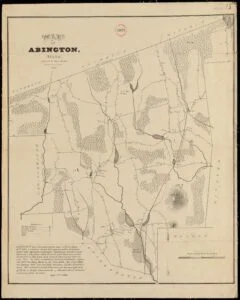
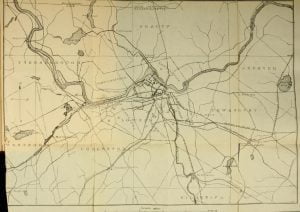
1830 Map of Abington, Massachusetts

Volume 1 of the Abington, Massachusetts vital records details births recorded in the town up to 1850, featuring comprehensive research from town records, cemeteries, and church documents. Established in 1712, Abington’s jurisdictional changes may affect genealogical searches. The records also include separate listings for Black families, primarily by given names. Additionally, various surnames are cataloged, emphasizing the need to consider alternate spellings. For marriages and deaths, researchers should consult Volume 2.

Genealogy of Woodland, Idaho Families

Woodland Friends Church Sign

This book is based upon data secured by personal interviews and various other reliable sources of information concerning Woodland Idaho genealogy and history under the editorial supervision of Edna L. Egleston in 1944.

The San Antonio Story

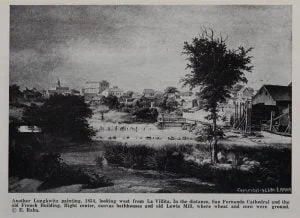
San Antonio Texas in 1854 looking west from La Villita

“The San Antonio Story” by Sam Woolford, with contributions from his wife Bess Carroll Woolford, is a history of San Antonio, Texas. Published in 1950 by Joske’s of Texas, the book was conceived as a remedy for the lack of historical knowledge among San Antonio’s school children, a concern identified by Herbert U. Rhodius, chairman of the Municipal Advertising Commission of San Antonio in 1948-49. Rhodius and his colleagues believed that a readable and authentic history could address this educational gap, making it suitable supplementary reading for public junior high schools.

Wintergreen Cemetery, Port Gibson, Mississippi

Wintergreen Cemetery, Port Gibson, Mississippi

This survey of Wintergreen Cemetery, Port Gibson, Mississippi, was completed in 1956 by Mr. Gordon M. Wells and published by Joyce Bridges the same year. It contains the cemetery readings Mr. Wells was able to obtain at that date. It is highly likely that not all of the gravestones had survived up to that point, and it is even more likely that a large portion of interred individuals never had a gravestone.

Brown Genealogy

Brown Genealogy

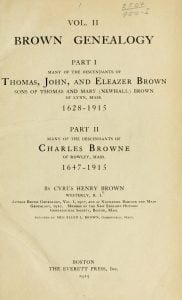
In 1895, Cyrus Henry Brown began collecting family records of the Brown family, initially with the intention of only going back to his great-grandfathers. As others became interested in the project, they decided to trace the family lineage back to Thomas Brown and his wife Mary Newhall, both born in the early 1600s in Lynn, Massachusetts. Thomas, John, and Eleazer, three of their sons, later moved to Stonington, Connecticut around 1688. When North Stonington was established in 1807, the three brothers were living in the southern part of the town. Wheeler’s “History of Stonington” contains 400 records of early descendants of the Brown family, taken from the town records of Stonington. However, many others remain unidentified, as they are not recorded in the Stonington town records. For around a century, the descendants of the three brothers lived in Stonington before eventually migrating to other towns in Connecticut and New York State, which was then mostly undeveloped. He would eventually write this second volume of his Brown Genealogy adding to and correcting the previous edition. This book is free to search, read, and/or download.

The Amidon Family of Rehoboth, MA

The Amidon Family

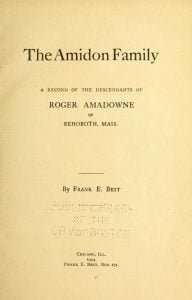
The Amidon Family genealogy book details the lineage of Roger Amadowne, a French Huguenot who fled to England and later to America after the revocation of the Edict of Nantes. Documented in Salem, Massachusetts in 1637, variations of his surname include Amadon, Amidown, and Ammidon. The work, organized with biographical sketches and two helpful indexes, presents the family’s history and is richly illustrated. Originally published in 1904, it serves as a valuable resource for descendants and historians alike.

The genealogy and history of the Ingalls family in America

The genealogy and history of the Ingalls family in America

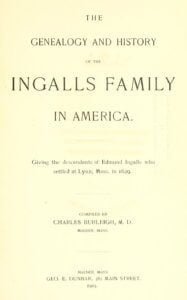
Edmund Ingalls, son of Robert, was born about 1598 in Skirbeck, Lincolnshire, England. He immigrated in 1628 to Salem, Massachusetts and with his brother, Francis, founded Lynn, Massachusetts in 1629. He married Ann, fathered nine children, and died in 1648.

Lowell Massachusetts Genealogy

1894 Map of Lowell

Tracing ancestors in Lowell, Massachusetts online and for free has been greatly enhanced by the University of Massachusetts in Lowell which provided digitized version of a large quantity of the Lowell public records. Combined with the cemetery and census records available freely online, you should be able to easily trace your ancestors from the founding of Lowell in 1826 through 1940, the last year of available census records. To add color to the otherwise basic facts of your ancestors existence we provide free access to a wide range of manuscripts on the history of Lowell, it’s manufactures and residents.

Richard Dexter Genealogy, 1642-1904

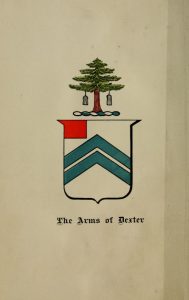
Arms of Dexter

Being a history of the descendants of Richard Dexter of Malden, Massachusetts, from the notes of John Haven Dexter and original researches. Richard Dexter, who was admitted an inhabitant of Boston (New England), Feb. 28, 1642, came from within ten miles of the town of Slane, Co. Meath, Ireland, and belonged to a branch of that family of Dexter who were descendants of Richard de Excester, the Lord Justice of Ireland. He, with his wife Bridget, and three or more children, fled to England from the great Irish Massacre of the Protestants which commenced Oct. 27, 1641. When Richard Dexter and family left England and by what vessel, we are unable to state, but he could not have remained there long, as we know he was living at Boston prior to Feb. 28, 1642.

Descendants of Alexander Bisset Munro of Bristol, Maine

Munro Family

Alexander Bisset Munro was born 25 Dec. 1793 at Inverness, Scotland to Donald and Janet (Bisset) Munro. Alexander left Scotland at the age of 14, and lived in Dimecrana in the West Indies for 18 years. He owned a plantation, raising cotton, coffee and other produce. He brought produce to Boston Massachusetts on the ship of Solomon Dockendorff. To be sure he got his money, Solomon asked his to come home with him, where he met Solomon’s sister, Jane Dockendorff. Alexander went back to the West Indies, sold out, and moved to Round Pond, Maine, and married Jane. They had 14 children: Janet, Alexander, Margaret, Nancy, Jane, Mary, Solomon, Donald, John, William, Bettie, Edmund, Joseph and Lydia.

1923 Historical and Pictorial Directory of Angola Indiana

1923 Angola Indiana Directory Book Cover

Luedders’ historical and pictorial city directory of Angola, Indiana for the year 1923, containing an historical compilation of items of local interest, a complete canvass of names in the city, which includes every member of the family, college students, families on rural lines, directory of officers of county, city, lodges, churches, societies, a directory of streets, and a classified business directory.

1899 Directory for Middleboro and Lakeville Massachusetts

1899 Middleboro and Lakeville Massachusetts Directory Cover

The 1899 Directory for Middleboro and Lakeville, Massachusetts, compiled by A. E. Foss & Co., provides a comprehensive list of residents and businesses, alongside town officers, schools, churches, and societies. It includes notable historical events and offers a detailed account of the local community, featuring numerous surnames from both towns. This directory serves as an essential resource for understanding the demographics and social structure of Middleboro and Lakeville during that period.

Treaty of October 11, 1842

Treaty of October 11, 1842

The Treaty of October 11, 1842, involved the Confederated tribes of the Sac and Fox Indians ceding their lands west of the Mississippi River to the United States, while reserving a right to occupy these lands for three years. The treaty stipulated annual payments to the tribes and provisions for their relocation, including assistance during their move and the establishment of blacksmith and gunsmith shops. An agreement for necessary funds for the tribes’ welfare and charitable purposes was also included. The treaty required Senate ratification and consent from the tribes for any amendments.

Slave Narrative of John Cameron

John Cameron, born in 1842 in Jackson, Mississippi, recalls his experiences as a slave under Howell Magee. He describes a relatively comfortable life, with adequate food, care, and leisure time. Cameron appreciated his master and mistresses, noting they treated their slaves well. He worked as a gardener and was content with his life until the Civil War disrupted everything. After the war, he and other former slaves returned to Mississippi, but he faced difficulties reconnecting with his now-adult children. Cameron reflects on the changes in society since the war, expressing nostalgia for the past.

Slave Narrative of Cy Hart

Cy Hart recounts his family history, detailing the sale of his father, Ephram Hart, by Marse Ephram Hart to Marse Paul Cameron. Cy describes life on the plantation, including chores and the processing of wheat into flour. During the Civil War, Yankee soldiers came to their home seeking food, and Cy’s mother provided them with a meal. After the war, they remained with Marse Paul until his death, honoring him by carrying his coffin, which reflects the complicated relationships between enslaved individuals and their owners.

Biography of Charles Cameron

Charles Cameron, born February 24, 1835, in Aberdeenshire, Scotland, migrated to America in 1853 and settled in Collingwood, Ontario, in 1855. He became a prominent figure as warden of County Simcoe and President of the Georgian Bay Transportation Company, enhancing regional trade and tourism. Cameron was actively involved in local government since 1871 and contributed to educational initiatives. A successful businessman, he held interests in various ventures and was recognized for his community spirit and leadership abilities. He married Margaret Barron and raised seven children.

Biography of Hon. Malcolm Cameron

The Hon. Malcolm Cameron, born on April 25, 1808, in Quebec, was a notable figure in Sarnia and Canadian politics. He established a successful mercantile career before entering public service as a member of the Upper Canada Assembly in 1836. Cameron held various governmental roles, including Minister of Agriculture and Queens Printer, while advocating for progressive causes. A dedicated liberal and active in numerous organizations, he was known for his generosity and modesty. Cameron passed away on June 1, 1876, remembered fondly for his contributions to society.

Biography of Hon. Justice M.C. Cameron

Matthew Crooks Cameron, born on October 2, 1822, in Dundas, Ontario, was a prominent lawyer and politician. His father, a merchant and public servant from Scotland, influenced Cameron’s early life. He attended Upper Canada College and began his legal career in 1849, excelling in various law partnerships. Cameron entered public office in 1852, served in the Ontario Parliament, and held significant roles in the provincial government, including Provincial Secretary. He was also involved in various successful enterprises and was married to Charlotte Ross, with whom he had six children. Cameron passed away in 1866.