History of the Seneca County New York Press
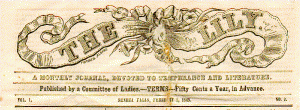
Masthead of the Lily in Seneca Falls

The history of the press in Seneca County reflects the broader narrative of American journalism’s evolution, characterized by local newspapers that documented societal changes and opinions. The first publication, the Seneca Patriot, emerged in 1815, followed by various newspapers that reflected political trends from Federalism to Democratic ideals. Notable figures, such as Amelia Bloomer, contributed to the media landscape with publications advocating reform. Though many papers faced struggles with sustainability, they played pivotal roles in shaping public discourse and preserving local history, ultimately illustrating the press’s enduring influence in the county.
Murdock Family of Norwich Vermont

Hon. Thomas Murdock moved to Norwich from Connecticut in 1767, marrying Elizabeth Hatch and raising a family that included six children. Prominent in local affairs, he held various positions before his death in 1803. His sons, Asahel and Constant, were active voters, with Asahel eventually returning to Connecticut. Jasper, also a son, built an impressive residence at Norwich Plain. The estate changed hands over the years, influencing the town’s development, and remnants of it, including a fish pond, remain part of its history.

Biography of Honorable Reuben Hatch

Reuben Hatch, born on July 7, 1763, in Preston, Connecticut, moved to Norwich with his father early in life. He attended Dartmouth College but left due to health issues, later becoming a successful farmer in Tunbridge, Chelsea, and Weathersfield. Hatch owned significant properties, including a large brick house and a tavern. He represented Tunbridge and Chelsea in the General Assembly and married Eunice Dennison, with whom he had ten children. Hatch passed away on January 5, 1818, in Norwich.

Biography of Abel Curtis

Abel Curtis, born June 13, 1755, in Lebanon, Connecticut, was a notable figure in Norwich’s early history. A Dartmouth College graduate in 1776, he played a crucial role in local governance from 1778 until his death in 1783. Curtis served in various capacities, including town clerk and legislator, and was instrumental in maintaining the unity of Connecticut River towns during the Revolutionary War. His contributions spanned multiple committees and conventions, reflecting his commitment to both state and community.

Biography of Honorable Daniel Azro Ashley Buck

Daniel Azro Ashley Buck, born April 19, 1789, in Norwich, Vermont, graduated from Middlebury College in 1807 and from West Point in 1808. He served in the military during the War of 1812, eventually becoming a captain. A significant figure in Vermont politics, he represented Chelsea in the state legislature, served as speaker, and held congressional office twice. Despite his early successes, Buck struggled with alcoholism, leading to a decline in his later years. He died in Washington, D.C., on December 22, 1841.

Biography of Honorable Daniel Buck

Daniel Buck, born on November 9, 1753, in Hebron, Connecticut, opened Norwich’s first law office in the mid-1780s after serving in the Revolutionary War. He became a respected attorney and public servant, representing Norwich at the 1791 convention considering Vermont’s admission to the Union. Buck served in the Vermont legislature and one term in the U.S. Congress. Despite his early success, his later years were marked by financial difficulties and personal struggles, leading to his death in Chelsea on August 16, 1816.

Burton Family of Norwich Vermont

Jacob Burton arrived in Norwich from Preston, Connecticut, in 1765 with his family, becoming one of the town’s founding figures. He purchased land that encompassed much of the present Norwich village, erecting the first dwelling there. His son, Reverend Doctor Asa Burton, who faced significant hardships in his youth, pursued education against his father’s initial opposition and later became a prominent minister in Thetford, Vermont. Asa notably expanded his church’s membership from sixteen to nearly five hundred over his lifetime, influencing many future clergy.

Baxter Family of Norwich Vermont

The Baxter family, originally from Norwich, Connecticut, settled in Norwich, Vermont, in 1777. Elihu Baxter and his wife, Tryphena Taylor, had fifteen children, with twelve surviving to adulthood. Their descendants spread across Vermont and beyond, with several establishing prominent careers. Notable figures include William Baxter, a distinguished lawyer, and James Baxter, a member of the Provincial Parliament in Canada. The family’s influence extended through various trades and professions, with connections maintained in the region into the 19th century.

Free Masonry in Norwich Vermont

Norwich, Vermont, has no recorded Masonic Lodge, though many residents joined lodges in neighboring towns, notably the Franklin Lodge in Hanover, established in 1796. Several Norwich men were members, with names documented from 1798 to 1810. The lodge relocated to Lebanon in 1821. Amidst the 1830 Anti-Masonic movement, tensions arose within the North Congregational Church, leading to a contentious debate over Masonic participation. Ultimately, a compromise allowed for a temporary cessation of conflicts between Masons and the Anti-Masonic faction.

History of the Merchants of Norwich VT

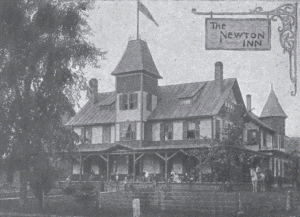
Newton Inn, Vermont

Peter Olcott operated a store in Norwich during the Revolutionary War, followed by Stephen Burton and Ichabod Marshall, early merchants who later moved west. The late 18th and early 19th century saw various merchants such as George Woodward, William Little, and Elias Lyman establishing businesses in the region. The mercantile landscape evolved with partnerships and new firms, including the Olds, Newton, and Lyman firms, adapting through various challenges, such as fires, until the late 19th century, reflecting Norwich’s commercial development.

History of the Industries of Norwich VT

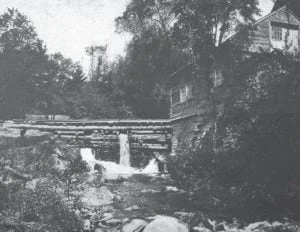
Knapp’s Mill, Norwich, Vermont

The industries of Norwich, VT, while not extensive, have displayed diverse characteristics since the late 18th century. Early establishments included grist and saw mills along Blood Brook, with ownership changing hands over the years. Other ventures featured tanneries, harness and trunk making, and the production of potash and furniture. Notable craftsmen, such as blacksmiths and boot makers, contributed to the local economy. Over time, businesses evolved, leading to the establishment of a creamery in 1888, which later became part of Hood Co.

Migration of Families out of Norwich VT

In the late 18th and early 19th centuries, Norwich, Vermont, experienced significant emigration, leading to a notable decline in its population. Initially home to 40 families in 1771, the town saw many residents relocate to newer settlements, such as Royalton and Randolph, during and after the Revolutionary War. Prominent families, including the Hibbards and Carpenters, contributed to the establishment of towns in northern Vermont and beyond. By the 1800s, the trend of outmigration intensified, marking a long-term shift in the region’s demographic landscape.

Postmasters and Postal Service in Norwich Vermont

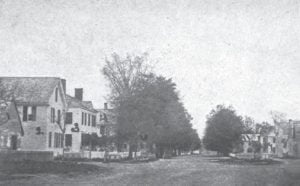
Norwich Vermont Street Scene

Norwich, Vermont, established its first post office on July 1, 1805, with Jacob Burton as postmaster. Operating from his harness shop, he managed limited mail, receiving only two weekly deliveries. By contrast, the volume of mail handled today far surpasses that of early 19th-century Vermont, and the postal system has evolved significantly since the state’s admission to the Union in 1791. Over the years, additional post offices were created throughout the area, reflecting the growth and changing needs of the community.

Political Parties in Norwich Vermont

In Norwich, Vermont, political parties have historically maintained a close balance, with elections often fiercely contested. Initially aligned with the Federalists, the town shifted towards the Republicans following the formation of the party in the mid-1850s. Prior to this, Democratic candidates generally enjoyed a stronghold, particularly from 1833 to 1854, despite significant competition. The rise of anti-slavery sentiment led to a decline in the Whig Party and a shift toward the Republican Party, culminating in significant support for Abraham Lincoln in 1860, marking a turning point in local political history.

History of Norwich Vermont Education

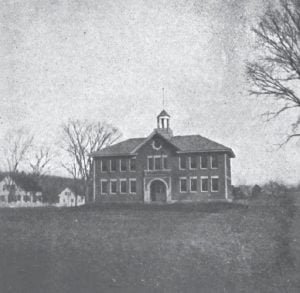
High School Building, Norwich Village, Erected in 1898

The history of education in Norwich, Vermont, traces back to efforts in 1782 to establish school districts. The first successful division occurred in 1785, creating the First School District. Over the years, multiple districts were formed, with the establishment of a committee for school supervision in 1824. Notable developments included the construction of a brick schoolhouse in 1845 and the incorporation of the Norwich Classical and English Boarding School in 1867, although it ultimately closed in 1877. The town’s education framework evolved significantly, culminating in a unified system in 1892.

Norwich Vermont in the Civil War

During the Civil War, Norwich, Vermont, contributed 185 soldiers to the Union Army, representing over ten percent of its population of 1,759. Of these, 27 men died in service. The town provided substantial bounties totaling around $32,000 to support its troops. Although the community largely supported the war effort, some residents expressed disloyalty, yet over time, many reconciled their past by honoring the fallen soldiers on Memorial Days. Overall, Norwich’s commitment to the Union cause reflected a broader dedication seen throughout Vermont.

Norwich Vermont in the War of 1812

In June 1812, as war with Great Britain loomed, Norwich, Vermont, convened a town meeting to express their views. A carefully crafted document was adopted, voicing support for President Madison and Congress’s war measures, while denouncing critics. The resolutions outlined grievances against both Britain and France, affirming the right to declare war for just causes. Coincidentally, Congress declared war on the same day, prompting Norwich to raise taxes to support military efforts, reflecting strong local commitment to the war.

Norwich Vermont in the Revolutionary War

Norwich, Vermont provided modest participation in the Revolutionary War, highlighted by its formation of a Committee of Safety in March 1777. Evidence suggests a militia was established as early as 1774. The town contributed to regiments under Colonels Warner and Bedell. Local militias organized for defense amid threats from British forces in 1776, further demonstrating Norwich’s involvement. Despite lacking comprehensive records, the enlistment of local soldiers was significant, along with efforts to protect the community from loyalist activities and contribute to the war effort.

Church History of Norwich Vermont

The first generation of Norwich settlers accomplished a significant community milestone by constructing a meeting house for public worship within a decade of settlement. This project involved the entire community, showcasing their determination despite limited resources. A committee ultimately selected the location after significant debate, with the cornerstone laid in 1778. Delays due to the Revolutionary War slowed progress, but by 1785, the building was completed and became a site for various civic activities, including sessions of the Vermont Legislature. The meeting house served the town until 1817 when a new structure was erected due to growing needs.

The Ministerial Act of Vermont

The Ministerial Act, enacted by Vermont’s legislature in October 1783, mandated local taxation for building meeting houses and supporting ministers. In 1785, Norwich decided to assume the cost of its meeting house via taxation, raising £694 from its citizens. This tax, payable in various forms, equalized expenses for all, regardless of prior contributions. The meeting house became a town property, leading to new seating arrangements based on age and contribution. The Act remained until 1801, fostering a unified religious practice among Norwich’s residents.