New Hampshire Men

New Hampshire Men presents 407 biographical sketches, with portraits, of men who were active in commercial, professional, and political life in New Hampshire in 1893.

New Hampshire Men presents 407 biographical sketches, with portraits, of men who were active in commercial, professional, and political life in New Hampshire in 1893.
New Hampshire Men of Progress contains 289 biographical sketches and portraits of leaders in business and professional life in and of the state of New Hampshire. It was edited by the staff of the Manchester Union under the supervision of Richard Herndon.
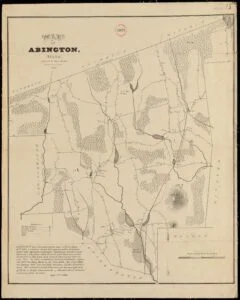
Volume 2 of the Abington, Massachusetts vital records compiles marriage and death records up to 1850, complementing Volume 1, which contains birth records. Established in 1712, Abington’s boundaries have shifted, affecting historical jurisdiction. Extensive research from town records, cemeteries, and family Bibles ensured comprehensive documentation, including the identification of Black families recorded by given names. The volume is organized alphabetically by marriages and deaths.
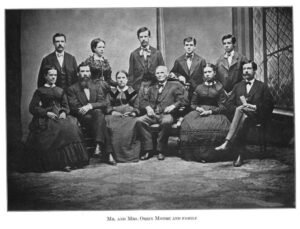
The genealogical record of Goffstown, New Hampshire, was a substantial undertaking, hampered by the extinction of early families and the widespread scattering of descendants. Efforts to gather vital statistics necessitated considerable travel and correspondence, often revealing discrepancies in recorded dates across various sources. Despite challenges, contributions from former works and assistance from individuals proved invaluable in compiling this record. The comprehensive index reflects the depth of research involved in documenting the town’s heritage.

History of Francestown, New Hampshire is a historic and genealogical record of the town from its first settlement in 1758 through the beginning of 1891. It records Francestown’s settlement, civic growth, religious and educational institutions, military participation, industries, and social customs, followed by an extensive genealogical register of families associated with the town.
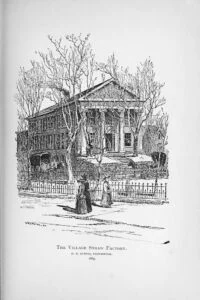
Alphabetical indexes to the vital records of Medway, Massachusetts, up to the year 1850, supplemented by information from church registers, cemetery inscriptions and other private sources to include Rev. Dr. Jacob Ide’s account of Marriages and Deaths, 1814-1849.
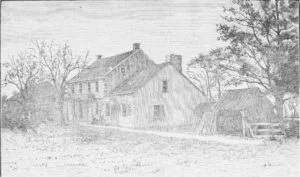
A brief history of John and Christian Fretz and a complete genealogical family register, is a record of people who crossed an ocean for their beliefs, carved homes out of wilderness, and built churches where they could worship in peace. It’s brings to light the kind of history that’s often overlooked: the slow, steady work of building a life and heritage. In putting this record together, Rev. Fretz gave thousands of descendants a way to connect with their past, and a reason to be proud of it.
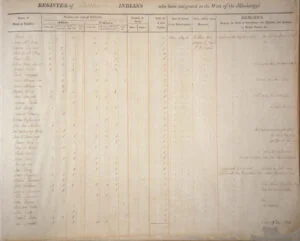
This Muster Roll details Cherokee Indians who migrated west of the Mississippi River under B. F. Curry’s supervision. It includes payments made by Capt. Vashon, outlining the number of individuals and slaves receiving subsistence. Each Indian received $32.50, with payments occurring in April or May 1832. The document lists heads of families and their respective counts of males, females, and slaves, totaling 231 men, 193 women, and 157 slaves, with a cumulative total of 561 individuals.

Volume II of History of the Town of Cornish, New Hampshire, with Genealogical Record, 1763–1910, compiled by William Henry Child and published in 1911, presents a detailed genealogical account of the families who settled in Cornish from its founding through the early 20th century.
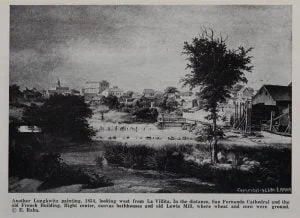
“The San Antonio Story” by Sam Woolford, with contributions from his wife Bess Carroll Woolford, is a history of San Antonio, Texas. Published in 1950 by Joske’s of Texas, the book was conceived as a remedy for the lack of historical knowledge among San Antonio’s school children, a concern identified by Herbert U. Rhodius, chairman of the Municipal Advertising Commission of San Antonio in 1948-49. Rhodius and his colleagues believed that a readable and authentic history could address this educational gap, making it suitable supplementary reading for public junior high schools.
Published in Knoxville, Tennessee in 1956 and distributed by the Genealogical Publishing Company of Baltimore, Maryland, Sevier County, Tennessee: Population Schedule of the United States Census of 1830 (Fifth Census) provides a transcription of the often difficult to read, 1830 Sevier County Tennessee census. Authored by Blanche C. McMahon and Pollyanna Creekmore, this meticulous reproduction of the original census record sheds light on the people of Sevier County in 1830.
The History of Ontario County, New York genealogical section provides an extensive array of surnames, indicating the comprehensive nature of the section in Part 2. These genealogies not only serves as a reference for individuals researching family histories but also reflects the diverse settler and immigrant populations that have contributed to the fabric of Ontario County. Each surname represents a family’s journey, struggles, and contributions to the county’s development over centuries.
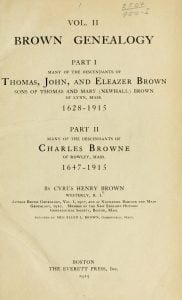
In 1895, Cyrus Henry Brown began collecting family records of the Brown family, initially with the intention of only going back to his great-grandfathers. As others became interested in the project, they decided to trace the family lineage back to Thomas Brown and his wife Mary Newhall, both born in the early 1600s in Lynn, Massachusetts. Thomas, John, and Eleazer, three of their sons, later moved to Stonington, Connecticut around 1688. When North Stonington was established in 1807, the three brothers were living in the southern part of the town. Wheeler’s “History of Stonington” contains 400 records of early descendants of the Brown family, taken from the town records of Stonington. However, many others remain unidentified, as they are not recorded in the Stonington town records. For around a century, the descendants of the three brothers lived in Stonington before eventually migrating to other towns in Connecticut and New York State, which was then mostly undeveloped. He would eventually write this second volume of his Brown Genealogy adding to and correcting the previous edition. This book is free to search, read, and/or download.

The History of Littleton New Hampshire is comprised of three volumes, two volumes of history, and a final volume of genealogies. Considered one of the best examples of local history written in the early 20th century, is your ancestors resided in Littleton then you need these books. Read and download for free!

The *History of Old Chester from 1719 to 1869* by Benjamin Chase, published in 1869, offers a detailed account of the early settlement and development of Chester, New Hampshire. Compiled with the assistance of local historian Judge Samuel D. Bell, the book explores the town’s founding, genealogies, and significant events, using primary sources such as deeds, probate records, and personal diaries. Chase aimed to preserve the history and traditions of Chester’s early settlers while providing a comprehensive record for future generations. The work covers a broad range of topics, including religious, military, industrial, and genealogical history.
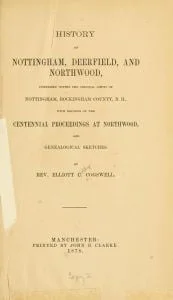
History of Nottingham, Deerfield, and Northwood, comprised within the original limits of Nottingham, Rockingham County, N.H., with records of the centennial proceedings at Northwood, and genealogical sketches.
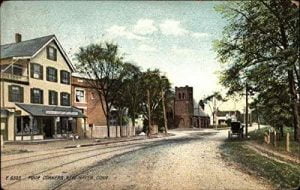
The Families of Ancient New Haven compilation includes the families of the ancient town of New Haven, covering the present towns of New Haven, East Haven, North Haven, Hamden, Bethany, Woodbridge and West Haven. These families are brought down to the heads of families in the First Census (1790), and include the generation born about 1790 to 1800. Descendants in the male line who removed from this region are also given, if obtainable, to about 1800, unless they have been adequately set forth in published genealogies.
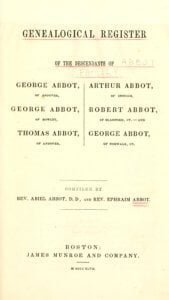
In 1847, Abiel Abbot and Ephraim Abbot compiled a comprehensive genealogical record titled “Abbott Genealogical Register,” detailing the lineage of several Abbott families originating from early New England settlers. Initially aimed to document the descendants of George Abbot, Sr. of Andover, the scope expanded to include numerous branches such as George Abbot, Jr., Thomas Abbot of Andover, Arthur Abbot of Ipswich, Robert Abbot of Branford, Ct., and George Abbot of Norwalk, Ct., among others. This volume, published by J. Munroe and Company in Boston, Massachusetts, integrates meticulously gathered data, revealing the expansive and intertwined genealogies of the Abbott families. The authors’ painstaking research and dedication to accuracy, despite challenges in data completeness, provide a valuable resource for anyone tracing the Abbott lineage or studying early American familial structures.

Two volumes of Cox family genealogy combined as one. The first volume contains information about the various early Cox families across America. The second volume deals specifically with the descendants of James and Sarah Cock of Killingworth upon Matinecock, in the township of Oysterbay, Long Island, New York.

Following his failure to secure a contract for Indian rations, Sam Houston engaged in a series of contentious correspondences, criticizing officials and accusing Colonel Hugh Love of collusion. His passion led to public outbursts, including an intemperate proclamation against opponents. Despite his controversies, he was seen as an advocate for Indian rights, notably the Cherokee and Creek tribes. Houston’s deeper ambitions in Texas and his relationships with these tribes were marked by significant developments, including allegations of attempts to manipulate land settlements in their favor.