Peace Attempts with Western Prairie Indians, 1833
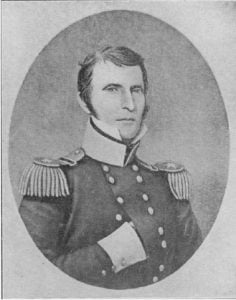
General Henry Leavenworth

In 1830, the Treaty of Dancing Rabbit Creek initiated the relocation of the Choctaw Indians to territories between the Canadian and Red rivers. However, the Choctaw faced threats from Comanche, Kiowa, and Wichita tribes, who attacked traders and settlers. In May 1833, Colonel Arbuckle sent a military expedition to protect the traveling Choctaw and assert U.S. power. Despite efforts, the expedition suffered losses, including ranger George B. Abbay, who was captured, and ultimately failed to achieve its objectives, highlighting the challenges of westward expansion.
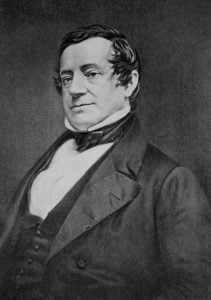
Washington Irving at Fort Gibson, 1832

Irving Washington

The McIntosh Creeks established productive farms along the Arkansas River, but their land was mistakenly included in the 1828 treaty with the Cherokee, leading to tensions and grievances. The Creeks petitioned the government for aid against attacks from other Indian bands. In response, Congress set up a commission to address these issues, appointing three commissioners, including Montford Stokes. Eventually, Washington Irving joined the commission’s journey from St. Louis to Fort Gibson, experiencing the rich tapestry of frontier life and the challenges faced by the tribes.

Biographical and Portrait Cyclopedia of Chester County, PA

Title Page for Biographical and Portrait Cyclopedia of Chester County Pennsylvania

An introductory page for the Biographical and Portrait Cyclopedia of Chester County, Pennsylvania, this volume includes a historical sketch of the county by Samuel T. Wiley and more than 500 biographical sketches of prominent local men and leading citizens. It also outlines Chester County’s colonial origins, early boundaries, and its role in the formation of neighboring counties.

Expeditions of Fowler and James to Santa Fe, 1821

General Thomas James

Following Pike’s return from Santa Fe, interest surged for further exploration. In 1821, expeditions led by Major Jacob Fowler and General Thomas James departed towards Santa Fe after witnessing the impact of previous travelers’ accounts. Fowler’s party advanced from Fort Smith, while James’s group left St. Louis with a keel boat, trading goods with local tribes. Both parties faced significant challenges but eventually reached Santa Fe, paving the way for continued American trade in the region, culminating in further expeditions and encounters with the Comanche.

Establishment of Fort Smith in 1817

Quapaw Cession Map

In 1817, a military post was established at Belle Point, now Fort Smith, Arkansas, to protect white settlers and the Cherokee from Osage hostilities. Major William Bradford led the detachment tasked with this, supported by Major Stephen H. Long, who surveyed the area. The post was strategically located at the junction of the Poteau and Arkansas rivers, facilitating navigation and trade. Subsequent treaties with the Osage and other tribes led to significant land cessions, shaping early relations and territorial boundaries in the region.

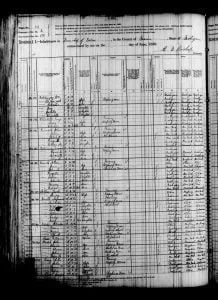
Indians in Mason County Michigan 1880 Census

Mason County 1880 Census Reel 0594, page 475

These 355 people were identified as Indians (I) in column 4 (color) of the 1880 census for Mason County Michigan. In order to have been enumerated they are believed to either have renounced tribal rule, and under state law, exercised their rights as citizens; or because they “mingled” with the white population of these Michigan towns were enumerated under the expanded definitions.

Biographies of Western Nebraska

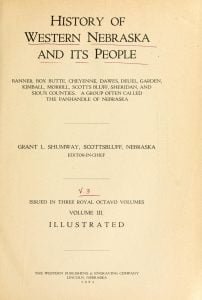
History of Western Nebraska and its People

A historical overview of western Nebraska and its pioneer settlers, this volume highlights the men who helped build counties across the Nebraska Panhandle, including Cheyenne, Box Butte, Deuel, Garden, Sioux, Kimball, Morrill, Sheridan, Scotts Bluff, Banner, and Dawes. It also points readers to biographies, history volumes, and a gallery of 143 photographs.

Muster Roll of Captain James Clark’s Company

Title page to the Aroostook War

Muster Roll of Captain James Clark’s Company of Light Infantry in the Detachment of drafted Militia of Maine, called into actual service “by the State, for the protection of its Northeastern Frontier, from the twentieth day of February, 1839, the time of its rendezvous at Bangor, Maine, to the eleventh day of May, 1839, when discharged or mustered.

Muster Roll of Captain John D. Barnard’s Company

Title page to the Aroostook War

Muster Roll of Captain John D. Barnard’s Company of Infantry in the Detachment of drafted Militia of Maine, called into actual service by the State, for the protection of its Northeastern Frontier, from the sixth day of March, 1839, the time of its rendezvous at Augusta, Maine, to the twenty-eighth day of March, 1839, when discharged or mustered.

Muster Roll of Captain Nathan Barker’s Company

Title page to the Aroostook War

Muster Roll of Captain Nathan Barker’s Company of Light Infantry in the Detachment of drafted Militia of Maine, called into actual service by the State, for the protection of its Northeastern Frontier, from the sixth day of March, 1839, the time of its rendezvous at Augusta Maine, to the twenty-sixth day of March, 1839, when discharged or mustered.

Bean and Bane Family Genealogy of Saco Valley Maine

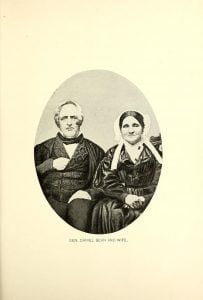
Gen. Daniel Bean and Wife

The Bean and Bane family genealogy traces origins to a supposed ancestor from the Isle of Jersey, though evidence suggests a Scottish lineage, with the surname derived from Gaelic meaning “fair.” Key figures include Lewis Bane, who settled in Boston around 1670, and his sons, who established roots in York, Maine. Captains Lewis and Joseph Bane played prominent roles in early settlements and conflicts with Native Americans. Generations of Beans and Banes contributed significantly to the region’s history, including military service and local governance.

Representative Men of Maine – Biographical Sketches and Portraits

Representative Men of Maine Title Page

A historical collection of portraits and biographical sketches of prominent Maine residents in business, industry, the professions, and politics, along with profiles of every governor since statehood in 1820. Published in 1893, it offers a rich snapshot of the people who shaped Maine’s public life and leadership.

1899 Directory for Middleboro and Lakeville Massachusetts

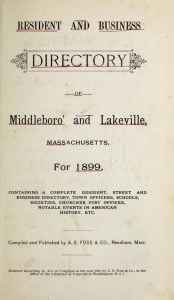
1899 Middleboro and Lakeville Massachusetts Directory Cover

The 1899 Directory for Middleboro and Lakeville, Massachusetts, compiled by A. E. Foss & Co., provides a comprehensive list of residents and businesses, alongside town officers, schools, churches, and societies. It includes notable historical events and offers a detailed account of the local community, featuring numerous surnames from both towns. This directory serves as an essential resource for understanding the demographics and social structure of Middleboro and Lakeville during that period.

Ridgelawn Memorial Cemetery – Oxford Michigan

This cemetery record from Oxford, west of Burdick Street, lists hundreds of burials collected in September 2001 by Christopher Schnur. The transcription includes names, birth and death dates, military service, family relationships, and epitaphs, offering a detailed historical snapshot of local families, veterans, children, and spouses buried in the cemetery.

Bean, Ormond Robert – Obituary

Ormond R. Bean, a retired Portland City Commissioner, passed away at 89 due to natural causes. He served in various capacities over 31 years, including on the Portland City Council and as Oregon Public Utility Commissioner, while also contributing to wartime transportation efforts during WWII. Known for his integrity and calm demeanor, he was respected by colleagues and the community. Bean graduated from the University of Oregon and had a notable career in municipal finance. He is survived by his children and grandchildren.

Biography of Fred Bean

Fred Bean married Frances A. Robbins in 1877 and took over the Robbins homestead, continuing the sheep-raising business. He operated a thriving dairy and engaged in horse breeding while contributing to local enterprises, including the Warner Glove Factory and the Farmers Fair Association. Active in Masonry, Bean served in various leadership roles and was a Selectman and State Representative, focusing on insurance and town matters. The Beans, who are active in their Baptist church, have one daughter, Stella May.

The Texas Cherokee 1820-1830

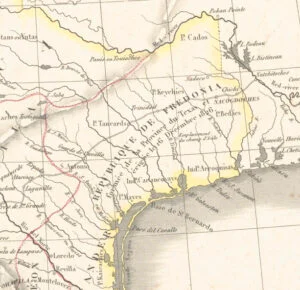
1835 Mapr of the Republique de Fredonia

Between 1812 and 1836, the Texas Cherokee Nation faced significant challenges as they settled in Texas after migrating from Arkansas. Led by Chief John Bowles, they sought peace, gaining recognition as Mexican citizens. However, rising tensions with the Republic of Texas culminated in their expulsion in 1839. Despite earlier treaties affirming their land rights, the government adopted destructive policies against them, ultimately leading to conflict. This tragic history underscores the complexities of their struggle for land and sovereignty, mirroring broader themes of displacement and conflict in American history.

Slave Narrative of Nancy Rogers Bean

Nancy Rogers Bean, born in Boggy Depot, Oklahoma, reflects on her early life as a slave before the Civil War, recalling her large family and the one-room log cabin they lived in. She was often loaned to various families, with fond memories of her last mistress, Mrs. O’Neal, who treated her kindly. While she never witnessed battles, she heard the soldiers at Fort Gibson. After slavery ended, Nancy married Joe Bean, but their children did not survive, and they eventually separated. She expresses relief that slavery is over, allowing her to live in peace.

Biographical Sketch of Benjamin L. Bean

Benjamin L. Bean, born in La Fayette County, Wisconsin, and raised in Iowa County, enlisted in the Thirty-third Wisconsin Infantry during the Civil War in 1862 and served until the war’s end. In 1866, he moved to Nebraska, working as a railroad foreman until 1867, when he shifted to farming in Arizona Precinct. He currently owns 553 acres, with 140 acres cultivated, and manages a livestock operation of approximately forty cattle and fifty hogs.