Abington Massachusetts Marriage and Death Records
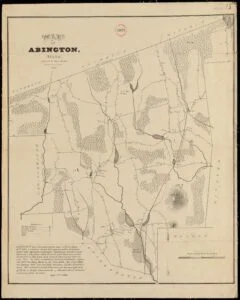
1830 Map of Abington, Massachusetts

Volume 2 of the Abington, Massachusetts vital records compiles marriage and death records up to 1850, complementing Volume 1, which contains birth records. Established in 1712, Abington’s boundaries have shifted, affecting historical jurisdiction. Extensive research from town records, cemeteries, and family Bibles ensured comprehensive documentation, including the identification of Black families recorded by given names. The volume is organized alphabetically by marriages and deaths.
Abington Massachusetts Birth Records

1830 Map of Abington, Massachusetts

Volume 1 of the Abington, Massachusetts vital records details births recorded in the town up to 1850, featuring comprehensive research from town records, cemeteries, and church documents. Established in 1712, Abington’s jurisdictional changes may affect genealogical searches. The records also include separate listings for Black families, primarily by given names. Additionally, various surnames are cataloged, emphasizing the need to consider alternate spellings. For marriages and deaths, researchers should consult Volume 2.

Genealogies of the Town of Goffstown New Hampshire

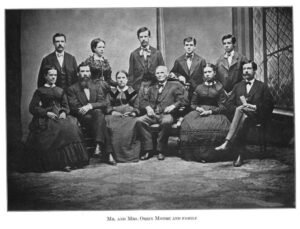
Orrin Moore and family of Goffstown, New Hampshire

The genealogical record of Goffstown, New Hampshire, was a substantial undertaking, hampered by the extinction of early families and the widespread scattering of descendants. Efforts to gather vital statistics necessitated considerable travel and correspondence, often revealing discrepancies in recorded dates across various sources. Despite challenges, contributions from former works and assistance from individuals proved invaluable in compiling this record. The comprehensive index reflects the depth of research involved in documenting the town’s heritage.

History of Glastonbury Connecticut, 1653-1853

Indian Map of Glastonbury

The history of Glastonbury, Connecticut, from 1653 to 1853 chronicles an account of its schools, commerce, mills, and ecclesiastical societies. The author, Alonzo Bowen Chapin, balances the general history with personal narratives, making the reading engaging for individuals tracing their ancestry. The work provides valuable insights into the town’s development, the contributions of its early ministers, and the influences of religion and learning that shaped the community. Unfortunately, the work is limited in the depths of the genealogy presented.

History of Minneapolis and Hennepin County, Minnesota

History of Minneapolis and Hennepin County, Minnesota

The aim of this history was to present in a permanent form the key incidents in the history of Minneapolis, from its earliest settlement to its publication in 1895. The primary facts and events recounted were mostly obtained from living witnesses and participants. It was rare for a city with more than two hundred thousand inhabitants to have so many of its first settlers still alive. The city’s growth had been so extraordinary and unprecedented that many of its earliest settlers remained. Some information was also gleaned from the notes left by now-deceased writers who witnessed the events described. Great care was taken to verify the accuracy of all facts and incidents mentioned. While it might have been too much to hope that the work was entirely free from errors, it was confidently believed that any such errors were few and insignificant.

Ancestors of Charles W. Milliken of Barnstable, MA

Dr. Charles Warren Milliken, a prominent physician from Barnstable, MA, traces his lineage to early settlers like Hugh Mulliken and John Milliken, revealing a rich familial history entwined with significant events in the region. His ancestors, including notable figures such as Edward Milliken, were influential in local governance and community development. The Milliken family contributed to society through professions in farming, law, and medicine, culminating in Dr. Milliken’s distinguished medical career and involvement in various professional organizations.

Descendants of Veranus Filoon of North Bridgewater, MA

v filoon

The Filoon family, with roots tracing back to James Filoon of County Armagh, Ireland, has made significant contributions to the communities of Abington and North Bridgewater (now Brockton). Notable members include Veranus Filoon, a successful businessman in the shoemaking industry, and his sons Fred and Henry, who continued the family’s legacy in commerce and dentistry, respectively. This family’s history intertwines with the influential Brett and Fullerton families, reflecting their deep ties to New England’s early settlers and their enduring impact on local society.

Descendants of Frederick Packard of Brockton, MA

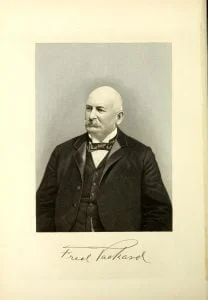
Fred. Packard

Frederick Packard, born in 1836 in Brockton, MA, emerged as a prominent figure in the local shoe manufacturing industry. His success stemmed from hard work and business acumen. He began his career making boots and shoes, eventually founding firms such as Burt & Packard, which gained a reputation for quality. A respected community member, Packard was active in local organizations and politics but shunned public office. He married Mary Eliza Ramsdell, and after a long and prosperous life, he passed away in 1910, leaving a lasting legacy.

Descendants of Mark Lothrop of Bridgewater MA

The Lothrop family, tracing its origins to Mark Lothrop, who settled in Salem, Massachusetts in 1643, has a rich history in New England. Mark was a key figure in Bridgewater, serving in various civic roles until his death in 1685. His descendants, including Samuel and Edmund Lothrop, contributed significantly to local governance and community affairs. Notable family members included Howard Lothrop, an influential town clerk and state legislator, and several who served during the Revolutionary War, showcasing the family’s enduring legacy in Massachusetts history.

1899 Directory for Middleboro and Lakeville Massachusetts

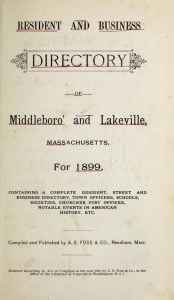
1899 Middleboro and Lakeville Massachusetts Directory Cover

The 1899 Directory for Middleboro and Lakeville, Massachusetts, compiled by A. E. Foss & Co., provides a comprehensive list of residents and businesses, alongside town officers, schools, churches, and societies. It includes notable historical events and offers a detailed account of the local community, featuring numerous surnames from both towns. This directory serves as an essential resource for understanding the demographics and social structure of Middleboro and Lakeville during that period.

Norwich Vermont in the Civil War

During the Civil War, Norwich, Vermont, contributed 185 soldiers to the Union Army, representing over ten percent of its population of 1,759. Of these, 27 men died in service. The town provided substantial bounties totaling around $32,000 to support its troops. Although the community largely supported the war effort, some residents expressed disloyalty, yet over time, many reconciled their past by honoring the fallen soldiers on Memorial Days. Overall, Norwich’s commitment to the Union cause reflected a broader dedication seen throughout Vermont.

Biography of Alger, William Rounseville

William Rounseville Alger was born on December 28, 1822, in Freetown, Massachusetts. He worked in a cotton mill while self-educating and attended Harvard Divinity School, graduating in 1847. He served as a Unitarian pastor in various locations, published several influential books, and was active in Masonic and literary circles. Alger gained recognition for his bold public addresses, notably on the slavery issue, and his legislative prayers were published. He married Anne Langdon and had seven children, contributing extensively to both theology and literature throughout his life.

Biographical Sketch of Alger, Alpheus B.

Alpheus B. Alger was born on October 8, 1854, in Lowell, Massachusetts. He graduated from Harvard College in 1875 and attended Harvard Law School, later working at the law office of Josiah G. Abbott. Admitted to the bar in 1877, he practiced law in Boston. A committed member of the Democratic Party, he served on various committees, held positions in local government, and participated in the state Senate. Alger was also involved in several civic organizations and Masonic groups throughout his life.