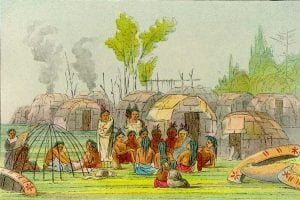
Winnebago

The Winnebago Indians, linguistically linked to the ŧΩiwere and Mandan, were first recorded by Jesuit missionaries in the early 17th century. Nearly decimated by conflicts with the Illinois tribe, survivors established villages around Green Bay and Winnebago Lake. Throughout the 19th century, they faced land cessions and devastating smallpox outbreaks. Many relocated to Iowa and Minnesota, and by 1890, they had adapted to agricultural life. Today, they mainly inhabit reservations, with some still pursuing traditional hunting practices.

Notice of the Miscotins and Assigunaigs

The Miscotins and Assigunaigs were two extinct tribes that predated the Algonquins along the upper Lakes. Historical accounts suggest the Miscotins resided at various points on Lakes Huron and Michigan before being displaced southward. Their legacy includes tales of warfare against the Algonquins, who eventually occupied the area. The Algonquins, known for their canoeing skills, spread throughout the Upper Lakes after defeating the indigenous Mushkodains, or Little Prairie Indians, believed to be connected to the lost Miscotins.

Mineralogical and Geographical Notices

This account details various mineral resources and geological features of regions in the United States. It discusses lead ore from Wisconsin and Iowa, highlighting the differences in yield and quality in various mining areas. The rich copper ore of Lake Superior shows great productivity through careful assays, while native silver is noted from Michigan’s drift stratum. Additionally, the discovery of petroleum in Chickasaw lands is mentioned for its medicinal properties. Lastly, a thorough examination of the geological features of western New York provides a rich landscape of terraces and resources, emphasizing the region’s agricultural potential.

Early Native American Gardening

Grand River Michigan Ancient Garden Beds - Plate 6

The prairies of the West, particularly in Indiana and Michigan, reveal signs of ancient agricultural practices through the remnants of garden beds, suggesting a period of fixed cultivation by indigenous peoples. These beds, measuring from twenty to three hundred acres, exhibit organized patterns that imply a more advanced civilization than that of nomadic hunters. While their exact origin remains uncertain, it’s likely that they represent the agricultural efforts of early Native American groups before European contact, bridging the gap in the region’s pre-colonial history.

Pontiac’s War

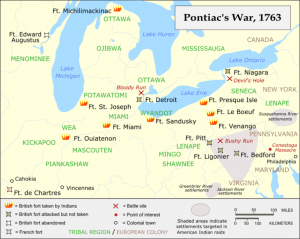
Map of Pontiacs War

In the early 18th century, French settlers cultivated strong ties with Native American tribes around the Great Lakes, contrasting sharply with the English. The Ottowa chief Pontiac emerged as a key figure in resisting British encroachment after they took over French territories in 1760. In a coordinated effort in 1763, Pontiac mobilized a coalition of tribes to assault British forts, notably seizing Michilimackinac. Despite early successes, his campaign ultimately faltered, and he met his end under uncertain circumstances, illustrating the tumultuous relations in post-colonial North America.

Chippewa Indians

Catlin, George - 334, Chippeway Village and Dog Feast at the Falls of St. Anthony; lodges build with birch-bark: Upper Mississippi

The Chippewa Indians, also known as Ojibwa, derive their name from a term meaning “to roast until puckered,” referencing their moose hide moccasins. They are a major subdivision of the Algonquian language family, originally located around Sault Sainte Marie but later expanding throughout northern Lake Huron and Lake Superior. Historically, they separated from a larger group of tribes and utilized firearms to push westward, ultimately forming numerous bands and villages across the United States and Canada. Their population has seen fluctuations, with estimates ranging significantly across centuries.

Michigan Indian Tribes

The Chippewa Indians inhabited areas around Sault St. Marie and Lake Michigan early on. Other tribes, such as the Fox, Kickapoo, and Huron, likely also resided in Michigan, although documentation is uncertain. The Menominee ceded land in 1836, while the Miami occupied the St. Joseph River valley. The Ottawa, prominent as traders, spread through Michigan and surrounding states. The Potawatomi, known for their fire-making skills, also occupied the lower peninsula, moving southward over time. Other tribes, including the Sauk and Wyandot, had varying presence and impact in the region.

Native American Cemeteries

Native American Cemeteries offers an extensive and detailed list of all known Indian cemeteries across the United States and Canada. This resource is dedicated to cemeteries that have significant concentrations of Native American and First Nation burials. While it is true that Native Americans and First Nation Peoples are often interred in general cemeteries, this page focuses specifically on those burial grounds where Native heritage is prominently represented.

Thirteenth Michigan Infantry

Capt. Clement C. Webb

A short account of the Forty-fourth Annual Reunion of the Thirteenth Michigan Infantry. Includes the names of living members in 1909.

1894 Michigan State Census

1894 Thornapple Barry County Michigan Sample Census Image

If you had an ancestor residing in Michigan during 1894 then you may have the chance to fill some of that census gap by using the 1894 state census of Michigan, of which parts are available online for free.

Biography of Martin M. Brown, M.D.

Dr. Martin M. Brown, born on July 13, 1863, in Jacksonville, Vermont, became a prominent physician and surgeon in North Adams, Massachusetts. After graduating from Rush Medical College in 1888, he established his practice in 1891, focusing on general surgery. Active in civic affairs, he served on the North Adams School Board and chaired the Medical Advisory Board during World War I. A respected member of various medical and fraternal organizations, he married Mary Blakeslee and had three children who sadly passed away in infancy.

Biographical Sketch of Harry Landon Chapman

Harry Landon Chapman, born on October 29, 1875, in Jerseyville, Illinois, is the son of T. S. Chapman and Sarah E. Landon. A graduate of the Michigan law school, he practiced law briefly before shifting his focus to banking. Since moving to Moline in 1904, he has become vice-president of the Peoples Bank and Trust Company. A dedicated Republican and active member of the First Baptist Church, Chapman values community and professional integrity, reflecting the honorable legacy of his ancestry.

Biography of Hugh J. Downey

Hugh J. Downey, born in Manchester, New Hampshire in 1882, grew up in Adams, Massachusetts. He attended Baltimore Medical School, graduating in 1910, and later pursued advanced studies in Dublin, Ireland. After serving as a resident physician in Detroit, he established a successful practice in Pittsfield. Known for his optimistic demeanor and innovative approach to medicine, he became a respected physician and community member, involved with various medical societies and local organizations. He married Isabelle Anson and has two children.

Biography of Marion Knox Case

Marion Knox Case, born in 1877 in Belding, Michigan, is a descendant of a family with roots dating back to the thirteenth century. His ancestor, John Case, emigrated from England to America in 1635. Marion began working at the Belding Brothers silk mills at thirteen and rose to become manager of the Northampton, Massachusetts plant by 1924. He is active in the Masonic community and the Methodist Church. Marion married Marguerite Barron in 1901, and they have one son, William Knox Case.