
The Canoe Maker

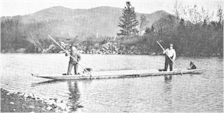
The Canoe-maker of the Pilchuck worked collaboratively to create canoes from selected trees, utilizing traditional tools like chisels and hammers. The process involved careful shaping, where bone or elkhorn chisels sculpted wood, and sometimes fire was employed to facilitate carving. Canoes were designed to be narrow and high in the middle, with sides gradually spread for form. The finishing involved scraping and rubbing with stones, and often resembled a coffin, reflecting the community’s pride in the craftsmanship.
Shla-Ahk, the Story Teller

Shla-Ahk, the Otter, is recognized as the first storyteller of the fire war, revealing that many were unsure of the origins of fire and sought his knowledge. After some reluctance, he agreed to share his tale, requiring his mouth to be cut open for his words to flow. He introduced key figures involved in the conflict, including Chub, the signalman, and several other animals who played vital roles. Additionally, he recounted an interesting detail about Kleatlad, the Snail, who lost her ears in a moment of excitement during the war.

The Fox and the Salmon

Sbeau, the Fox, and Su-Adu, the Salmon, share a symbiotic relationship. Sbeau regularly explores rivers and creeks, searching for safe spots for salmon to lay their eggs. When he encounters salmon in danger, he warns them to move to safer areas, ensuring their survival. In return for his efforts, Sbeau receives a fish daily, highlighting a mutual benefit rooted in the natural balance between predator and prey in their ecosystem.

Story of So-Obdi

So-Obdi, known as “The Great Hunter,” was born to parents who wished for him to excel in hunting. As a young boy, he learned essential skills and eventually became recognized for his impressive feats, including the capture of grizzly bears. Guided by a vision, he sought a mystical lake to strengthen his abilities and encountered challenges, including a near-drowning incident. There, he met a girl lost from her berry-picking party, and their shared experiences led to their eventual marriage, solidifying his legacy as an exceptional hunter and leader.

Old Indian Camps

In 1910, the author investigated several old Indian camp sites, noting particularly one near Stanwood. This site, located by the river, featured a large mound made up of clamshells, rocks, and bones, indicating long-term use. Traces of camps can be found from Stanwood to Hat Slough, but few are as notable. Other sites included an old fireplace discovered at Pilchuck and the historical intersection of trails near the N. P. railway, where a past battle left a lasting cultural memory for local tribes.

The Creeks

The Toli-Dachub (Pilchuck) was a prime location for game, featuring rich resources like elk, deer, and bear. Nearby, Klee-ekub (Deer creek) hosted a permanent Indian camp, while Kal-ub (Boulder creek) extended from Three Finger Mountain. Snakub (French creek) was known for mountain beavers, and Ke-kepalitch (Squire creek) offered excellent trout fishing. These creeks served as vital hunting grounds for various Indigenous families residing close to these water sources, each contributing to the rich ecological landscape of the region.

Legend of Two Mountains

The tale of So-Bahli-Ahli (White Horse Mountain), Ska-Duloas (Mt. Higgins), and Qua-Hae-Eths depicts a fierce rivalry between two women for the affections of a man. So-Bahli-Ahli and Qua-Hae-Eths lived contentedly until Ska-Duloas appeared, seeking to win him over. A dramatic battle ensued, during which So-Bahli-Ahli inflicted lasting scars on Ska-Duloas. The conflict ended with Ska-Duloas victorious yet disfigured, while Qua-Hae-Eths remained passive, forever watching the strife unfold from the mountains.

The Whetstone

At Utsalady, Indigenous peoples discovered a high-quality stone ideal for sharpening tools including axes, knives, and scrapers made of hard materials. Remnants of flat stones are prevalent around ancient camps, indicating extensive use. The source rock, once substantial in size, has eroded significantly over time, now reduced to a low-level formation exposed at low tide.

Saukwa Beault – Sauk Prairie Legend and History

Sauk Prairie, originally a marshland inhabited by Beavers, was discovered by an Indian scout who envisioned it as a summer camp for his tribe. After negotiating for the land, the tribe cultivated the area, known for its abundant edible plants and game. This led to the establishment of permanent camps as more individuals migrated to the Prairie. Later, in response to the arrival of missionaries, the tribe sought guidance from a distant community before partially adopting Christianity. However, their church was eventually destroyed, symbolizing the challenges faced with European influence.

Indian Legends of the Stillaguamish

Stoluckquamish

The collection “Indian Legends of the Stillaguamish” consists of stories about animals, people, and places, passed down by friends and elders. It captures the oral traditions of the Canoe Indians, emphasizing the significance of these tales in understanding local heritage. The author reflects on the challenge of accurately spelling native words and acknowledges the variations in legends among tribes. While some stories may remain unpublished until verified, the narratives highlight the deep connection between the Indigenous people and their environment, inviting listeners to learn from their knowledge.