
Muskogean Mound Builders

The lush bottomlands along the North Fork of the Shenandoah River, particularly between Strasburg, Woodstock, and New Market, harbor archaeological evidence of an advanced Native American culture. However, the scarcity of archaeological studies limits definitive conclusions about Mississippian sites in the area. Historically, the Muskogean mound builders, specifically the Tamahiti, thrived in southwestern Virginia until the 1730s before joining the Creek Indian Confederacy. Their name, meaning “Merchant People,” reflects their trading culture, with linguistic connections to various Native American dialects and languages.
Archaic Period

During the Archaic Period (7,000 BC – 1,000 BC), the climate of the Shenandoah Valley shifted to resemble today’s conditions, favoring large game herds like deer, bison, and elk. Native American cultures relied heavily on these animals for sustenance. While agriculture experimentation began elsewhere as early as 3,500 BC, evidence of pottery and advanced agriculture in Virginia emerged much later, around 1,200 BC. The absence of extensive archaeological studies limits definitive conclusions about this era in western Virginia.

Woodland Period

The Early Woodland Period (1000 BC – 200 BC) in the Mid-Atlantic region marked an evolution from Late Archaic traditions, with increasing sophistication in environmental adaptation, population growth, and trade connections. Notable is a trade route linking North Georgia and Tennessee with the Potomac River Valley. The Adena Culture emerged in the northern Shenandoah Valley around 600 BC, while the Middle Woodland Period (200 BC – 900 AD) introduced pottery and the bow and arrow, though hunting remained reliant on atlatls and spears. The Late Woodland Period (900 AD – 1100 AD) is less documented, with a scarcity of studied sites.

Paleo-Indian Period

The Shenandoah Valley, part of the Ridge and Valley Province, features igneous and metamorphic rock formations, including remnants of ancient volcanoes. During the Early Paleo-Indian Period (15,500–10,000 BC), it resembled tundra landscapes, with arctic animals present. Despite this, no glacial evidence has been found, and human occupation remains elusive. As temperatures rose, large mammals like mastodons migrated into the valley. By the Late Paleo-Indian Period (10,000–7,000 BC), the environment evolved, supporting diverse flora and fauna, while early humans utilized local resources for hunting and tool-making.

Exploration and Settlement of the Shenandoah Valley

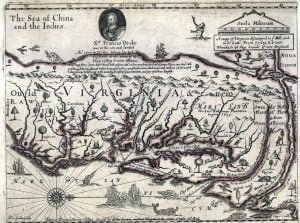
Farrer 1650 map of the colonies of Virginia and Maryland

The exploration and settlement of the Shenandoah Valley began with Johann Lederer’s 1670 expedition, which subsequently led to further exploration by figures like Colonel Cadwallader Jones and George Ritter. Thomas Fairfax’s 1719 inheritance of the Northern Neck estate catalyzed the influx of Germanic and other European settlers who engaged in intensive farming. Native Americans resided in the area until the mid-18th century, when displacement occurred amidst conflicts like the French and Indian War, marking a significant demographic shift in the valley’s history.

The Rickohockens’ Role in Native American Slavery

During the Third Powhatan War (1644-1646), the Rickohockens allied with Powhatan and launched severe attacks on white settlers, resulting in over 500 deaths. To mitigate future conflicts, Royal Governor William Berkeley negotiated trade contracts with the Rickohockens, including firearms for Native American slaves. The tribe’s slave raids devastated neighboring populations, particularly in the Shenandoah Valley, leading to significant demographic shifts. The Rickohockens’ aggressive tactics and involvement in the slave trade contributed to the decline of Indigenous groups, notably the Manahoac, between 1660 and 1676.

Slave Narrative of Martha J. Jones

Martha J. Jones, born in Buckingham County, Virginia, in 1847, shared her memories of the Civil War during an interview at age 90. She recounted her upbringing on a large farm and her father’s involvement in West Virginia’s legislature. Three of her brothers fought for the Confederacy, with one dying in battle. Married to Union Army lieutenant John R. Jones, she eventually settled in New Castle, Kentucky. Jones noted her father’s humane treatment of their three slaves, contrasting with her uncle’s practices of buying and trading slaves.

Slave Narrative of Catherine Slim

Catherine Slim, an 87-year-old ex-slave, was born in Rockingham, Virginia. She recalls her difficult upbringing, including the loss of her mother and being bound out to work from a young age. Slim describes harsh treatment, including the denial of education and beatings, and the meager living conditions for slaves. After escaping before the Civil War, she experienced a moment of joy when freedom was announced. Slim’s narrative provides insight into the struggles and resilience of enslaved individuals in the South.

Slave Narrative of John W. Matheus

John W. Matheus, a 77-year-old ex-slave, recounts his early life under the ownership of Racer and Michael Blue in Jefferson County, Ohio. He shares memories of his mother, his experiences during the Civil War, and the challenges faced by African Americans post-emancipation, noting both the kindness and hostility in Ohio. Matheus reflects on moral lessons learned in childhood and his eventual departure from slavery. Later, he established a stable life in Steubenville, building a family and earning respect in the community through years of dedicated service.

Slave Narrative of Reverend Williams

Reverend Williams, a 76-year-old Methodist minister from Greenbriar County, West Virginia, shares his life story during an interview in Lebanon, Ohio. Born to a free mother and enslaved father, he emphasizes the significance of education provided by Miss Frances Cree, his grandmother’s owner. Throughout his ministry, he has advocated for traditional hymns over spirituals, believing in a practical expression of faith. Williams reflects on the cultural differences within the church and his commitment to maintaining a consecrated life, underscoring resilience and community values.

Slave Narrative of Nan Stewart

Nan Stewart, born in February 1850 in Charleston, West Virginia, recounts her life as a slave on Marse Harley Hunt’s plantation. She describes her family’s origins, work as a housemaid and nurse, and the kindness of her masters. Despite challenges, her narrative includes moments of joy and community, such as food preparations for Christmas and games played with other children. Stewart also shares her experiences during the Civil War, her marriage in 1873, and the legacy of her family, reflecting a life marked by resilience and cultural heritage.

Slave Narrative of Sarah Woods Burke

Sarah Woods Burke, an 85-year-old ex-slave born in Grayson County, West Virginia, recounts her early life on a plantation. She describes the harsh conditions of slavery, including poor food supply and brutal punishments by slaveholders. Burke shares chilling memories, such as the whipping of a cook and the dangers children faced from wild animals. After moving to Washington County, Ohio, she married at 15, raised a large family, and endured significant hardships, including a house fire and her husband’s death.

Slave Narrative of James Campbell

James Campbell, born on January 15, 1852, in Monroe County, West Virginia, recalls his life as a slave on Marse John Alexander’s farm. He describes a relatively peaceful existence, with adequate food and absence of harsh treatment, although he noted that other slaves faced cruelty. Campbell worked primarily in milking and berry picking, enjoying moments like maple sugar making. His family was denied education, but he learned to read and write after moving to Ohio post-Civil War. He expresses gratitude for his freedom and the role of President Lincoln.

Genealogy of Ezekiel French

Ezekiel French, born June 17, 1775, in New Jersey, was the son of Aaron French. He married three times, primarily to Phebe Bates, with whom he had several children. The family moved from Pennsylvania to West Virginia in 1798 and later settled in Miami County, Ohio, in 1811. His offspring included Isaac, Asa, and Daniel French, among others, with significant connections to the local Methodist Episcopal community. Ezekiel passed away on January 1, 1861, leaving behind a rich family legacy.

Biography of Robert Fulton Ellison, M. D.

Dr. Robert Fulton Ellison, born on October 26, 1889, in Douglas, West Virginia, hails from a family with deep Virginian roots and a legacy of service, including a Revolutionary War ancestor. His father, William Madison Ellison, was an educator and later turned to agriculture, significantly influencing Dr. Ellison’s development. Renowned for his professional achievements in St. Louis, Dr. Ellison also distinguished himself during World War I, embodying the spirit of progress and enterprise characteristic of his lineage.

Biography of Edwin R. Christman

Edwin R. Christman, born on September 6, 1887, in Wheeling, West Virginia, rose to prominence as secretary of the Silurian Oil Company in St. Louis. Educated in Washington, Pennsylvania, he began his career with the McClure Company before joining the Silurian Oil Company in 1908. A dedicated family man, he married Genevieve Templeman and has three children. During World War I, he actively supported American defense efforts. Christman is a Knight of Columbus and a committed Republican, recognized for his contributions to both business and community.

Biography of George Ewing

George Ewing, often referred to as Lieut. Ewing, is believed to be the first white settler in present-day Ames township, Ohio. Born in New Jersey, he served honorably in the Continental Army during the Revolutionary War. After the war, he moved to the frontier of Ohio, where he became a pioneer and contributed to his community by supporting education and local governance. Ewing’s legacy continued through his son, Thomas Ewing, who would achieve notable success as a lawyer and statesman, even serving in the U.S. Senate.

Biography of Calvary Morris

Calvary Morris, born in 1798 near Charleston, West Virginia, faced the hardships of pioneer life before moving to Athens in 1819. He began as a farmer and transitioned to education, teaching despite his limited qualifications. His political career blossomed with multiple terms in local and state offices, including sheriff and state senator, where he played a vital role in the successful Hocking canal project. After a stint in Congress, Morris shifted to agriculture and later returned to public service as probate judge, leaving a lasting impact on his community.

Biography of John Monroe Farnsworth

John Monroe Farnsworth, born on January 4, 1876, in West Virginia, emerged as a notable oil well contractor and producer in Kansas after moving there in 1902. With a rich background in the oil industry, his career began in West Virginia and included key roles with several companies before establishing himself independently. He has successfully operated numerous drilling outfits and holds valuable oil leases near Humboldt. Farnsworth is married to Elma Jimison, and they have three children, showcasing his commitment to family and community.